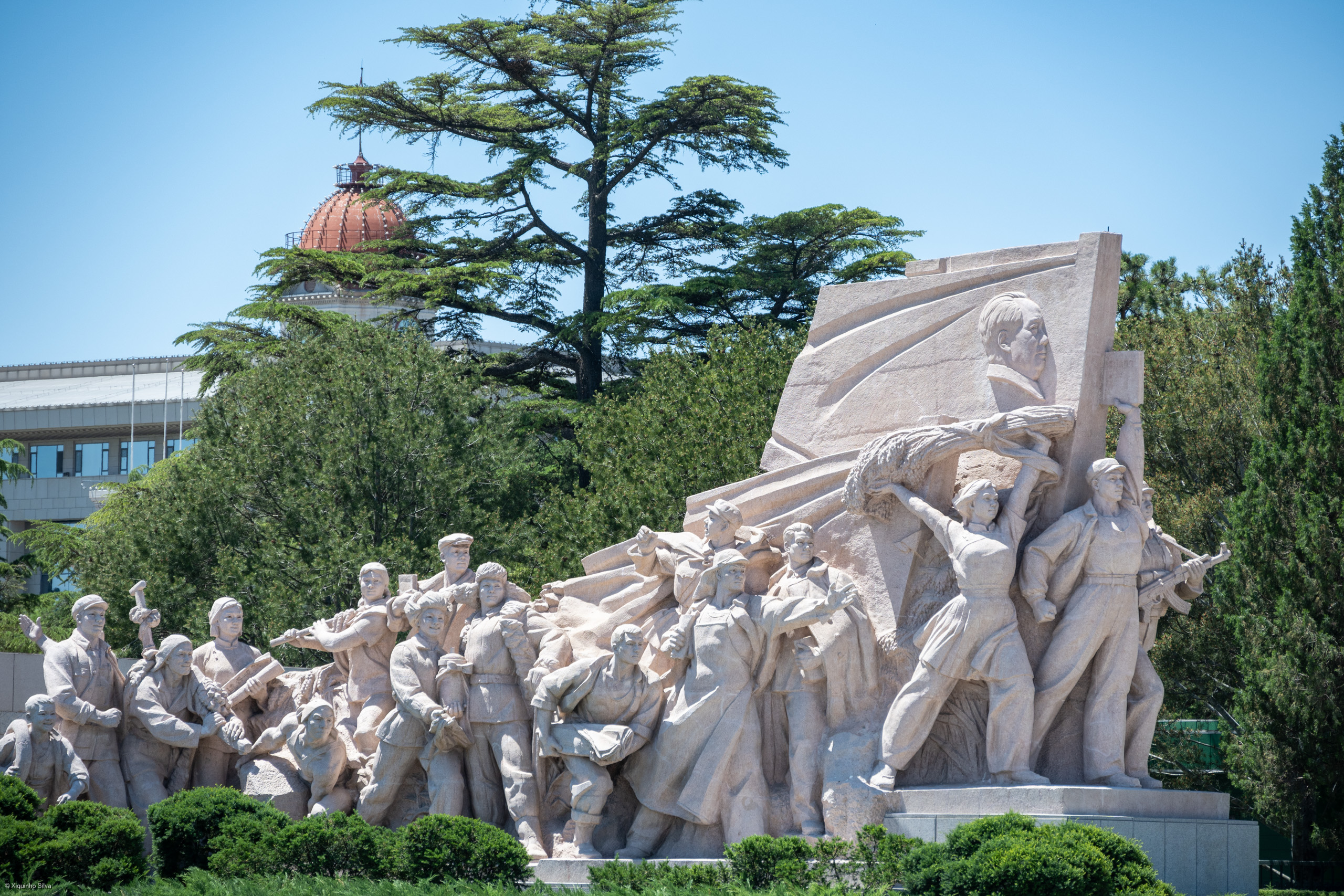
Chairman Mao Memorial Hall
Mao Zedong had signed a pledge to be cremated. His Communist Party had championed cremation as modern, egalitarian, consistent with revolutionary principles. Yet when Mao died on September 9, 1976, the Party's Central Committee decided within a month that his body would be preserved and placed on permanent display in the center of Tiananmen Square. The contradiction sits at the heart of this building, literally and figuratively -- a monument to revolutionary austerity built like a pharaoh's tomb, anchoring the ideological geography of modern China.
A Nation Poured Into Stone
Construction began on November 24, 1976, barely two months after Mao's death. The speed was staggering, and the effort was deliberate theater: 700,000 people from across China's provinces, autonomous regions, and ethnic groups performed symbolic voluntary labor on the site. The building materials themselves became a map of the nation's geography. Granite arrived from Sichuan, porcelain plates from Guangdong, pine trees from Yan'an in Shaanxi -- where Mao had established his revolutionary base decades earlier. Saw-wort seeds came from the Tian Shan mountains of Xinjiang, soil from earthquake-stricken Tangshan, colored pebbles from Nanjing, milky quartz from the Kunlun Mountains, pine logs from Jiangxi, and rock samples from Mount Everest. By May 24, 1977, the memorial hall was complete. The entire project had taken six months.
Where the Gate of China Stood
The hall occupies one of the most symbolically charged locations in Beijing. It sits on the former site of the Gate of China, the southern entrance to the Imperial City during the Ming and Qing dynasties -- a gate that had changed names with each ruling power. The Ming called it the Great Ming Gate; the Qing renamed it; the Republic rechristened it the Gate of China. Soviet advisors recommended its demolition in 1952 to expand Tiananmen Square, and it was torn down in 1954. Twenty-two years later, Mao's mausoleum rose on the same spot. The architects faced a specific challenge: the building had to incorporate traditional Chinese aesthetics without evoking the imagery of imperial tombs. Whether they succeeded depends on one's perspective.
The Crossed-Leg Debate
Even the statue of Mao inside became a subject of high-level political deliberation. Party Chairman Hua Guofeng and Vice Chairman Ye Jianying personally reviewed the design options. The central question: should the seated figure have its legs crossed or flat? The government chose crossed legs. After the statue was completed, some officials felt the cross-legged pose was too casual for the solemn atmosphere. The Central Committee studied the matter and decided to commission a replacement with flat legs. But replacing a monumental statue proved cumbersome, and ultimately Deng Xiaoping settled the question with characteristic pragmatism -- there was no need to replace it. The statue remained cross-legged. Outside, four clay sculpture groups flank the entrances, depicting themes of democratic revolution, socialist construction, and the continuation of revolutionary ideals.
Pilgrimage and Protocol
The memorial hall draws enormous crowds. Long queues snake through Tiananmen Square each morning as visitors line up for a brief view of Mao's embalmed remains, enclosed in a crystal sarcophagus. The hall closed for nine months of renovations in 1997, reopening on January 6, 1998. Foreign heads of state have made visits a part of diplomatic protocol -- Fidel Castro came in 1995, Venezuelan President Nicolas Maduro in 2018. On September 29, 2019, General Secretary Xi Jinping led Politburo members through the hall. The building serves as both tourist attraction and political instrument, a place where the Party periodically reaffirms its connection to its founding chairman on the anniversaries of his birth.
From the Air
Located at 39.901N, 116.392E in the center of Tiananmen Square, Beijing. The memorial hall is visible as a rectangular structure on the square's central axis, between the Monument to the People's Heroes and Zhengyang Gate. Nearest airports: ZBAA (Beijing Capital International, 25 km NE) and ZBAD (Beijing Daxing International, 46 km S). Best viewed at 3,000-5,000 ft AGL.