Chak Chak
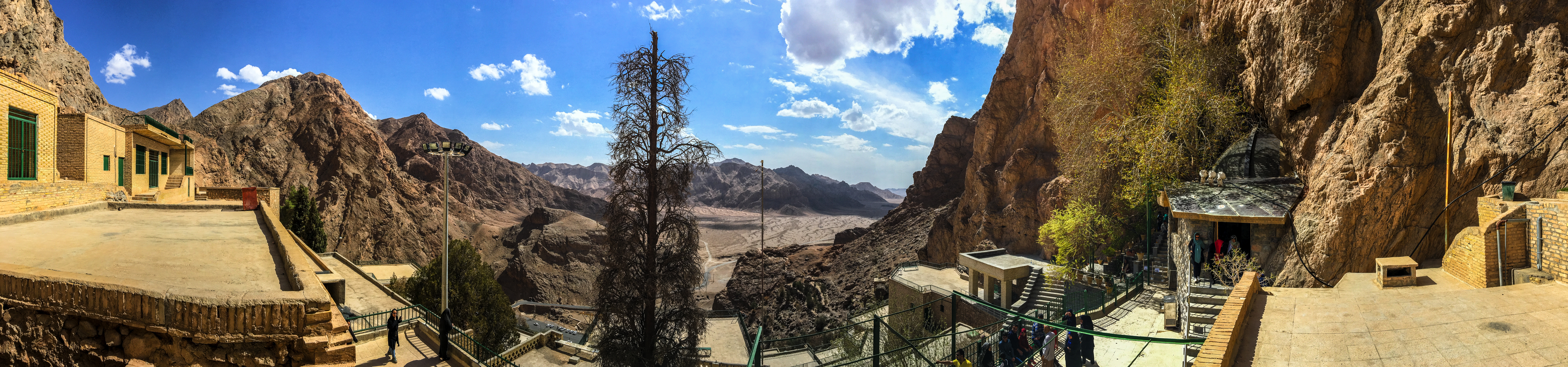
Listen for the dripping. In the silence of the Iranian desert, where the nearest major city shimmers in heat haze nearly a hundred kilometers away, a spring weeps steadily from bare rock. Chak chak, chak chak -- the sound that gave this place its name, a rhythmic dripping that Zoroastrians say has continued without pause for nearly fourteen centuries. High on a cliff face in the Yazd province, tucked into the mountainside like a secret the desert is reluctant to share, sits the most sacred mountain shrine of one of the world's oldest religions.
A Princess and a Mountain
The story begins in 640 CE, when the Arab conquest of Iran was dismantling the Sassanid Empire and the Zoroastrian faith it upheld. Nikbanou, the second daughter of Yazdegerd III -- the last Sassanid king -- fled eastward as the Rashidun army advanced. Cornered against these desert cliffs with no escape, she prayed to Ahura Mazda, the supreme deity of Zoroastrianism. The mountain, according to tradition, opened and swallowed her whole, granting divine protection that no army could breach. The spring that seeps from the rock face? Those are the mountain's tears, shed in eternal grief for the princess it absorbed. An ancient tree growing beside the spring is said to have sprouted from Nikbanou's walking cane. Pilgrims once pointed to a petrified colorful cloth visible in the rock face, believed to be a fragment of her garment, though generations of devoted visitors have since carried its pieces away.
Fire That Never Dies
The temple itself is a man-made grotto carved into the cliff, its entrance guarded by two heavy bronze doors. Step inside and the desert vanishes. Marble floors reflect the glow of fires that burn perpetually in the sanctuary -- an eternal flame central to Zoroastrian worship, where fire represents truth and righteousness. The walls are darkened by centuries of smoke, layered with the residue of devotion. Incense thickens the air. Outside, below the shrine, roofed pavilions cling to the cliff face, built to shelter the pilgrims who make the journey here. The architecture is modest compared to the landscape that frames it. This is not a place that competes with its setting -- the mountain is the shrine, and the grotto merely marks where the sacred meets the accessible.
Five Days in June
Every year, from June 14 to 18, the desert road to Chak Chak fills with traffic. Thousands of Zoroastrians travel from across Iran and from India, where the Parsi community has preserved the faith since their own ancestors fled the same Arab conquest that sent Nikbanou running. They come from Mumbai, from Tehran, from diaspora communities scattered worldwide. For five days, this remote cliff becomes the beating heart of a religion that once dominated an empire stretching from Egypt to Central Asia. Zoroastrianism, which likely influenced Judaism, Christianity, and Islam with its concepts of heaven, hell, and a final judgment, now counts fewer than 200,000 adherents globally. The annual gathering at Chak Chak is both celebration and defiance -- proof that a faith stretching back over three thousand years still lives, still gathers, still tends its sacred fires.
Desert Sanctuary
Chak Chak is one of several mountain pirs -- pilgrimage shrines -- scattered across the Yazd region, but it stands as the most revered. Its remoteness is part of its power. The surrounding landscape is relentlessly arid, a terrain of rock and dust where temperatures can exceed 40 degrees Celsius. That a spring flows here at all feels improbable. That it has flowed continuously, drip by drip, seems like the kind of fact that invites legend. The site sits near the city of Ardakan in Yazd province, a region that has served as a refuge for Iranian Zoroastrians for centuries. Yazd itself is home to some of the oldest fire temples still in use, and the desert around it preserves towers of silence where the dead were once laid out for sky burial. Chak Chak is the spiritual anchor of this landscape -- the place where history, legend, and living practice converge on a single dripping cliff.
From the Air
Located at 32.35N, 54.41E in the desert mountains of Yazd province, central Iran. The shrine is nestled into a cliff face visible as a light-colored scar on the mountainside. Elevation approximately 1,500 meters. The nearest significant airport is Yazd Shahid Sadooghi Airport (OIYY), roughly 70 km to the southeast. The terrain is arid and mountainous with excellent visibility in dry conditions. The city of Ardakan lies to the west.