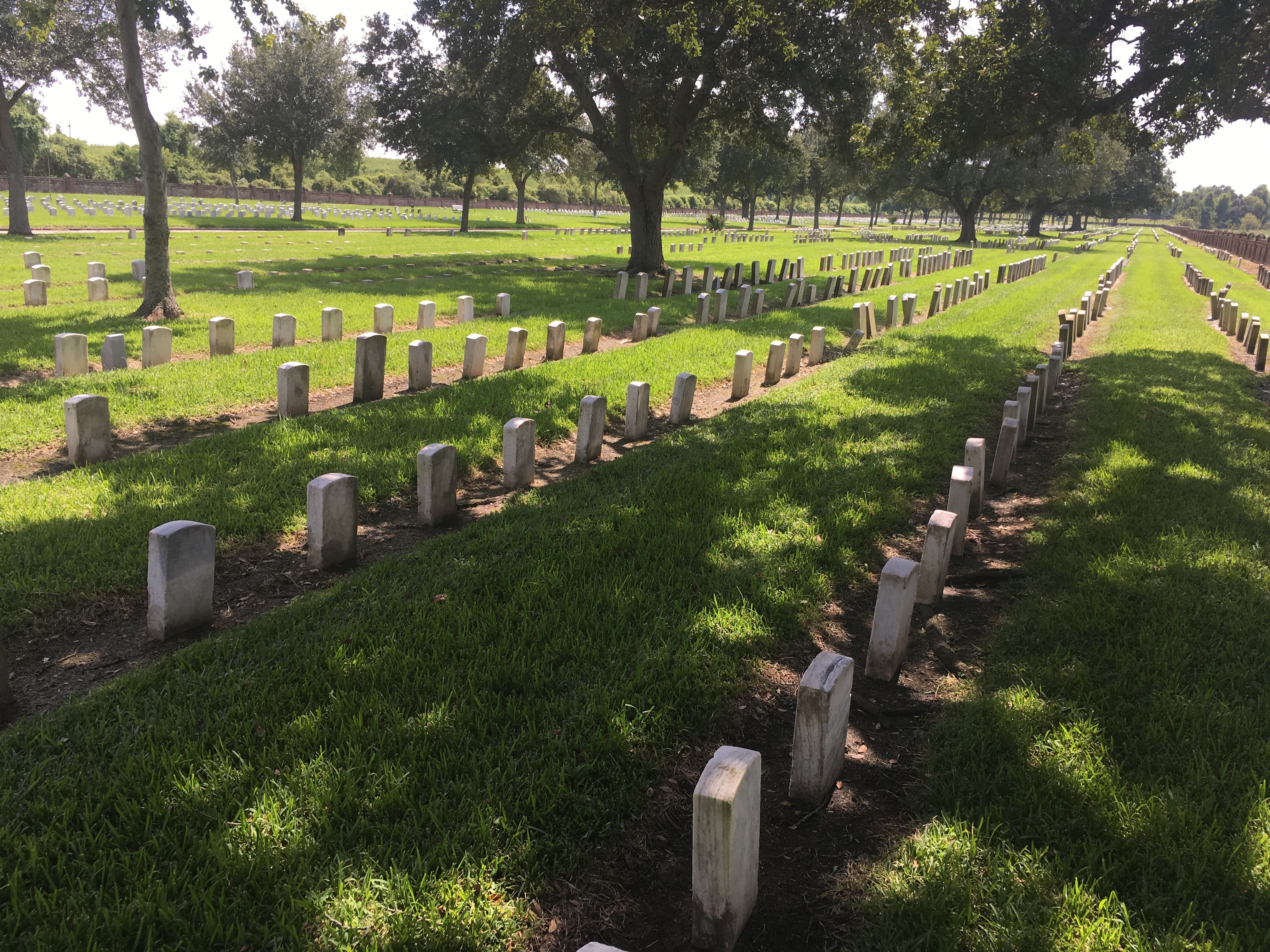
Chalmette National Cemetery
One headstone among thousands at Chalmette National Cemetery belongs to Private Lyons Wakeman of the 153rd New York Infantry. Wakeman served, fought, and died during the Civil War. Only after burial did the truth emerge: Private Wakeman was born Sarah Rosetta Wakeman, a young woman who had disguised herself as a man to enlist. Her stone stands among more than 15,300 others in this cemetery just southeast of New Orleans, each marker carrying its own story from a sweep of American conflict that stretches from the War of 1812 to the Vietnam War.
Battlefield Turned Burial Ground
The cemetery sits on the Chalmette Battlefield, the very ground where Andrew Jackson's ragtag force of soldiers, pirates, and militia defeated a British invasion force on January 8, 1815, in the Battle of New Orleans. The irony is layered: despite this famous connection to the War of 1812, only four graves from that conflict remain here. The vast majority of the 15,300 interments belong to Civil War soldiers. Originally known as Monument Cemetery, the grounds received the remains of nearly 12,000 soldiers relocated from makeshift battlefield burial plots scattered across Louisiana after the Civil War. Approximately 7,000 of those buried here are unknown, their identities lost to the chaos of war. The cemetery was formally transferred to the National Park Service in 1933, and listed on the National Register of Historic Places on October 15, 1966.
Flowers That Speak for the Silent
Victorian-era cemetery designers at Chalmette embraced the language of flowers, a cultural tradition that assigned symbolic meaning to every plant species. Arbor vitae represented immortality. Weeping willows stood for mourning. Cedar signified strength, magnolias dignity, roses love, olive trees peace, sago palms victory, and laurels honor. The original landscaping turned the entire cemetery into a botanical eulogy, each tree and shrub chosen to say what words could not. Though hurricanes and time have altered the canopy, the intent remains visible in the oldest plantings, a garden designed not just for beauty but for meaning.
A Cemetery That Faced the River
Until 1910, visitors to Chalmette National Cemetery arrived by boat from the Mississippi River. The original entrance faced the water, reflecting an era when the river was Louisiana's primary highway. Then a railroad and highway arrived at the northern end, and the entrance was relocated. The Great Mississippi Flood of 1927 forced even more dramatic changes. When the levees along the cemetery's riverside were widened, roughly 400 soldiers had to be disinterred and reburied together in a mass grave. The superintendent's house at the river side was demolished, replaced by smaller structures near the new entrance. The cemetery's relationship with the Mississippi was severed, its orientation literally reversed.
Weathering the Storms
South Louisiana's hurricanes have tested Chalmette National Cemetery repeatedly. Hurricane Betsy in 1965 and Hurricane Camille in 1969 damaged the foliage, stripping away trees that had taken decades to grow. Then came 2005. Hurricane Katrina toppled headstones and collapsed much of the perimeter wall. Hurricane Rita followed weeks later, compounding the destruction. The cemetery and park operated on limited public hours for years afterward. Among the quietly remarkable details of this place: a single Royal Navy headstone marks the grave of Able Seaman Watcyn G. Jones, a British sailor killed during World War II and buried far from home in the Louisiana heat. His presence is a reminder that the reach of the wars memorialized here extended well beyond American borders.
The Erased Neighbors
Adjacent to the national cemetery lies the site of the Freedmen's Cemetery, a four-acre burial ground established in 1867 for approximately 7,000 African American civilians. When the national cemetery needed space, these remains were reinterred at the neighboring Freedmen's Cemetery. That burial ground, too, was eventually neglected and forgotten, its history tangled with the broader story of Reconstruction and its failures. A historical marker near the entrance to Chalmette National Cemetery now memorializes the site. The pattern of displacement continued into the 1960s, when the nearby community of Fazendeville, founded around 1870 as a home for newly freed enslaved people, was demolished to expand the battlefield grounds for the 150th anniversary commemoration of the Battle of New Orleans.
From the Air
Located at 29.94N, 89.99W on the east bank of the Mississippi River in St. Bernard Parish, about 6 miles southeast of downtown New Orleans. The cemetery's orderly rows of white headstones are visible from lower altitudes, adjacent to the open Chalmette Battlefield with its 100-foot-tall obelisk monument. The Mississippi River curves just to the south. Nearest airports: Louis Armstrong New Orleans International Airport (KMSY) about 20 miles west, and New Orleans Lakefront Airport (KNEW) about 8 miles northwest. Best viewed at 2,000-3,000 feet AGL.