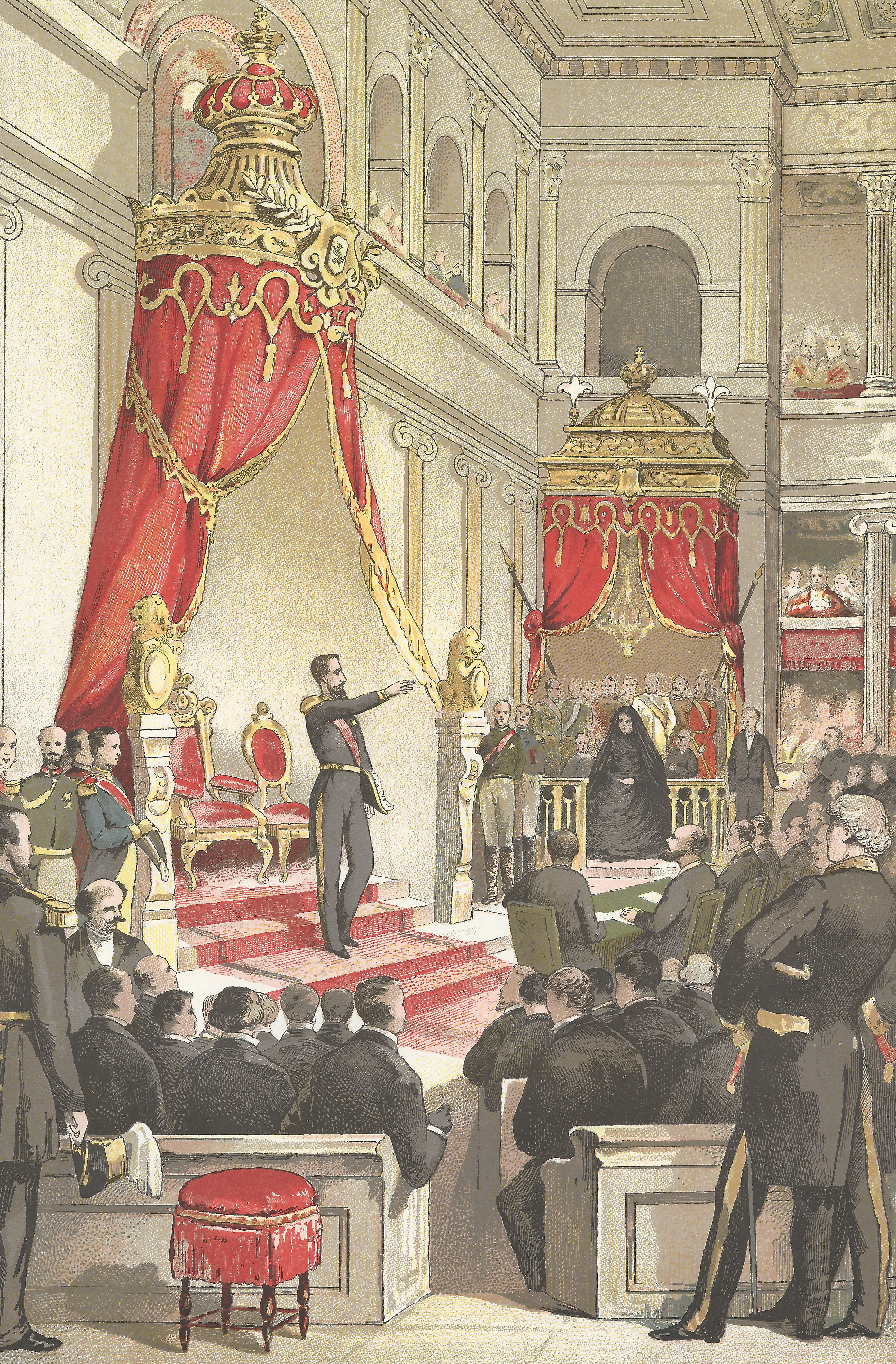
Chamber of Representatives (Belgium)
There are 150 seats in the room, and no Belgian party has ever won enough of them to govern alone. That is not a quirk of any particular election. It is the structural reality of the Chamber of Representatives. Belgium runs on coalitions, and has done so for over a century, because the seats are split between Dutch-speaking and French-speaking language groups — 88 and 62 today — and within each group the vote fragments across half a dozen parties. To pass anything important you need agreement that crosses both linguistic and ideological lines. The room itself sits in the Palace of the Nation in Brussels, walls and benches done in deep green, modeled after the British House of Commons. The Senate next door is red. The colors are British. Everything else is decidedly Belgian.
The Math of Coalition
Article 62 of the Belgian Constitution fixes the Chamber at 150 members. They are elected from 11 districts — the ten provinces plus the Brussels-Capital Region — using the D'Hondt method of proportional representation with a 5% threshold per district. The 150 are then sorted into two language groups: 88 Dutch-speaking, 62 French-speaking, with the German-speaking community represented within the French-language group. For most legislation a simple majority of representatives is enough. But for *community laws* — the bills that govern how Belgium's federalized state actually works — you need majorities in both linguistic groups. Both communities are constitutionally guaranteed equal power. That guarantee is what makes coalition-building so delicate, and why an outright majority of 76 seats has been beyond reach for any single party since the end of World War I.
Inside the Palace of the Nation
Both chambers of the Federal Parliament meet inside the Palace of the Nation, a long neoclassical building near the Royal Park. The Chamber's hemicycle is decorated in green; the Senate's is red. The color scheme is deliberately borrowed from Westminster, where the Commons sits on green leather and the Lords on red. Parliament opens automatically every year on the second Tuesday of October, without needing the king to summon it — a detail tucked into the constitution that signals the limits of the monarch's authority. The session runs effectively year-round, broken only by Christmas, Easter, and a long summer recess that ends in late September. Committees meet on Tuesdays and Wednesdays. The plenary session takes Thursday afternoons. Every Thursday between 2 and 3 p.m. is Question Time, when ministers face the floor. Fridays, by tradition, are quiet.
How the Vote Happens
Voting in the Chamber takes three forms, each with its own purpose. The most common is the roll call, electronic since 1995 — required for the end of debates on a government statement, for the vote on bills as a whole, and whenever eight members request it. For routine matters with a clear majority, the Chamber votes by sitting and standing, an anonymous show of who rises. If the result is in doubt, the vote happens again, this time electronically. The rarest method is the secret vote, reserved for appointments and nominations. Legislation is never voted on in secret. The taking of votes is a procedure built for transparency on the things that matter most and efficiency on the things that don't.
Outranking the Prime Minister
By Belgian protocol, the President of the Chamber of Representatives stands immediately behind the king in the order of precedence — second or third, depending on age, sharing those positions with the President of the Senate. Both outrank the prime minister. The arrangement says something about how Belgians think about democracy: parliament is constitutionally the senior partner. The President presides over plenary sessions, controls the debates, decides which bills are admissible, and represents the Chamber abroad. The Bureau handles management, the Conference of Presidents sets the weekly agenda, and a College of five Quaestors handles the practical work of running the building — staff, security, computers, catering. None of this looks dramatic. All of it keeps a fragmented, multilingual, coalition-built parliament functioning.
Where the Final Word Lives
The Chamber and the Senate were once near-equals; a 2014 reform put the Chamber clearly on top. For ordinary legislation the Chamber now has the final word. The Senate can review and propose amendments, but it cannot block. A handful of matters — constitutional revisions, community laws, treaty ratifications, the basic structure of the federal state — still require both chambers to pass identical text, preserving the Senate's role as a chamber of reflection. A few matters are the Chamber's alone: granting naturalizations, holding ministers civilly and criminally accountable, approving the federal budget, appointing the parliamentary ombudsmen, setting military quotas. The Chamber also exercises political control over the federal government itself. A motion of no confidence can topple a cabinet. In a country built on coalition, that power is the ultimate safety valve.
From the Air
The Palace of the Nation, home to the Chamber of Representatives, stands at 50.847°N, 4.365°E on the eastern edge of the Brussels Royal Park (Parc de Bruxelles / Warandepark). From altitude the long rectangular palace is easily identified by the adjacent rectangular formal park to its west and the Royal Palace at the park's southern end. Brussels Airport (EBBR) lies about 10 km northeast; the European Quarter (with the European Parliament) is roughly 1 km east. The terrain is gentle and urban; clear views are best in continental high-pressure weather rather than the typical maritime overcast.