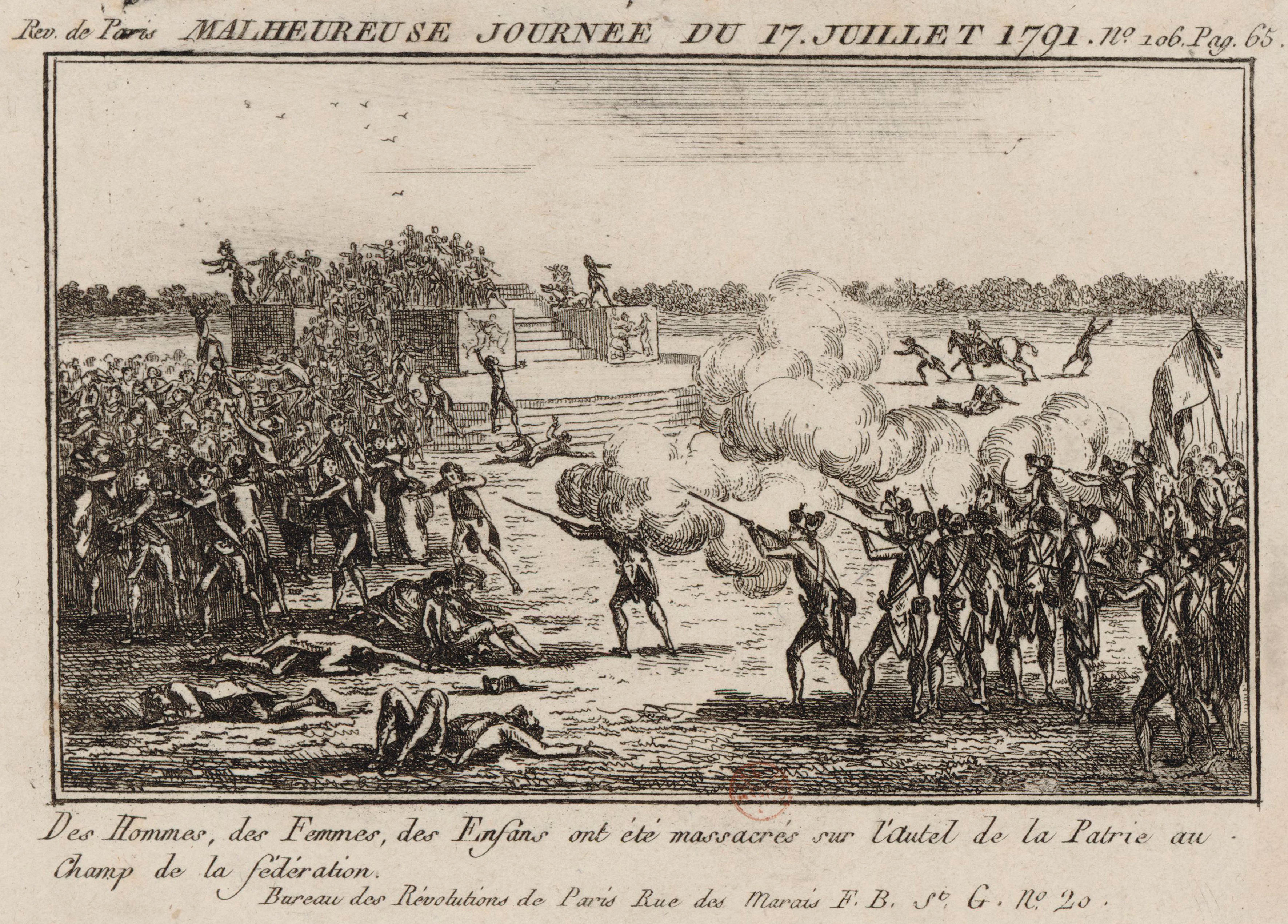
Champ de Mars Massacre
Just over a year before the massacre, the Champ de Mars had hosted the grandest celebration in French history. The Fete de la Federation on July 14, 1790, drew hundreds of thousands to the vast parade ground beside the Seine, where Lafayette - hero of two revolutions - led the nation in swearing an oath to the constitution. Twelve months later, on July 17, 1791, Lafayette returned to the same field. This time he brought the National Guard, a red flag signaling martial law, and orders to fire into a crowd of his own countrymen. The revolution devoured its celebrations faster than anyone had imagined.
A King Who Ran
The crisis began with a botched escape. On June 20, 1791, Louis XVI and his family slipped out of the Tuileries Palace disguised as servants, heading for the Austrian border and the protection of Marie Antoinette's relatives. They were recognized at Varennes, arrested, and brought back to Paris in humiliating procession. The flight shattered any remaining illusion that the king supported the Revolution. Lafayette and the National Assembly scrambled to contain the damage, concocting the transparent fiction that Louis had been kidnapped. But the people of Paris had seen the king run, and no amount of political theater could unsee it. When the Assembly decreed on July 15 that Louis would keep his throne under a constitutional monarchy, radical republicans were outraged.
Fifty Thousand Signatures
Jacques Pierre Brissot, editor of Le Patriote francais and a leading voice of the republican movement, drafted a petition demanding Louis's removal. The Cordeliers Club - the populist faction led by Georges Danton and Camille Desmoulins - organized a mass signing at the Champ de Mars for July 17. Initially the Jacobins supported the effort, but Robespierre urged them to withdraw, sensing the danger of an open confrontation. The Cordeliers pressed ahead with a more radical version calling for a republic. By midday, 50,000 people had gathered at the altar of the fatherland, the ceremonial platform at the center of the field. About 6,000 had signed. Families brought children. The mood was determined but peaceful.
The Red Flag Falls
Earlier that morning, two men had been discovered hiding beneath the wooden platform of the altar - apparently trying to spy on women from below. The crowd seized them and, in the volatile atmosphere, hanged them on the spot. Mayor Jean Sylvain Bailly used this incident as pretext to declare martial law, a legal mechanism that required displaying a red flag before troops could act. Lafayette arrived with National Guard detachments from three directions. When the first volley rang out, people near the altar assured each other it was only blanks. The second volley changed no one's mind. The third tore through the crowd. Men, women, and at least one child were killed at the altar itself. Estimates of the dead range from a dozen to fifty - the exact number was never established, because establishing it served no one in power.
A Hero Unmade
Lafayette had been the most trusted man in France. His service in the American Revolution, his role in drafting the Declaration of the Rights of Man, his leadership of the National Guard - all had made him seem like the one figure who could guide the Revolution without betraying it. The Champ de Mars ended that. The man who had helped Americans fight for liberty had ordered French soldiers to shoot French citizens exercising the right to petition. His influence in Paris collapsed almost overnight. Danton and Desmoulins, who had helped organize the petition, went into hiding. The moderate constitutionalists who had backed the crackdown found themselves discredited. The massacre did not stop the republic from coming - it accelerated it. Within a year, the monarchy fell. Within two years, the king was dead. Bailly, who as mayor had declared the martial law, was executed in 1793, with the massacre counted among his crimes.
The Field Remembers Nothing
Today the Champ de Mars is the manicured park that stretches from the Eiffel Tower to the Ecole Militaire, filled with tourists photographing the iron lattice above and joggers circling the gravel paths below. Nothing marks the spot where the altar of the fatherland once stood, where thousands gathered to demand a republic and some of them died for it. The field has been redesigned so thoroughly and so often that the landscape of 1791 is unrecoverable. Yet the massacre's significance runs through every subsequent chapter of French political history - the idea that a government willing to shoot its own petitioners has forfeited its legitimacy. The Revolution radicalized after July 17, 1791, not despite the violence but because of it. The Champ de Mars taught France that moderation could kill.
From the Air
The Champ de Mars (48.856°N, 2.298°E) is the large rectangular park stretching southeast from the Eiffel Tower toward the Ecole Militaire in the 7th arrondissement of Paris. From altitude, it is one of the most recognizable green spaces in Paris, unmistakable due to the Eiffel Tower at its northwest end. The park is approximately 780 meters long and 220 meters wide. Nearest airports: Paris Charles de Gaulle (LFPG) 25km northeast, Paris Orly (LFPO) 14km south. Recommended viewing altitude: 2,000-4,000 feet for context of the surrounding neighborhood and the Seine riverfront. The Ecole Militaire at the southeast end was already standing in 1791 and provides a historical anchor point.