Champaner-Pavagadh Archaeological Park
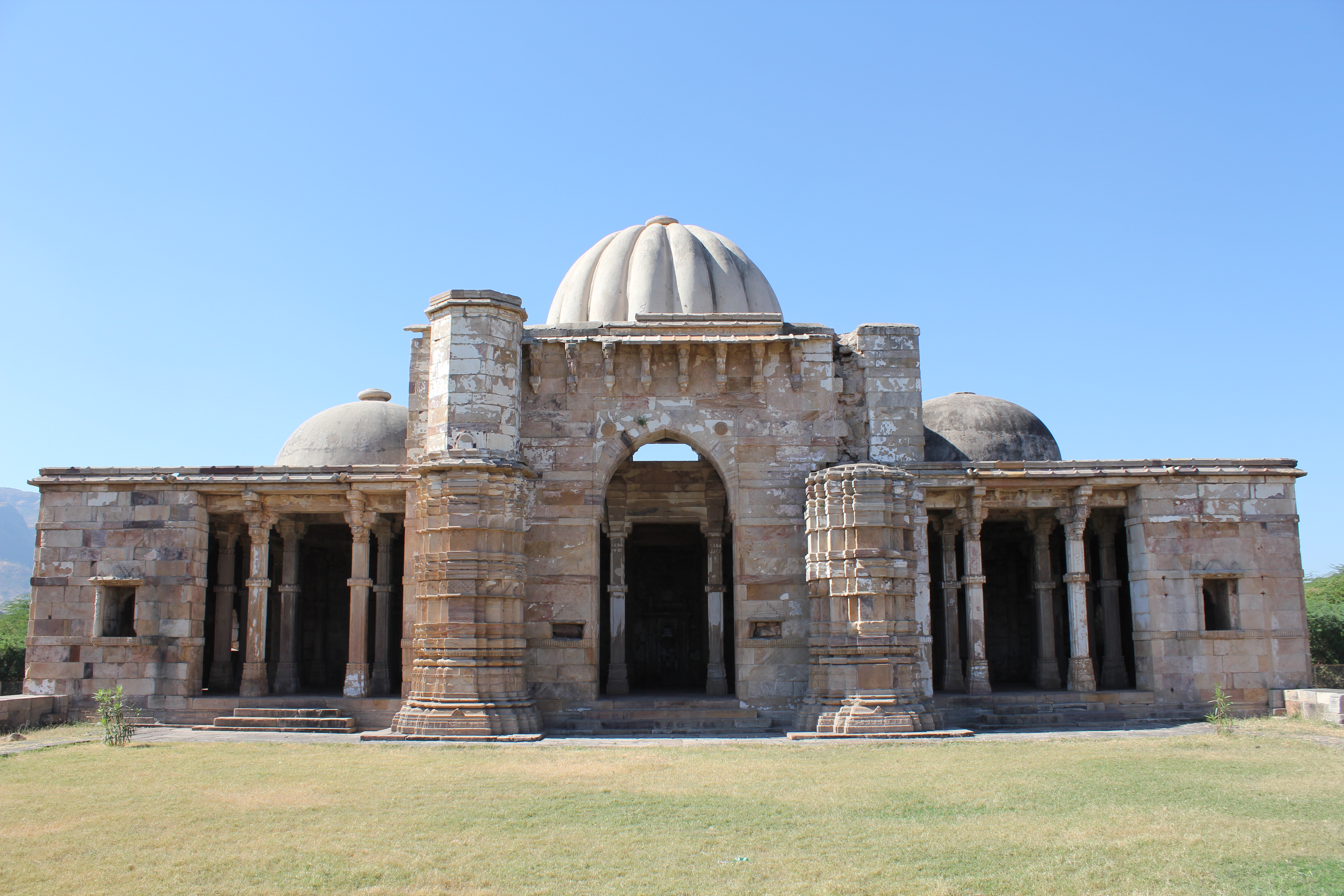
A king named his city after his best friend. In the eighth century, Vanraj Chavda, ruler of the Chavda Dynasty, founded a settlement at the foot of the 800-meter Pavagadh Hill in what is now Gujarat's Panchmahal district, and called it Champaner -- after his general and companion Champa. Twelve centuries later, the friendship is forgotten but the city endures, its ruins and living temples sprawling across more than 1,300 hectares of forested hillside. UNESCO inscribed Champaner-Pavagadh Archaeological Park as a World Heritage Site in 2004, recognizing something found almost nowhere else: an early Islamic, pre-Mughal city that has survived virtually unchanged, its sandstone mosques and Hindu temples standing side by side as evidence of a cultural transition that the rest of India built over long ago.
Conquest on the Hill
Pavagadh Hill was a natural fortress, and the kingdoms that held it knew it. The Solanki kings of Gujarat and the Khichi Chauhans built fortifications along its slopes and ruled from its heights for centuries, repelling the Rao of Idar in 1418 and the Muslim rulers of Ahmedabad around 1450. But in 1483, when Sultan Mahmud Begada's captain Malik Asad was raiding through Champaner, the Rajput ruler Raval Jaisingh attacked and killed him -- a provocation that brought Begada's full army to the hill. The siege lasted more than a year before the walls were breached on 17 November 1484. Raval Jaisingh was wounded and offered amnesty for six months, then executed when he refused to convert to Islam. His son, however, accepted conversion and was given the noble title "Nizam-ul-Mulk." Begada renamed the city Muhammadabad Champaner and, over 23 years, transformed it into his capital, eventually moving his court from Ahmedabad.
Where Hindu Meets Islamic
What makes Champaner exceptional is not any single building but the conversation between them. The Jami Masjid near the east gate, built by Sultan Begada, is considered one of the finest mosques in western India -- not because it is purely Islamic but because it is not. Hindu architectural motifs weave through its interiors, a blend that preserves Islamic ethos while acknowledging the craftsmen who carved it. The Baroda Heritage Trust has catalogued 114 monuments across the site: mosques, tombs, stepwells, palace ruins, entrance gates, and residential complexes dating from the eighth to the sixteenth century. Only 39 are maintained by the Archaeological Survey of India, limited by funding. The rest stand in various states of dignified decay, their sandstone slowly yielding to monsoon and root.
Pilgrims and Precipices
At the summit of Pavagadh Hill sits the Kalika Mata Temple, an active Hindu shrine that draws thousands of devotees throughout the year and vast crowds during the Navratri festival. Local legend holds that the hill's divinity comes from the right toe of the goddess Kalika, which fell here. The path to the top passes through eight numbered gates, cuts along staircase-like natural rock ledges with precipitous drops, and crosses a flat, boulder-strewn plateau before reaching a final steep scarp. A mono-cable ropeway, 740 meters long and capable of carrying 1,200 people per hour, now ferries pilgrims past the worst of the climb. Along the way, the ruins of Patai Rawal's palace emerge from the hillside, and marble temples with lantern towers mark the steepest sections. The Jain presence is equally ancient: King Samprati constructed shrines here as early as the third century BC, and the Achalgacch order of the Svetambara sect was founded on this hill in 1112 AD.
Layers Underfoot
Archaeological evidence suggests human habitation at Champaner during the Chalcolithic period, though the site remained marginal until roughly 400 AD. What visitors walk through today is a palimpsest: eighth-century Hindu temples underneath fifteenth-century Islamic fortifications, Jain shrines embedded in steps leading to a goddess temple, royal precincts wrapped in citadel walls with unexplored enclosures still waiting for excavation. The Baroda Heritage Trust led the landscape study and master plan that resulted in the UNESCO inscription, justifying the designation on grounds of "joint significance as a living Hindu pilgrimage center, its cluster of Jain temples, its remarkable preserved medieval urban fabric, its exquisite sandstone-carved mosques and tombs and its intangible heritage values." The Forest Department owns 94 percent of the land, while temple trusts and other organizations provide lodging for pilgrims and tourists -- a fragile arrangement that keeps the site alive but underfunded.
From the Air
Located at 22.48N, 73.53E in Gujarat's Panchmahal district. Pavagadh Hill (800 m) is a prominent landmark visible from considerable distance, with the fortified walls and temple structures discernible at lower altitudes. The archaeological park spans over 1,300 hectares of forested hillside. Nearest major airport: Vadodara (VABO), approximately 50 km to the southwest. Best viewed at 3,000-5,000 feet AGL. The ropeway to the Kalika Mata Temple at the summit is visible as a thin line ascending the steep face.