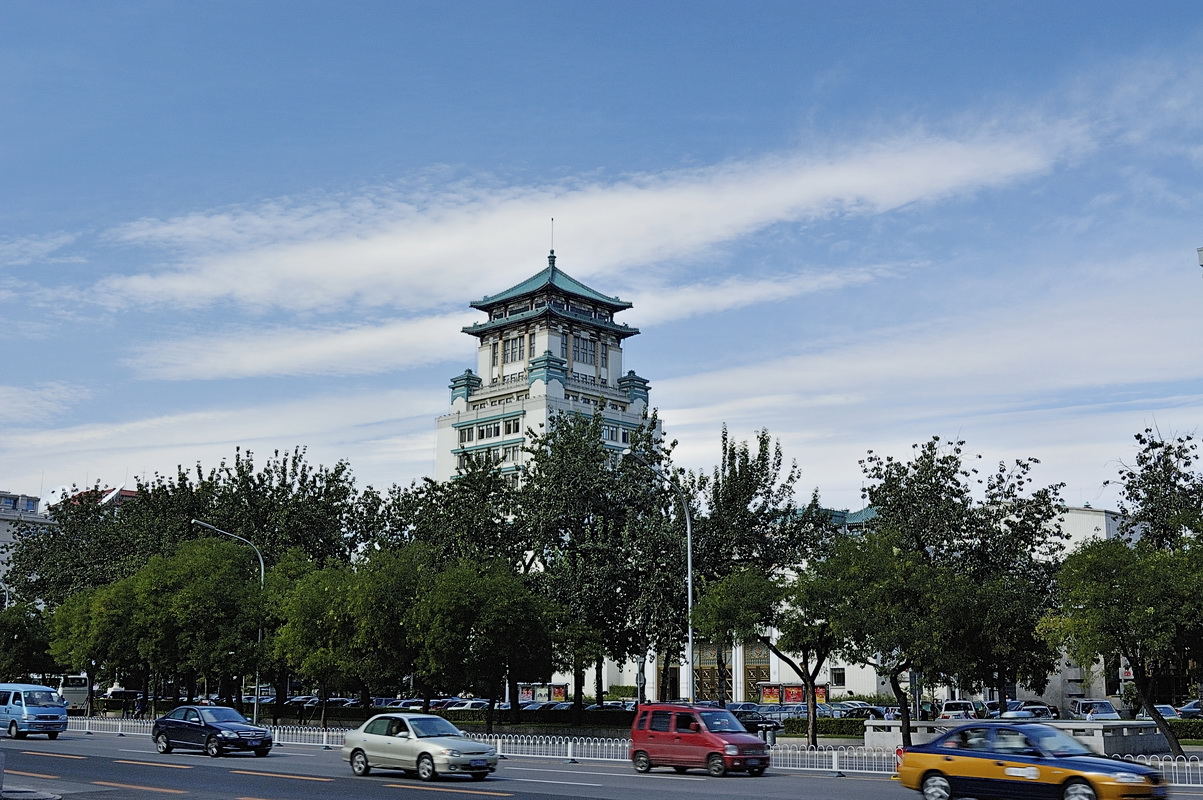
Chang'an Avenue
No commercial advertisements are allowed on Chang'an Avenue. No trucks may drive on it, day or night. The pavement is reinforced concrete, not asphalt, because tanks and armored vehicles roll down it during national celebrations, and asphalt would crack under the weight. These are not the regulations of an ordinary street. Chang'an Avenue is the road that runs directly past Tiananmen Gate, and in Beijing, that makes it something closer to a stage than a thoroughfare.
The Name That Remembers an Empire
Chang'an means "Eternal Peace," and it is also the ancient name for Xi'an, which served as China's capital during the Western Han and Tang dynasties. The avenue borrows that name deliberately, linking modern Beijing to the deepest roots of Chinese imperial power. Chinese often call it Shili Changjie, the Ten Li Long Street, or simply "China's No. 1 Avenue." In political conversation, "Chang'an Avenue" functions as a synecdoche for the central government, much as "the Beltway" refers to Washington in American English. The East and West Chang'an Streets were originally built as part of the Imperial City, running from gates flanking the square before Tiananmen. They became a single avenue only in 1952, when the old Chang'an Gates were demolished to expand Tiananmen Square.
A Boulevard Built by History
The avenue's evolution tracks the transformation of the Chinese state. After the fall of the Qing dynasty in 1912, the road between the two Chang'an Gates was named Zhongshan Road, after Sun Yat-sen. In 1940, the Inner City wall was breached at Jianguomen and Fuxingmen, extending the road east and west. The two streets, once separate approaches to the imperial heart, merged into a single artery as the old walls came down around them. In 2009, the avenue was widened to ten lanes for the 60th anniversary of the People's Republic. Today the extension line reaches from the Western Hills in the west to the Beijing City Sub-center and the Grand Canal in the east, stretching the length of the city like a spine.
Stage for a Nation's Drama
Chang'an Avenue has been the site of events that shaped modern China. The May Fourth Movement of 1919, which ignited Chinese nationalism and helped plant the seeds of the Communist Party, marched along it. The funeral procession of Premier Zhou Enlai in 1976 drew millions of mourners to its sidewalks. Most indelibly, the avenue was where a lone man stood before a column of tanks on June 5, 1989, the day after the military crackdown on the Tiananmen Square protests. That image, known worldwide as the Tank Man, was captured on Chang'an Avenue's concrete surface. During national celebrations, military parades travel from east to west along the avenue, the procession passing directly before Tiananmen Gate. The reinforced concrete pavement exists for these moments.
Power on Every Block
The institutions lining Chang'an Avenue read like an index of Chinese state power. The Great Hall of the People, where the National People's Congress meets, faces Tiananmen Square from the west. Zhongnanhai, the compound where China's top leaders live and work, sits behind walls just north of the avenue's western end. The National Museum of China, the National Centre for the Performing Arts, the People's Bank of China headquarters, the Cultural Palace of Nationalities -- all stand along the avenue or within steps of it. Both Beijing Railway Station and Beijing West Railway Station are nearby. Beneath the pavement, Line 1 of the Beijing Subway traces the avenue's path underground, the oldest line in the system and the one that follows the ancient axis of power.
From the Air
Located at 39.91°N, 116.40°E, running east-west through the heart of Beijing. The avenue is visible from altitude as the primary east-west corridor bisecting the city center, passing Tiananmen Square. Nearest major airport is Beijing Capital International (ZBAA/PEK), approximately 25 km northeast.