Chang and Eng Bunker
A Scottish merchant on a fishing boat in Siam mistook them for a strange animal. It was 1824, dusk on the Menam River, and two boys were swimming -- joined at the chest by a band of flesh and cartilage. Robert Hunter saw not two children but an economic opportunity, and five years later, Chang and Eng arrived in Boston Harbor. They were seventeen years old, spoke no English, and had no idea that their bodies would coin a phrase still used two centuries later. Today their story ends where it truly began: in the rolling hills south of Mount Airy, North Carolina, where two boys from Siam became American citizens, plantation owners, husbands, and fathers of twenty-one children.
From Meklong to the World Stage
Born in May 1811 in the village of Meklong -- today's Samut Songkhram, Thailand -- Chang and Eng were raised by their mother Nak after their father died, likely in a smallpox epidemic around 1819. Despite being connected at the sternum, they ran and played like any other children. Their mother treated them matter-of-factly, without special attention. When Hunter and American sea captain Abel Coffin finally brought them to the United States in the summer of 1829, the twins arrived in Boston to breathless newspaper coverage filled with racial stereotypes and wild exaggeration. They were exhibited in freak shows across America and Europe, performing somersaults and feats of athleticism, billed in 'Oriental' clothing as the 'Siamese twins.' But within three years, convinced their managers were cheating them, Chang and Eng broke free. They shed the pigtails, donned American suits, and began speaking English directly to their audiences, transforming their act from exotic spectacle into something closer to a dignified parlor conversation.
Putting Down Roots in Wilkes County
After a decade of touring, the twins played their final show in Jefferson, North Carolina, on July 4, 1839, and chose to stay. They purchased land near the rural community of Traphill in Wilkes County for three hundred dollars, along Little Sandy Creek near the Roaring River. They became naturalized citizens that same month -- despite a federal law restricting naturalization to 'free white persons,' local attitudes prevailed. They built a home, mingled with the county's elite, and by the early 1840s held the third-most-valuable property in the county. The Whig Party newspaper called them 'genuine Whigs.' The Boston Transcript reported they were 'happy as lords.' On April 13, 1843, Baptist preacher Colby Sparks married Eng to Sarah Yates and Chang to her sister Adelaide. Northern newspapers condemned the unions, but locally the reaction was muted. The brothers adopted the surname Bunker -- in honor of a New York woman they admired -- and settled into a life that defied every category 19th-century America had for them.
Two Houses, Three Days at a Time
The Bunkers eventually moved to Surry County, building homes south of Mount Airy along Stewart's Creek. Their domestic arrangement was as remarkable as anything in their performing days: the twins alternated between two separate houses, three days at each. The twin whose house they occupied made all decisions while his brother complied and kept silent. Between them, Chang and Adelaide had ten children and Eng and Sarah had eleven. Their plantations produced wheat, rye, corn, oats, and potatoes. They chopped wood with all four hands on a single axe for devastating force, or rapidly alternated swings. They hunted, fished, and drank. They were occasionally seen performing manual labor alongside the people they enslaved -- a practice that set them apart from the planter aristocracy they had joined. The Bunkers occupied a singular place in the racial landscape of the antebellum South: considered nonwhite, yet afforded the privileges of wealthy Southern slaveholders.
A Nation's Mirror
During the Civil War, newspapers seized on the twins as a metaphor for a divided nation. The New-York Tribune published a colorful allegory claiming Chang wanted the ligament between them painted black while Eng refused, and that a 'Dr. Lincoln' warned separation surgery would be 'dangerous for both parties.' The reality was less dramatic: both brothers supported Constitutional Union candidate John Bell in the 1860 election, favoring both slavery and the preservation of the Union. The war devastated their finances. Money they had lent was repaid in worthless Confederate currency, and the people they enslaved were emancipated. When they resumed touring after the war, Northern audiences saw them not as curiosities but as former Confederate slaveholders. Each had a son who served in the Confederate Army -- one injured, one captured. Chang suffered a stroke in 1870 that paralyzed his right side, and Eng spent their final years caring for his brother.
Then I Am Going
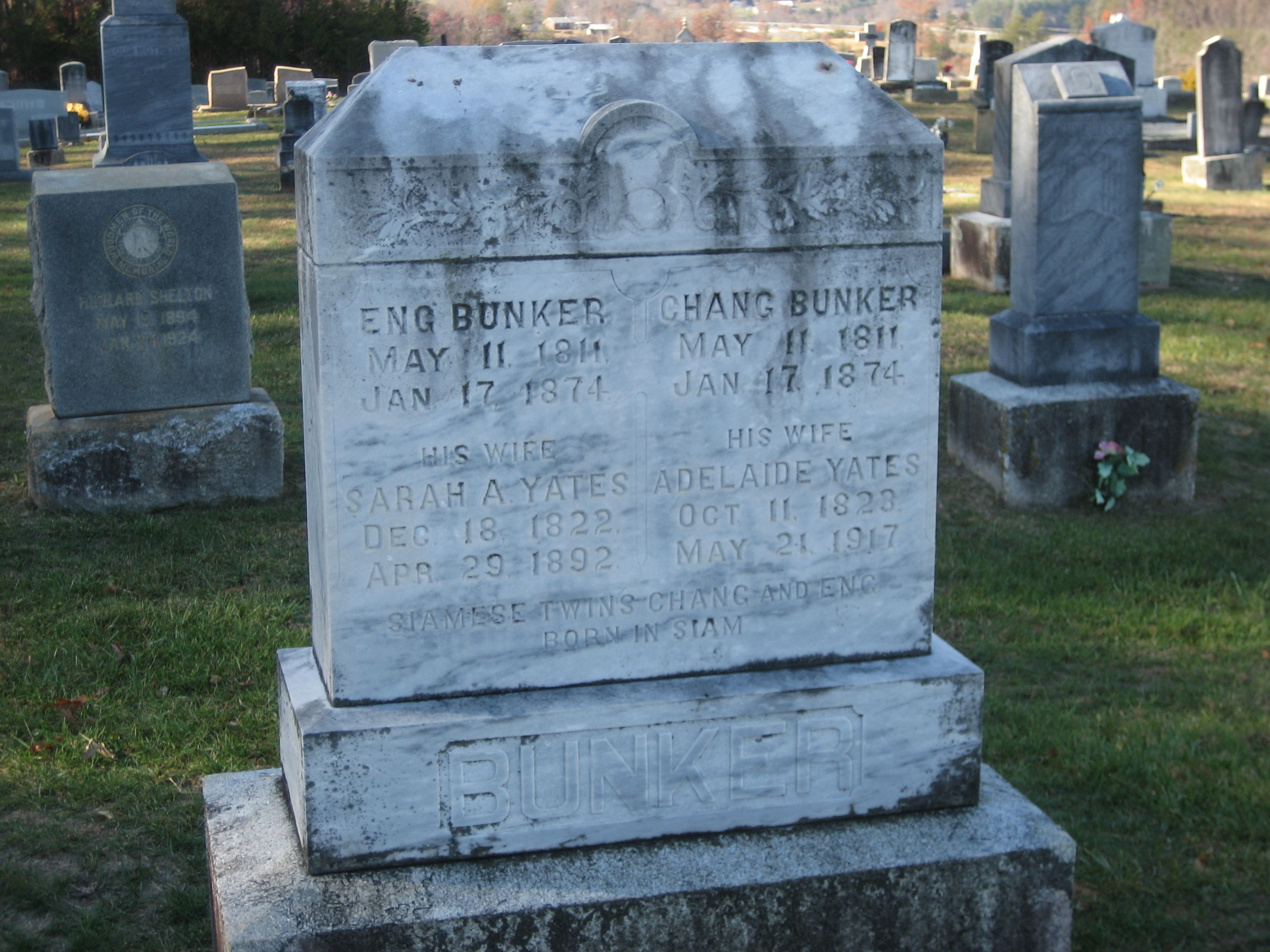
Early on the morning of January 17, 1874, one of Eng's sons checked on his father and uncle sleeping in a chair by the fireplace. 'Uncle Chang is dead,' the boy said. Eng, awake now, replied: 'Then I am going!' He died roughly two hours later. The autopsy at the College of Physicians of Philadelphia found their livers fused through the connecting band. Chang likely died of a cerebral blood clot; the leading theory for Eng's death held that he 'died of fright.' At sixty-two, they held the record for the longest-lived conjoined twins in history, a record that stood until 2012. Today their fused livers are preserved in a jar at Philadelphia's Mutter Museum. Their grave lies at White Plains Baptist Church outside Mount Airy. Some 1,500 descendants still live in western North Carolina, gathering annually on the last Saturday of June. Among them: a Pulitzer Prize-winning composer, an Air Force major general, and a president of the Union Pacific Railroad.
From the Air
Located at 36.45N, 80.63W near Mount Airy, North Carolina, in the rolling foothills of the Blue Ridge Mountains. Mount Airy is about 30 miles north of Winston-Salem. The nearest airport is Mount Airy/Surry County Airport (KMWK). From above, the landscape is gently hilly farmland with scattered woodland. The Andy Griffith Museum in Mount Airy contains a Bunker twins exhibit. Recommended viewing altitude: 3,000-5,000 feet AGL for the Mount Airy area.