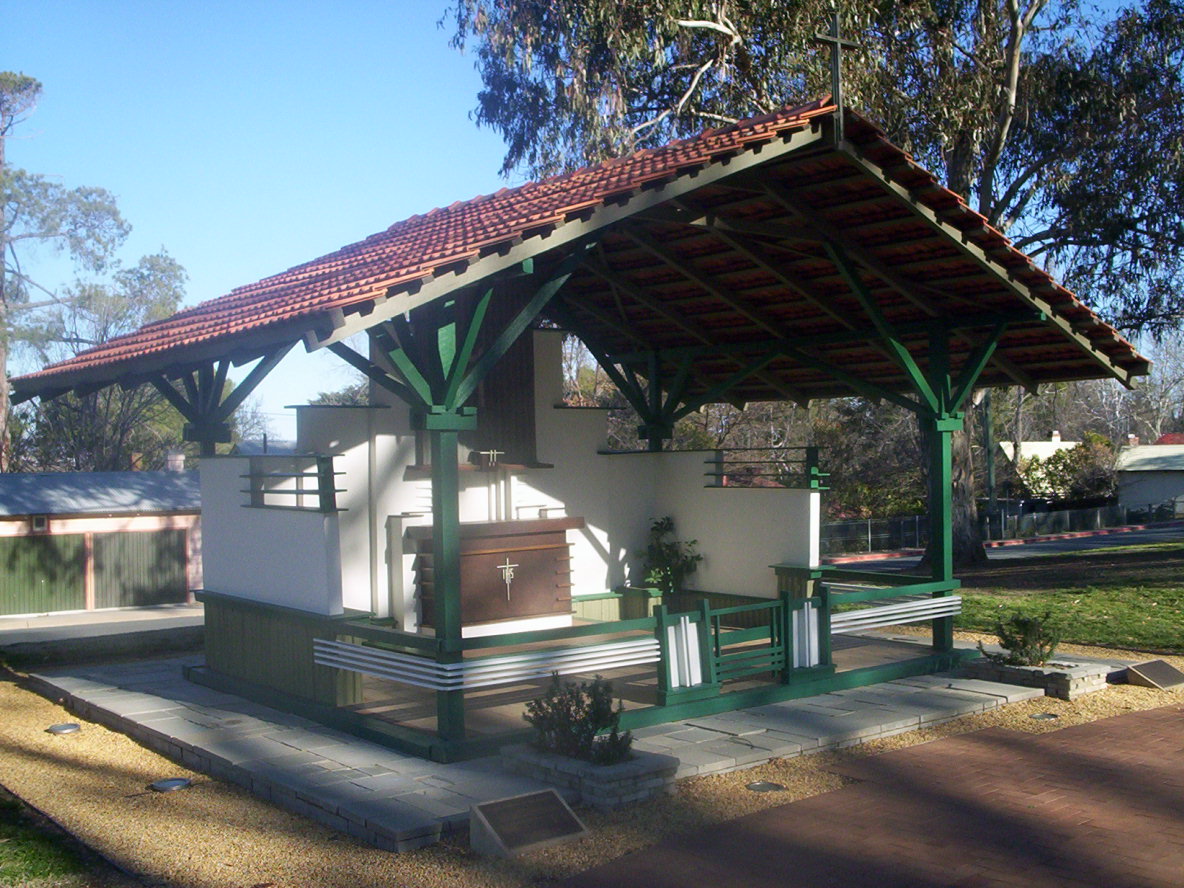
Changi Chapel and Museum
Arthur Westrop wrote 400 pages to a wife who would not read them for years. Every entry in his hidden diary was addressed to her, in Africa, while he sat behind the walls of Changi. Sergeant John Ritchie Johnston smuggled in a Kodak Baby Brownie camera his wife had given him and kept it concealed from his captors for the entire three and a half years of his imprisonment. These were not acts of resistance in any military sense. They were acts of refusal -- refusal to let captivity erase the people they had been before the fall of Singapore.
The Fall and the March
On 15 February 1942, the British surrendered Singapore to the Imperial Japanese Army in what Winston Churchill later called the worst disaster in British military history. What followed was a forced march. Approximately 48,000 soldiers and civilians -- men, women, and children -- were herded to Changi, on Singapore's eastern tip, where a network of barracks and the prison itself were converted into a vast internment camp. The area had been quiet until the 1920s, largely covered by mangrove swamps and rainforest, when the British began constructing batteries and barracks to protect Singapore from seaborne attack. The defenses they built were meant to repel an enemy approaching by sea. The Japanese came overland, through Malaya, and the fortress fell from behind. For three and a half years, until Japan's surrender on 15 August 1945, Changi held its prisoners in conditions that ranged from austere to brutal.
What They Built Inside the Walls
The Japanese did not restrict their prisoners' religious activities, and the internees seized that narrow freedom. Using scrap materials and converted buildings, they constructed multiple chapels within and around the prison. Among the most significant was St George's Church, the basis for the replica chapel that stands at the museum today. Another, the Roman Catholic Our Lady of Christians Chapel, was dismantled after the war, shipped to Australia, and reconstructed in 1988 at the Prisoner of War National Memorial in Duntroon, Canberra. But faith was only one outlet. Creativity became a survival strategy. Internees wrote, drew, read, crafted instruments, played sports, and staged concerts and plays. Stanley Warren, a prisoner of war, painted five Biblical murals on the chapel walls -- works now known as the Changi Murals. Mary Angela Bateman, one of the thousands of women and children imprisoned there, produced a set of watercolor paintings. Someone built a Morse code transmitter small enough to hide inside a matchbox.
Objects That Survived
The museum today holds 114 artifacts, most donated by former prisoners and their families. Beyond Westrop's diary and Johnston's camera, visitors encounter a section of the original Changi Wall, the matchbox Morse code device, Bateman's watercolors, and Warren's murals. A re-created Changi Gaol cell offers a physical sense of the cramped quarters -- historical recordings of conversations between internees play inside, voices from a captivity that ended eight decades ago made audible again. The Changi Cross sits on the altar of the replica chapel: a brass cross fashioned during the occupation by Harry Stogden from a 45-millimeter howitzer shell. Each object carries a specific human story. The diary was not just hidden -- it was written as a conversation with someone who could not hear it. The camera was not just smuggled -- it was a gift from a wife, preserved as a connection to a life that still existed somewhere beyond the wire.
Three Lives of a Museum
Singapore first built a museum and replica chapel beside Changi Prison in 1988. When the prison expanded in 2001, the chapel and museum relocated one kilometer away, and the Changi Chapel and Museum was officially established on 15 February 2001 -- the anniversary of Singapore's fall. For sixteen years the private firm Singapore History Consultants ran the museum before the National Museum of Singapore assumed operations in 2018 and closed the site for redevelopment. The COVID-19 pandemic delayed reopening by a year. On 18 May 2021 the renamed Changi Chapel and Museum opened virtually, its eight galleries organized as a narrative arc: from the fortress Changi once was, through the fall, internment, daily life as prisoners, resilience and creativity under duress, liberation, and finally the legacies that persist. Some earlier exhibits did not survive the transition -- notably over 400 paintings and sketches by POW William Haxworth, donated by his wife to the National Archives in 1986, are no longer on permanent display.
The Eastern Shore
Changi sits at the far eastern end of Singapore, at 1.3622 degrees north, 103.974 degrees east -- closer to the runways of Changi Airport than to the towers of Marina Bay. From the air, the area reads differently from the dense urban core to the west: lower buildings, more green space, the long curve of the coastline bending toward the Strait of Johor. Singapore Changi Airport (WSSS) is the dominant landmark, its parallel runways extending into reclaimed land just south of the museum's location. Seletar Airport (WSSL) lies to the northwest. The museum itself is modest in footprint, easy to miss from altitude. But what it contains -- the hidden diaries, the smuggled cameras, the art made from nothing by people who had lost everything except the determination to create -- asks a question that persists long after the visit ends: what would you refuse to let captivity take from you?
From the Air
Located at 1.3622°N, 103.974°E on Singapore's eastern shore, near Changi Airport. Singapore Changi Airport (WSSS) lies immediately to the south, with its parallel runways extending into reclaimed land. Seletar Airport (WSSL) is to the northwest. The museum occupies a modest footprint in the Changi area, surrounded by lower-density development and green space. Best viewed at 2,000-3,000 ft AGL. The eastern end of Singapore is identifiable by the airport complex and the coastline curving toward the Johor Strait.