Channel Tunnel
Eleven boring machines, each given a name - Brigitte, Europa, Catherine, Virginie, Pascaline, Severine on the French side; technical designations on the English - chewed eastward and westward through the chalk marl beneath the seabed for three years. On 1 December 1990, in a service-tunnel cavern roughly 22 kilometers offshore and 40 meters below the floor of the Channel, English worker Graham Fagg and French worker Philippe Cozette shook hands through a hole the size of a tea tray. For the first time since the last ice age severed Doggerland and isolated Britain on its island, the two sides of the world's busiest strait were physically connected. Construction had cost twice the budget - around 4.65 billion pounds in 1985 prices, roughly 9.5 billion at completion - and would not turn a profit for years. But the tunnel was real.
A 200-Year Dream
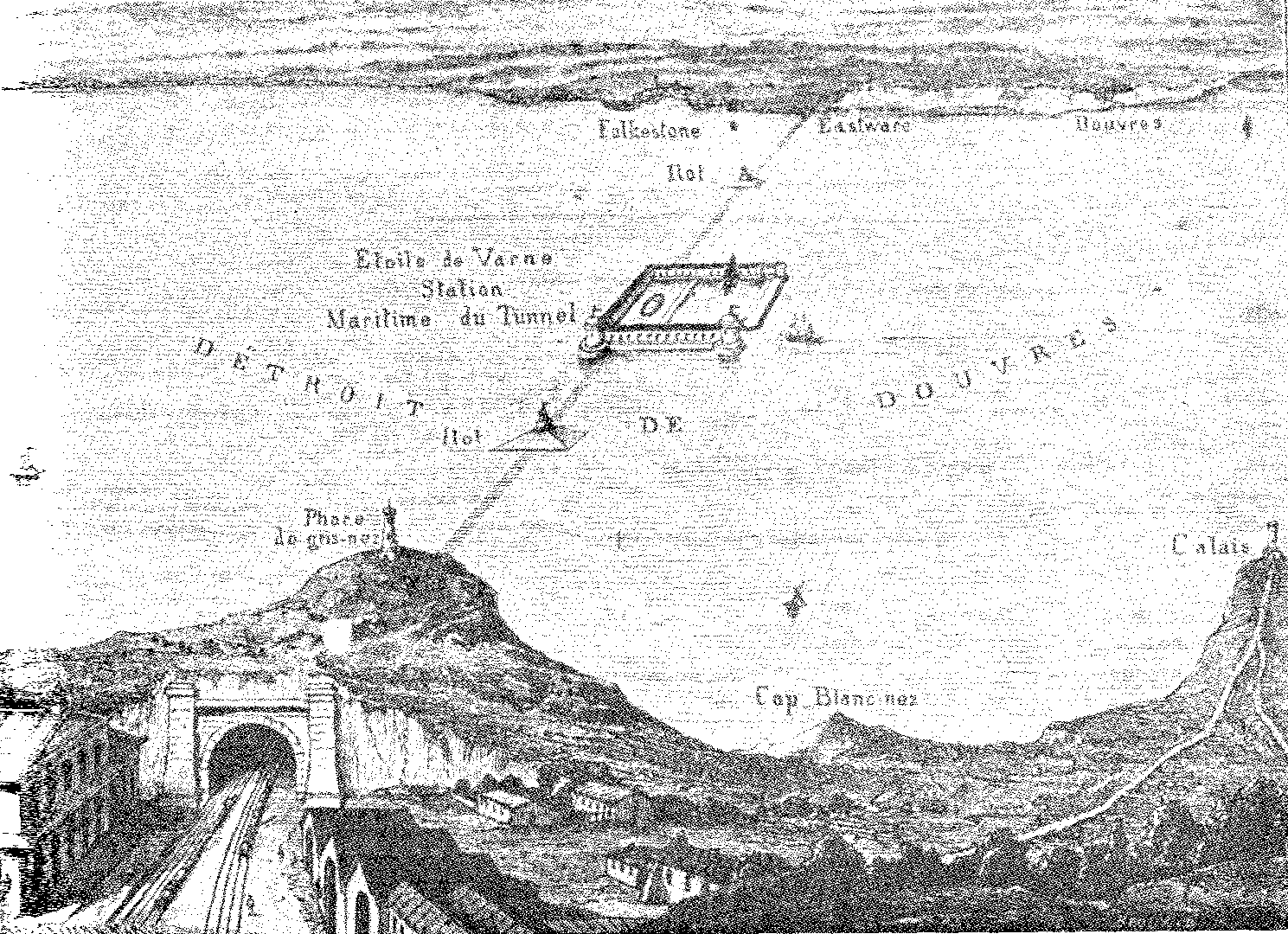
Engineers had been pitching cross-Channel tunnels since 1802, when Napoleon's mining engineer Albert Mathieu proposed a tube lit by oil lamps with a mid-Channel island for changing horses. Victorian schemes failed on cost or politics; a 19th-century British attempt was halted partly out of fear that an invasion army might use it. It took until the 1986 Treaty of Canterbury, signed by Margaret Thatcher and Francois Mitterrand, to commit both governments. Construction began in 1988 with no government money on either side - a privately financed gamble that nearly bankrupted Eurotunnel before the first train ran. Boring met in 1990, services started in 1994, and on 6 May that year the Queen and Mitterrand cut the ribbons at the two terminals.
Three Bores Through Chalk
The geometry is the engineering: not one tunnel but three, running side by side for 50.45 kilometers between Cheriton near Folkestone and Coquelles near Calais. Two 7.6-meter running tunnels carry trains in opposite directions. A smaller 4.8-meter service tunnel runs between them, connected every 375 meters by cross-passages that double as emergency escapes. Piston relief ducts link the running tunnels so that the pressure wave from a 160 km/h train doesn't hammer oncoming services. Two enormous undersea crossover caverns - the largest artificial undersea caverns ever built - let trains switch tracks at mid-Channel. Of the total length, 37.9 kilometers run under the sea, which makes this the longest undersea section of any tunnel on Earth.
The Chalk Marl
The reason all this was possible is a single soft, watertight band of rock called chalk marl. It runs almost continuously across the bottom of the Strait of Dover at a depth that lets engineers stay close enough to the surface to work, but deep enough to avoid the sandstones and harder layers that had defeated earlier schemes. The 1880s pilot tunnels under Shakespeare Cliff had proved chalk marl was almost ideal for boring: soft enough to cut quickly, stable enough not to collapse, and dry enough that water ingress was manageable. A century later the same rock saved the modern project from technical disaster - and, in 1996, from a catastrophic fire. When the chalk lining behind the concrete reached temperatures that should have collapsed it, it simply held.
Two Hours Fifteen
What runs through the bores has changed Britain's geography of travel. Eurostar passenger trains, based on the French TGV but built to UK loading gauge with extra fireproofing, cover London-Paris in 2 hours 15 minutes and London-Brussels in under 2 hours. LeShuttle car and lorry shuttles carry vehicles and their drivers between the terminals in 35 minutes - drive on in Kent, drive off in Pas-de-Calais. The HGV shuttle wagons are the largest rail wagons in the world, open lattice structures designed to carry articulated lorries with their drivers riding in a separate amenity coach. Cross-tunnel passenger traffic peaked above 18 million in 1998, then dipped, then climbed again. In 2024 alone Eurostar carried over 10 million passengers.
What It Means
Economically the tunnel has been a mixed verdict. A cost-benefit analysis found that the British economy would arguably have been better off without it; Eurotunnel suspended debt payments in 1995 to avoid bankruptcy, restructured in 1998, and only began turning consistent operating profits years later. The British and French governments extended the original concession by 34 years, to 2086, to give the operator time to recover. Socially, the verdict is harder to argue with. Britain - which had been an island for roughly 8,000 years since rising seas drowned Doggerland - was, for the first time, walkable to mainland Europe. Sociologists noted at the time that the tunnel represented a symbolic end of British insularity. The politics of Brexit, decades later, would suggest the symbolism cuts both ways.
From the Air
The Channel Tunnel runs roughly NW-SE between 51.10°N, 1.18°E (Cheriton/Folkestone terminal) and 50.93°N, 1.83°E (Coquelles/Calais terminal), passing under the narrowest part of the Strait of Dover. From cruise altitude the tunnel itself is invisible, but both terminals are unmistakable: vast figure-eight shuttle marshalling yards with multiple boarding platforms and motorway access ramps from the M20 and the A16. Best viewed from FL250-FL350 on the standard Dover-Calais corridor. Nearby airfields: Lydd (EGMD) and Manston (EGMH) on the English side; Calais-Dunkerque (LFAC), Le Touquet (LFAT), and Saint-Inglevert microlight field on the French side. On a clear day the White Cliffs and Cap Blanc-Nez are both visible from either coastline.