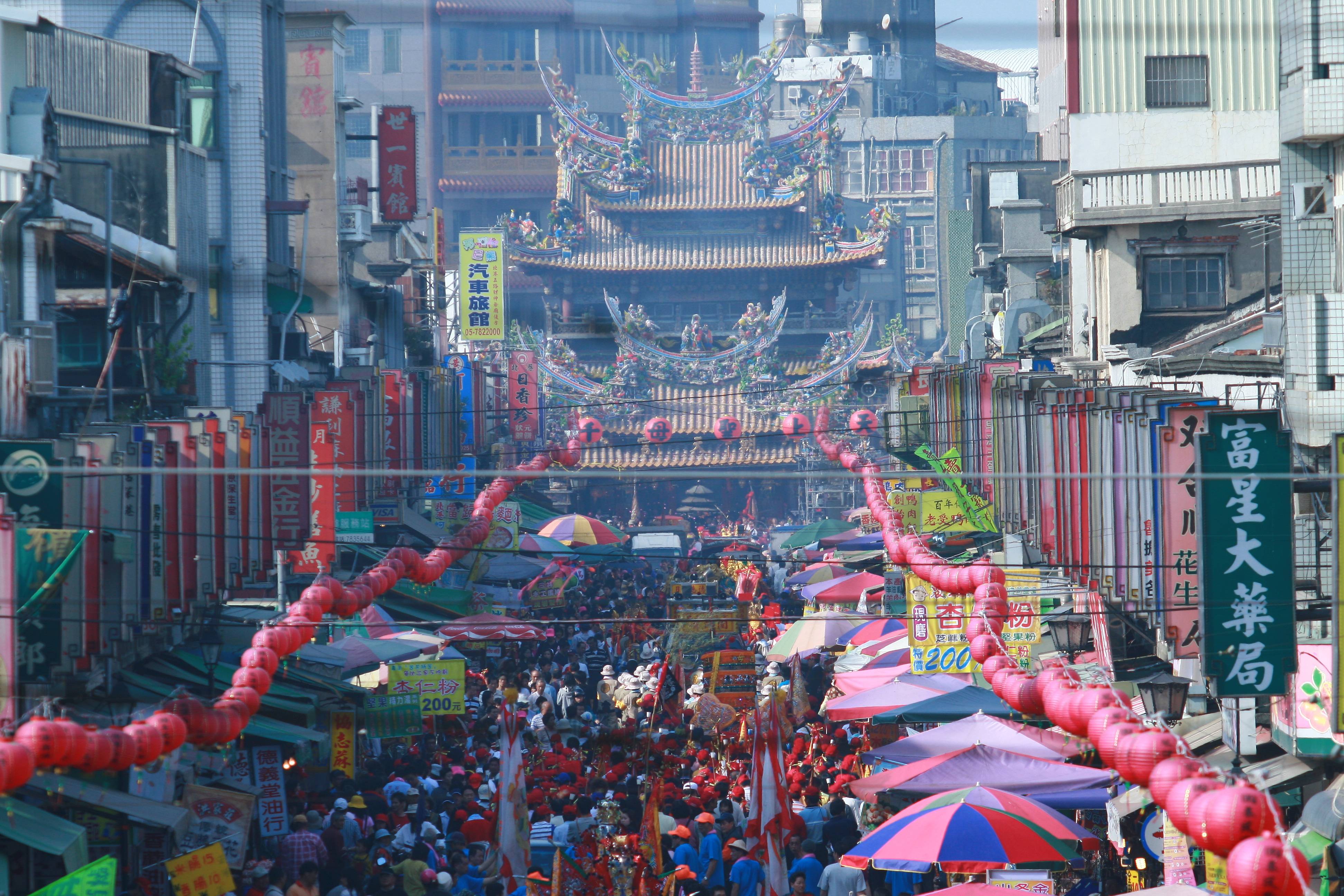
Chaotian Temple
Every spring, the streets of Beigang Township erupt. Firecrackers detonate in rolling waves, dragon dancers weave through incense smoke so thick it obscures the rooftops, and a million pilgrims press toward an ornate temple complex that has anchored this corner of Yunlin County since 1700. The Chaotian Temple is not merely a place of worship. It is the gravitational center of Mazu devotion in Taiwan, a living monument to the goddess of the sea whose influence shaped the island's settlement, commerce, and spiritual identity for centuries.
A Goddess Crosses the Strait
Mazu began as Lin Moniang, a woman from Fujian province whose legend grew after her death into one of the most powerful deities in the Chinese folk religion pantheon. As Fujianese merchants and fishermen crossed the Taiwan Strait in the 17th century, they carried her with them. In 1694, a Buddhist monk named Shubi arranged for a statue of Mazu to travel from her hometown temple in Meizhou to the bustling port of Beigang. Six years later, a local benefactor named Chen Li-Shum donated land and raised funds to give the goddess a permanent home. The Chaotian Temple rose from that gift, and Beigang's fortunes rose with it. The town was already one of Taiwan's most important ports; now it became a spiritual capital as well.
Incense, Gold, and Flying Dragons
Walk through the temple's gates and the first thing you notice is the density of detail. Layer upon layer of carved stone, painted wood, and gilded ornamentation cover every surface, the product of three centuries of expansion and devotion. But the Chaotian Temple's cultural reach extends well beyond its walls. The Flying Dragons, a dragon dance troupe affiliated with the temple since around 1924, once carried Great Dragon Flags through processions that drew crowds from across the island. The Beigang Wind Orchestra, founded in 1928 by Chen Chia-Hu, still marches on spiritual days, filling the streets with brass and percussion. And each year, the temple's Mazu statue embarks on a pilgrimage tour of Taiwan, visiting other Mazu temples in a circuit that reinforces the bonds between communities separated by mountains and rivers but united by faith.
The Weight of a Million Prayers
Numbers only hint at what happens here. More than a million pilgrims visit annually, making the Chaotian Temple one of the most visited religious sites in Taiwan. On peak festival days, the surrounding streets become impassable, choked with offerings, parades, and the continuous percussion of firecrackers meant to welcome the goddess and drive away evil spirits. Since 2020, the temple has also sponsored a Buddhist Shuilu Fahui ceremony, an elaborate multi-day ritual traditionally reserved for the most urgent spiritual needs, adapted here to pray for relief from the COVID-19 pandemic. It is a reminder that this is not a museum. The Chaotian Temple responds to the world as it changes, bending ancient traditions toward present needs without breaking them.
Beigang's Beating Heart
The town and the temple are inseparable. Beigang's economy, its festivals, its identity all orbit the Chaotian Temple the way smaller temples orbit Mazu herself. The extravagant architecture, classified as a national monument, draws tourists and scholars. The annual festivals draw performers, vendors, and television crews. But strip all of that away and what remains is a 300-year-old promise kept: a community that built a house for its protector and never stopped tending it. The incense smoke that darkens the ceiling beams is not just residue. It is accumulated devotion, compressed into visible form, layered over generations like geological strata. Each visit adds another film. Each prayer thickens the record.
From the Air
Located at 23.57°N, 120.30°E in Beigang Township, Yunlin County, central-western Taiwan. The temple complex is identifiable from the air by its traditional multi-tiered rooflines amid the dense township grid. Nearest airports: Chiayi Airport (RCKU) approximately 25 km to the southeast, Taichung International Airport (RCMQ) roughly 75 km to the north. Best viewed at 2,000-3,000 ft AGL in clear conditions. The coastal plain of Yunlin County is flat agricultural land, making the temple complex stand out among the surrounding low-rise buildings.