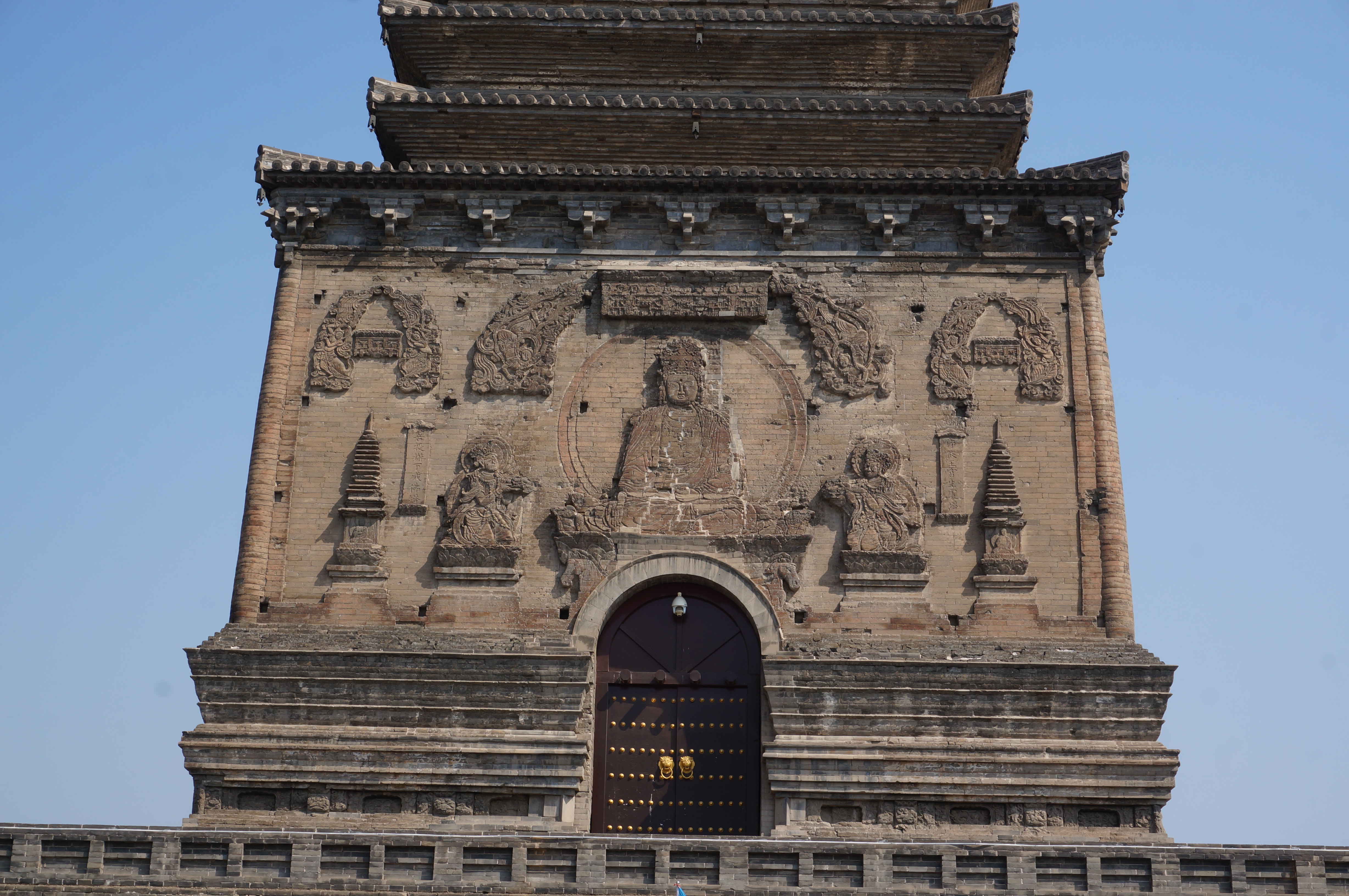
Chaoyang North Tower
Dig beneath the Chaoyang North Tower and you descend through Chinese history itself. When archaeologists began a major restoration in 1984, they discovered something extraordinary beneath this 42.6-meter brick pagoda in Liaoning Province: layer upon layer of rammed-earth foundations, each belonging to a different dynasty. The Sixteen Kingdoms period, the Northern Wei, the Sui, the Tang, the Liao -- five ages of construction compressed into a single site, each generation building atop the bones of the last. The Chinese call it the "Pagoda of Five Ages with One Body," and the name is not poetic license. It is an archaeological fact.
Empress, Emperor, and the Relay of Faith
The tower's story begins in the Northern Wei Dynasty, when Empress Dowager Feng ordered its construction on a site already layered with the palace ruins of three earlier Yan kingdoms. She named it Siyan Buddhism. In 602, during the Sui Dynasty, Emperor Wen sent Buddha relics to Yingzhou, and a new pagoda -- the Fanzhuan Temple Pagoda -- was erected on the original site to house them. The Tang Dynasty renamed it the Kaiyuan Temple Pagoda and rebuilt it again. When the Liao Dynasty arrived, the pagoda became the Yanchang Temple Pagoda and was restored twice more. Each dynasty that controlled this territory felt compelled not merely to maintain the tower but to claim it, renaming and rebuilding as if the structure's spiritual authority could be transferred along with its bricks.
The Buddhas of Four Directions
The tower as it stands today is a thirteen-story square brick pagoda with a hollow interior rising from a Sumeru base. Its four faces each display a Tantric Vajradhara Buddha seated in the lotus position, crowned and robed: Akshobhya with elephant seats on the east, Amitabha with peacock seats on the west, Baosheng Buddha with horse seats on the south, and Bujinkan Buddhism with winged golden bird seats on the north. Flanking bodhisattvas stand beside each figure. Carved around the body of the tower are eight spiritual pagodas commemorating key events in the Buddha's life, from his birth in the Palace of the King of Pure Rice to his achievement of Buddhahood beneath the Bodhi Tree. The iconographic program is dense, layered, and deeply intentional -- a sermon in stone.
Treasures of the Underground Palace
The tower contains two hidden chambers. High above, in the Heavenly Palace within the twelfth floor of the eaves, archaeologists in 1988 unearthed two Shakyamuni relics -- among the most sacred objects in Buddhist tradition -- sealed inside a gold-covered agate jar. Below, a corridor on the south side of the pedestal leads down into the underground palace beneath the tower, a chamber 4.48 meters high. This subterranean vault yielded a remarkable stone sutra building, 5.26 meters tall after restoration, its octagonal surfaces carved with the stories of the Seven Buddhas of the Past and inscribed with major sutras including the Heart Sutra of Prajna Paramita. Alongside it lay white porcelain vases with lotus patterns, jade rings, an onyx axe, an amber dragon disc, a jade flying celestial figure, a jade goose, glass vases with gold lids, and more than 400 copper coins. The dating inscription reads "the thirteenth year of Chongxi," placing these offerings firmly in the Liao period.
Resurrection of a Landmark
The comprehensive restoration from 1984 to 1992, funded by the State Administration of Cultural Heritage, returned the Chaoyang North Tower to something approaching its original appearance. In 1988, the tower was designated a national key cultural relic protection unit. Two years later, a museum of Buddhist culture opened at the site, drawing on the extraordinary finds from the underground palace and celestial palace above. A further renovation in 2003 accompanied the transformation of Chaoyang's old city, and the expanded Chaoyang Beita Museum opened to the public in 2006. The tower stands today as both an active archaeological site and a working museum, five dynasties compressed into one structure, each layer a chapter in the long story of faith and power in northeast China.
From the Air
Located at 41.58°N, 120.46°E in Shuangta District, Chaoyang City, Liaoning Province. The 42.6-meter pagoda is visible as a prominent structure in the city center. Nearest airport: Chaoyang Airport (ZYCY). Recommended viewing altitude: 5,000-8,000 ft. The tower is one of several historic pagodas in Chaoyang, with the paired South Tower also visible nearby.