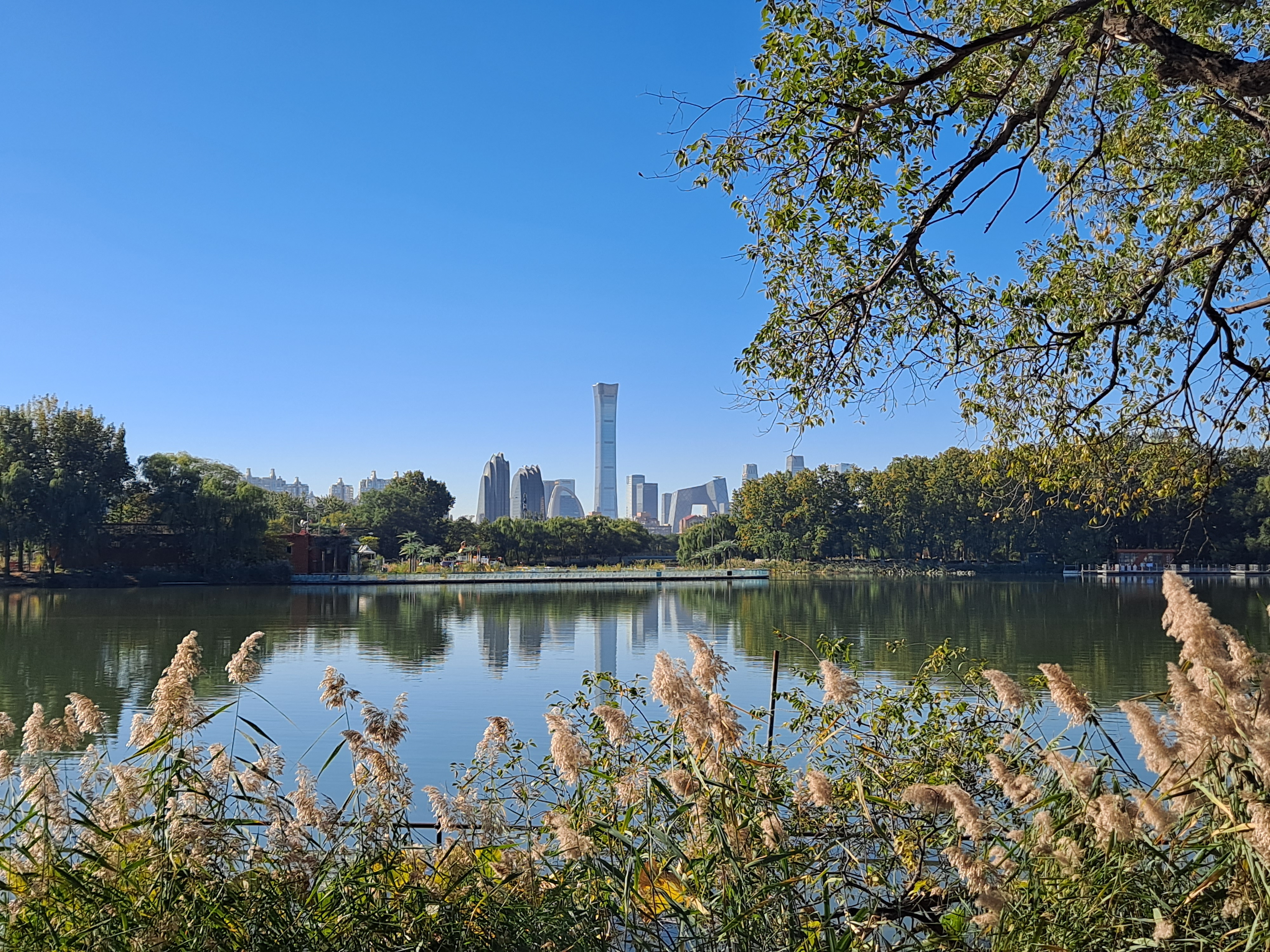
Chaoyang Park
When Beijing needed beach volleyball courts for the 2008 Summer Olympics, it shipped sand from Hainan island -- a tropical province over 2,000 kilometers to the south -- and dumped it in Chaoyang Park. The temporary stadium rose from what had been green space in the middle of a landlocked metropolis, a reminder that the Olympics could conjure any landscape they needed. After the Games, the sand went away. The park remained, as it has since 1984, Beijing's largest and most varied urban green space.
A Prince's Ground, A City's Lung
Chaoyang Park sits on land that once belonged to a prince's palace in Beijing's Chaoyang District. Construction of the modern park began in 1984, and the result is vast: 288.7 hectares in total, roughly 2.8 kilometers long and 1.5 kilometers wide. Water surfaces account for 68.2 hectares of that total -- lakes and ponds that give the park a spaciousness rare in a city where every square meter of land is contested. The majority of the remaining area is green space, a deliberate decision to keep the park as a breathing room for a district that has otherwise been aggressively developed. For the millions of residents in eastern Beijing, Chaoyang Park is the closest thing to open countryside.
Something for Everyone
The park is deliberately diverse in its offerings, mixing contemplative spaces with active recreation. Flower gardens and landscaped areas share the grounds with a fairground featuring rides and a roller coaster. Visitors can play laser tag, navigate a high ropes course, or swim in one of several large pools. Bicycles and boats are available for rent at multiple locations. The mix is intentional -- Chaoyang Park serves families with small children, teenagers looking for thrills, retirees seeking tranquility, and everyone in between. Since 2005, the Beijing Pop Festival has brought Chinese and international musical acts to the park each September, adding a layer of cultural programming to the recreational landscape.
Olympic Dreams and a Ferris Wheel That Never Was
The 2008 Olympics put Chaoyang Park on the international map. The beach volleyball competition, held in a purpose-built temporary stadium, drew global television audiences to a venue that most of the world had never heard of. The logistics alone were remarkable -- creating a beach sports facility in a city 1,200 kilometers from the nearest coast. After the Games, an even more ambitious plan emerged: the Beijing Great Wheel, a 208-meter giant Ferris wheel that would have dwarfed the London Eye. The project went into receivership in 2010, and the wheel was never built. The park's skyline remained defined by trees rather than steel, which may have been the better outcome.
Green Space in the Age of Concrete
Chaoyang Park matters most for what it is not. It is not another shopping mall, office tower, or residential compound. In a district where development has been relentless, the park's nearly 300 hectares represent an enormous reservation of land for public use. The water surfaces reflect the sky, the lawns absorb the noise, and the tree canopy filters the air. A replica of the Non-Violence sculpture -- the famous knotted-barrel revolver -- stands in the park, a small international gesture in a deeply local place. On any given weekend, the park fills with the ordinary life of a massive city: kites aloft, children running, couples strolling past flower beds. It is not dramatic. It is essential.
From the Air
Located at 39.95°N, 116.48°E in Beijing's Chaoyang District. The park's large green rectangle is visible from altitude as a distinctive break in the dense urban fabric of eastern Beijing. Nearest major airport is Beijing Capital International (ZBAA/PEK), approximately 18 km to the northeast.