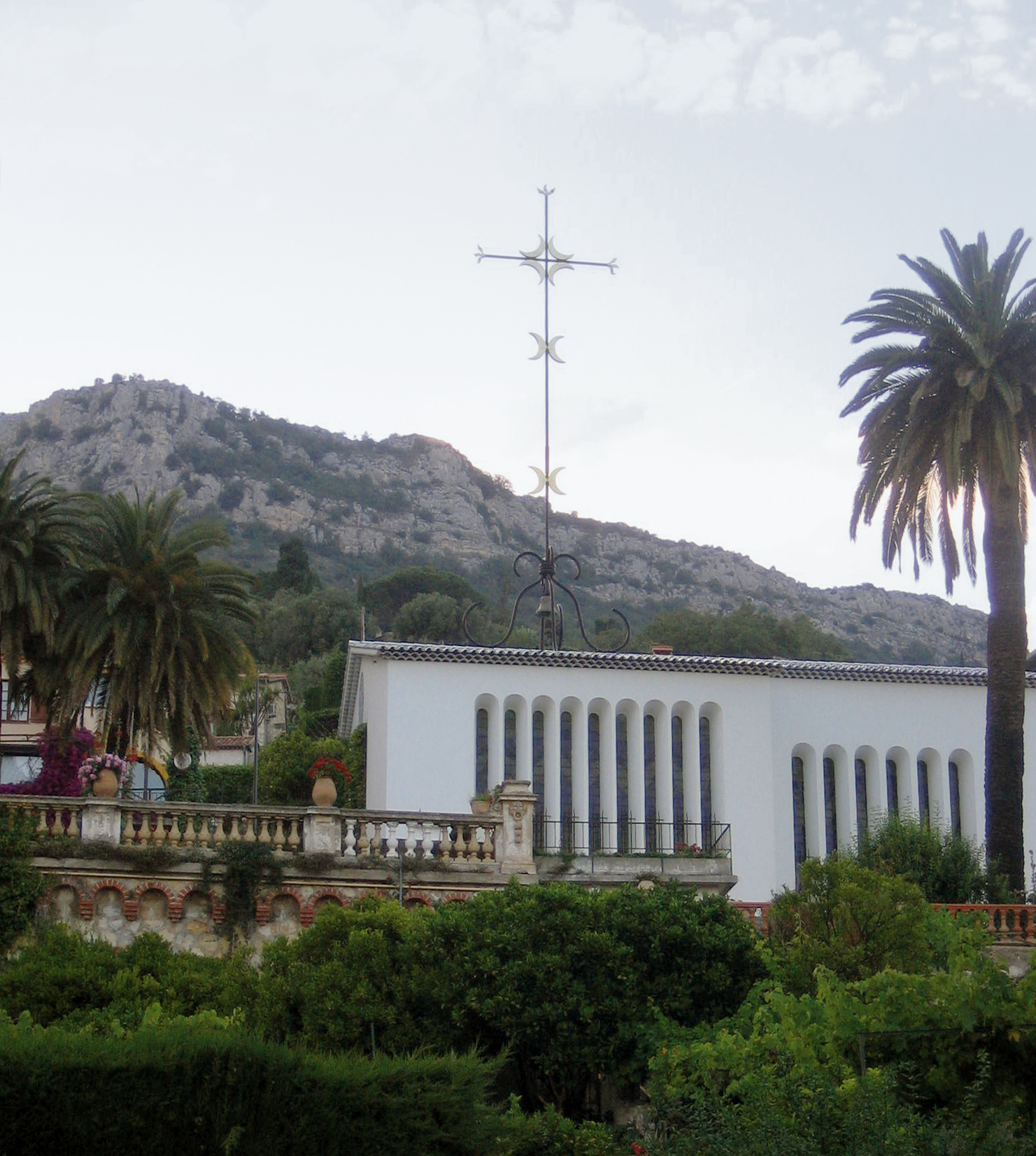
Chapelle du Rosaire de Vence
Henri Matisse was 77 years old, working from a wheelchair, when he declared the Chapelle du Rosaire de Vence to be his masterpiece. Not the paintings that had made him famous. Not the revolutionary cut-outs of his final years. A small Catholic chapel on a hillside in a Provencal town, designed for Dominican nuns who ran a school next door. He controlled every detail: the stained glass, the murals, the altar, the crucifix, the candleholders, the priests' vestments, even the confessional doors. The project consumed him from 1947 to 1951, and when it was finished, he had created one of the most extraordinary religious spaces of the 20th century.
A Debt to a Nurse
The chapel's origins lie in an unlikely friendship. In 1941, Matisse was recovering from cancer surgery in Nice when a young part-time nurse named Monique Bourgeois answered his advertisement seeking 'a young and pretty nurse.' She cared for him during his long recovery. Later, Bourgeois entered the Dominican Order, taking the name Sister Jacques-Marie. When the nuns at Vence began planning a new chapel for their school, Sister Jacques-Marie approached Matisse, who had settled nearby. The artist, already in declining health and confined to a wheelchair, took on the project with a commitment that surprised even those who knew him. What began as a favor to a former nurse became an obsession that would occupy the last productive years of his life.
Three Colors and the Mediterranean Light
The chapel's power derives from an almost impossible simplicity. Matisse designed three sets of stained-glass windows using only three colors: an intense yellow for the sun, a vivid green for the vegetation of the Riviera, and a deep blue for the Mediterranean Sea and sky. The windows flood the otherwise entirely white interior with shifting pools of color that move across the walls and floor as the sun tracks across the sky. The effect is not decorative but atmospheric -- the chapel breathes with light, its character changing hour by hour. Against this luminous backdrop, Matisse placed three murals executed in black paint on white ceramic tiles. The technique was born of necessity: too ill to stand, he worked from his wheelchair with a long stick, a brush strapped to his arm, drawing his designs on paper mounted to the wall before skilled craftsmen transferred them to tiles.
Saints and Stations on White Tile
The three murals show Matisse's ability to convey spiritual weight through radical simplicity. Behind the altar, Saint Dominic -- founder of the Dominican Order -- stands rendered in a few confident black lines against the white tiles, his form both monumental and weightless. On a side wall, the Virgin Mary holds the Christ child in an unconventional pose: rather than clutching him to herself, she offers him outward, to the world. The most powerful composition occupies the back wall: all fourteen Stations of the Cross compressed into a single unified composition. Beginning at bottom left with Jesus before Pilate, the narrative spirals upward to the three central images -- the Raising of the Cross, the Crucifixion, and the Deposition. The French artist Jean Vincent de Crozals served as Matisse's model for the figure of Christ. Pope Pius XII was so impressed by the vestments Matisse designed that he requested the nuns send a set to Rome for the Vatican's museum of modern religious art.
A Chapel Shaped Like a Ship
The building itself is modest: an L-shaped structure 15 meters long and 6 meters wide, entered by descending a flight of stairs from the hillside. The altar sits at the angle where the two legs of the L meet, visible from both the students' section and the nuns' section. The exterior is plain white, topped with a blue-and-white zigzag roof pattern and an elaborate wrought-iron cross. Some critics found the exterior underwhelming. Those who step inside tend to change their minds. The chapel works through accumulation of carefully considered details: the warm brown stone of the altar, chosen for its resemblance to the color of bread; the bronze crucifix and candleholders designed by Matisse; the locally crafted wrought-iron candle holder suspended from the ceiling with its perpetual flame. Along the corridor to the small gift shop, photographs document Matisse at work -- an elderly man in a wheelchair, reaching upward with his brush-tipped stick, concentrating with the intensity of an artist who understood this would be his final major work. He died three years after the chapel's consecration.
From the Air
Located at 43.73N, 7.11E in the hilltop town of Vence, about 10 km inland from the coast between Nice and Antibes. The chapel is small and not easily visible from altitude, but Vence itself sits on a prominent hill. Nearest airports: Nice Cote d'Azur (LFMN), Cannes-Mandelieu (LFMD). The surrounding landscape of terraced hillsides and perched villages is characteristic of the arriere-pays nicois. Best viewed at 2,000-3,000 feet AGL.