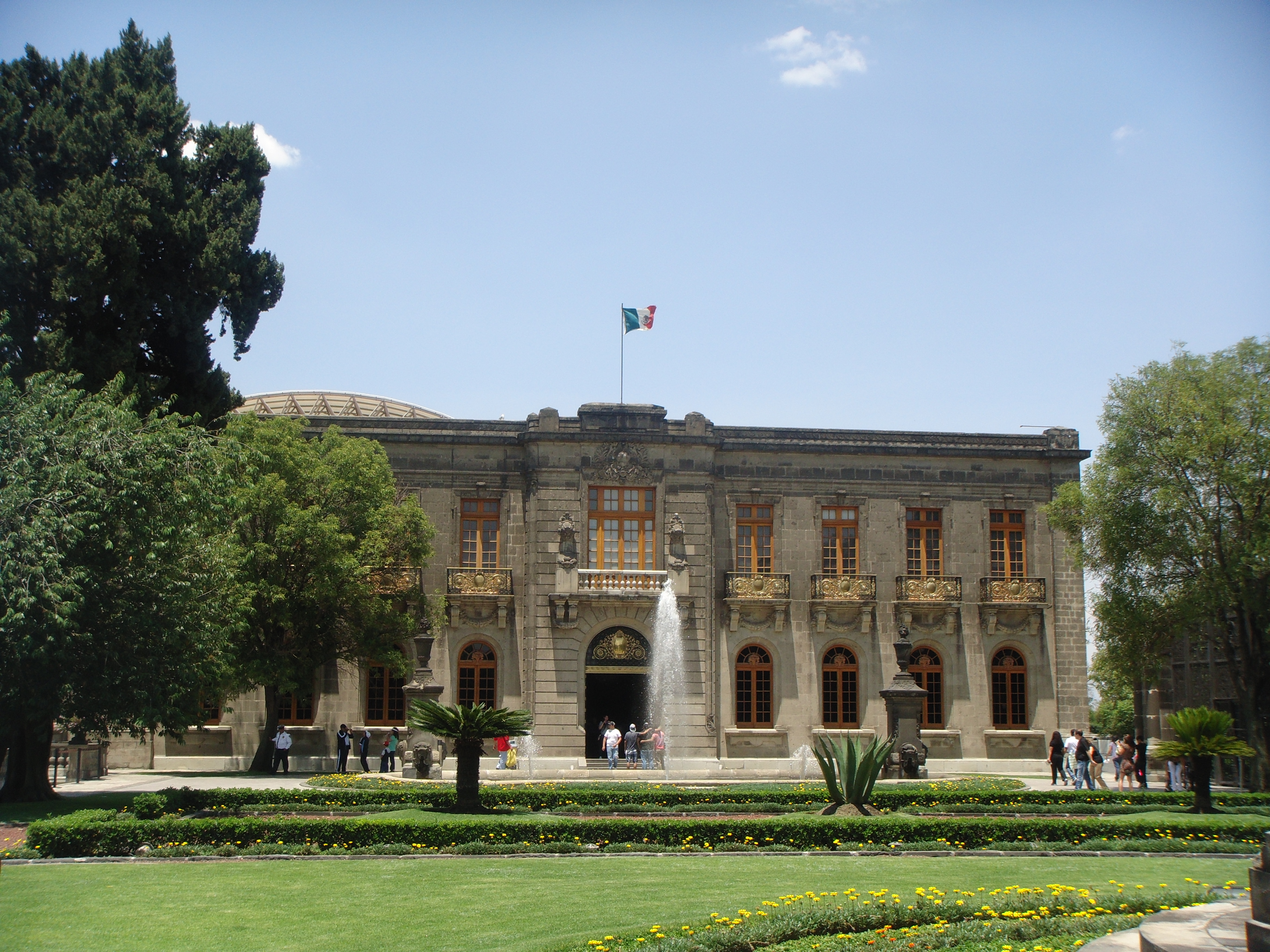
Chapultepec Castle: The Grasshopper Hill That Crowned an Empire
It is one of only two royal palaces in North America where monarchs actually lived, and the name means "on the hill of the grasshopper." Chapultepec Castle sits at 2,325 meters above sea level on a hilltop that the Aztecs considered sacred, overlooking what was once the lake-filled Valley of Mexico and is now a sprawling capital of over twenty million people. Since Viceroy Bernardo de Galvez ordered its construction in 1785, the building has been a colonial summer house, a gunpowder warehouse, a military academy, an imperial residence, a presidential home, an astronomical observatory, and - since 1939 - Mexico's National Museum of History. Few structures anywhere have reinvented themselves so many times, and fewer still carry such concentrated layers of a nation's story within their walls.
The Viceroy's Folly
Viceroy Bernardo de Galvez wanted a stately home at the highest point of Chapultepec Hill, and in August 1785 he got construction underway. Lieutenant Colonel Francisco Bambitelli of the Spanish Army drew the plans. When Bambitelli left for Havana, Captain Manuel Agustin Mascaro took over, pushing the work forward at such speed that rumors spread: Mascaro was building not a residence but a fortress, positioning himself to rebel against the Crown. Then Galvez died suddenly on November 8, 1786, and speculation shifted to poison - though no evidence has ever supported the claim. Without a patron, the unfinished building languished. The Spanish Crown ordered it auctioned at one-fifth of what had been spent, and found no buyers. In 1803, Alexander von Humboldt visited and was appalled to learn the Royal Treasury had sold the palace's windows to raise funds. Three years later, the municipal government of Mexico City finally purchased the hulk.
Boy Heroes and the Halls of Montezuma
After decades of abandonment during the War of Independence, the castle became a military academy in 1833. On September 13, 1847, during the Mexican-American War, it became a battlefield. United States forces stormed Chapultepec Hill in what became the Battle of Chapultepec, and the cadets defending it - some reportedly as young as thirteen - chose to fight rather than surrender. These young defenders became the Ninos Heroes, the "Boy Heroes" immortalized with a mural above the castle's main entrance and a monument at the hill's base. The U.S. Marine Corps remembers the same battle differently: the opening line of the Marines' Hymn, "From the Halls of Montezuma," refers to the storming of Chapultepec - though as historians have noted, the building was erected by Spanish rulers more than three centuries after the Aztec emperor Montezuma was overthrown. The Marine Corps blood stripe, the red trouser stripe worn by officers and NCOs, is traditionally said to commemorate the heavy casualties sustained that September day.
An Emperor's Boulevard
When Mexican conservatives invited the Habsburg archduke Maximilian to establish the Second Mexican Empire, the castle became his residence in 1864. Maximilian and his wife Empress Carlota hired European and Mexican architects to transform the building into a proper royal palace. Julius Hofmann and Carl Gangolf Kayser - who also worked on Neuschwanstein Castle for Maximilian's Wittelsbach cousin Ludwig II of Bavaria - designed neoclassical interiors. Botanist Wilhelm Knechtel created a roof garden. The emperor imported furniture and fine art from Europe, much of which is still displayed in the castle today. Because the castle sat on the outskirts of Mexico City, Maximilian ordered a grand boulevard connecting his residence to the city center, modeled on Vienna's Ringstrasse and the Champs-Elysees. He named it Paseo de la Emperatriz in honor of Carlota. After Maximilian's execution and the republic's restoration under President Benito Juarez in 1867, the boulevard was renamed Paseo de la Reforma - today one of Mexico City's most iconic avenues, its original imperial purpose quietly erased.
From Palace to Museum
The castle's final transformation began almost by accident. After the fall of the Second Empire in 1867, it served briefly as an astronomical observatory before becoming the official presidential residence in 1882. Presidents lived there through the Porfiriato, through the Mexican Revolution, through the turbulent 1920s. In 1934, President Lazaro Cardenas broke the tradition, moving the presidential residence to the more modest Los Pinos. Five years later, in 1939, he decreed the castle a national museum. It opened to the public on September 27, 1944. The castle has witnessed at least one more act of history since then: on January 16, 1992, the Chapultepec Peace Accords were signed within its walls, ending the twelve-year Salvadoran civil war under the mediation of UN Secretary-General Boutros Boutros-Ghali. Today, visitors walk through rooms where emperors slept and presidents governed, past stained glass hallways, through the Malachite Room, and out onto terraces that offer one of the finest views in Mexico City - the same prospect that made Aztec priests, Spanish viceroys, and Habsburg royals all covet this particular hill.
From the Air
Located at 19.421N, 99.182W atop Chapultepec Hill in western Mexico City, within the vast green expanse of Chapultepec Park (one of the largest urban parks in the Western Hemisphere). The castle is clearly visible from altitude as a structure crowning a forested hill surrounded by city. Paseo de la Reforma, the major boulevard, runs northeast from the park toward the historic center. Nearest major airport: Mexico City International Airport (MMMX/MEX), approximately 15 km east. Toluca International Airport (MMTO/TLC) is 60 km west. Best viewed at 3,000-5,000 feet. The park's green canopy contrasts sharply with surrounding urban development, making orientation straightforward.