Charles A. Lindbergh State Park
One day in 1911, a nine-year-old boy playing on the unfinished upper floor of a farmhouse near Little Falls, Minnesota, heard an engine louder than anything he had encountered before. He climbed out onto the roof and saw his first airplane. That boy was Charles Lindbergh, and the farmhouse -- rebuilt on the stone foundation of an earlier home destroyed by fire -- still stands on a bluff overlooking the Mississippi River. The 569-acre state park surrounding it preserves not just a famous aviator's childhood landscape but the story of a family that came apart and came together again in this very specific stretch of pine forest and river bottomland.
A House Built Twice
Charles August Lindbergh, known as C.A., was a prominent lawyer and real estate trader who purchased the property for a dairy farm in 1898. In March 1901 he married Evangeline Lodge Land, a college-educated descendant of two notable Detroit medical families who had come to Little Falls as a teacher. They built a three-story house on the bluff. Charles Augustus Lindbergh was born in 1902. Then, on August 5, 1905, fire started for unknown reasons on the third floor. The house burned to its stone foundation, though the family escaped injury and saved many household items. The replacement house, built on the same foundation, was much smaller -- C.A.'s finances were overextended and the marriage was straining. The new structure fit awkwardly onto the old footprint, producing a hallway with seven doors leading off it. The basement, intended as C.A.'s library, was never finished. Neither was the upper floor, which became young Charles's exclusive playground.
The Boy Who Slept on a Porch
C.A. entered politics in 1907 and served five consecutive terms in the U.S. House of Representatives. For the next decade, young Charles split his time between Detroit, Washington, and Little Falls, spending only two or three months each year on the farm. But those months shaped him. He would later credit the time spent working the land and playing along the Mississippi for his physical strength and self-reliance. Charles slept on a screened-in porch that served as his bedroom, refusing to move indoors on all but the very coldest winter nights. He became an early adopter of farm mechanization, taking over operations of the property. In 1920 he left for college and returned just once, in 1923, arriving in a Curtiss JN-4 biplane and landing in a field on the west side of the property. The farm boy had become a pilot. Within four years he would be the most famous person on Earth.
Souvenir Hunters and Salvation
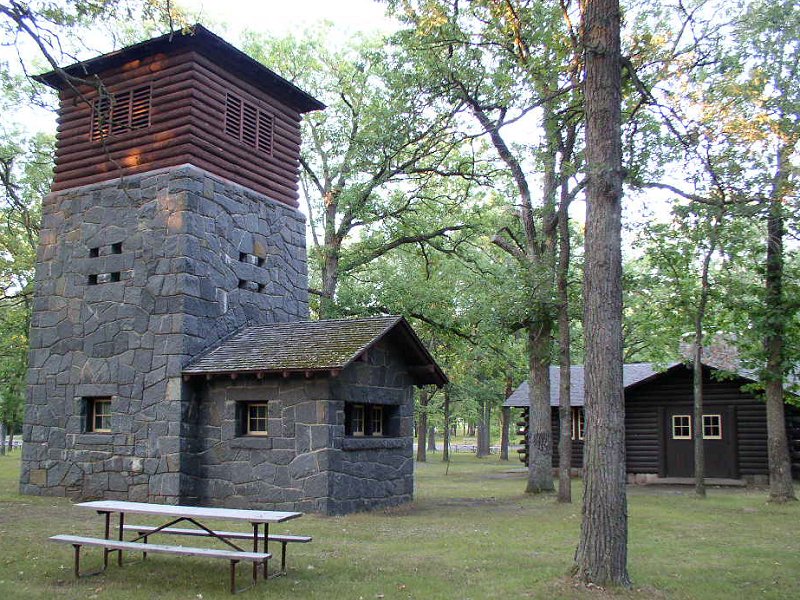
After Lindbergh's solo transatlantic flight in 1927 made him a global celebrity, the empty farmhouse became a target. Souvenir seekers broke in repeatedly, causing extensive damage to the property. The barn had already burned down, and C.A. had died in 1924. The farm was neglected and deteriorating. Encouraged by locals hoping to protect the site, the Lindbergh family donated the property to the state of Minnesota in 1931 as a park in memory of C.A. The family worked with the Minnesota Historical Society to restore the home and donated original furnishings. The Works Progress Administration developed the grounds for recreation in the late 1930s, building a picnic shelter, water tower, and retaining wall along Pike Creek -- all in the National Park Service Rustic style using local stone and logs. These WPA structures, built between 1938 and 1939, were listed on the National Register of Historic Places in 1989.
A Final Address from the Porch
In 1969, the house and its grounds were transferred to the Minnesota Historical Society. At the 1973 grand opening of an adjacent interpretive center, Charles Lindbergh spoke from the porch of his boyhood home. It was his final public address. He died the following year. The visitor center initially focused on three generations of Lindberghs in America, at the request of the famously private Charles. A 2002 remodeling doubled the exhibit space and expanded coverage of the aviator himself, including a full-size replica of the Spirit of St. Louis cockpit. Today the park's 569 acres hold a campground with 38 sites, glacial till deposited between 100,000 and 10,000 years ago, and pine forest with oak and prairie openings that remain similar to their pre-settlement composition. Slate boulders carried by glaciers from farther north are visible in Pike Creek. The Mississippi runs through it all, its water level now higher than when a boy used to swim in it.
From the Air
Located at 45.957°N, 94.390°W along the west bank of the Mississippi River on the outskirts of Little Falls, Minnesota. Elevation approximately 1,100 feet MSL. Little Falls/Morrison County Airport-Lindbergh Field (KLXL) is 3 nautical miles northeast -- fittingly named for the aviator who once landed a Curtiss JN-4 on the family property. Camp Ripley's Ray S. Miller Army Air Field is approximately 9nm north; be aware of military airspace. The park is identifiable from the air by the bend of the Mississippi and the wooded bluff along its west bank. Best viewed at 2,000-4,000 feet AGL. St. Cloud Regional Airport (KSTC) lies approximately 30nm south-southeast.