Charles Hosmer Morse Museum of American Art
"Let's buy everything that is left and try to save it." Jeannette Genius McKean spoke those words in 1957, standing before the charred remains of Laurelton Hall, Louis Comfort Tiffany's legendary Long Island estate. A fire had reduced the 84-room mansion to rubble, and with it, decades of the artist's most ambitious work seemed lost. But McKean and her husband Hugh, who had studied art at Laurelton Hall as a young man in 1930, began purchasing every salvageable fragment -- leaded glass windows, architectural elements, pieces of the chapel Tiffany had created for the 1893 World's Columbian Exposition. Those rescued treasures now form the core of the Charles Hosmer Morse Museum of American Art in Winter Park, Florida, a quiet institution on East Welborne Avenue that holds more of Tiffany's work than any other place on Earth.
A Family's Devotion
Jeannette Genius McKean founded the museum in 1942, dedicating it to her grandfather, Chicago industrialist Charles Hosmer Morse. Its first home was on the campus of Rollins College in Winter Park, where Hugh McKean served as president. In 1955, the McKeans organized the first exhibition of Louis Comfort Tiffany's work since the artist's death in 1933, reigniting public interest in a master craftsman who had fallen from fashion. When Tiffany's daughter contacted Hugh McKean two years later about the fire at Laurelton Hall, the couple's response was immediate and comprehensive. They acquired not just individual pieces but entire architectural ensembles: the poppy loggia, sections of leaded glass windows that had won international awards, and components of the chapel Tiffany designed for the World's Columbian Exposition in Chicago. The poppy loggia was later donated to the Metropolitan Museum of Art, where it was installed in the Charles Englehart Court. The museum moved to its current location on East Welborne Avenue in 1978.
Tiffany's Light, Preserved
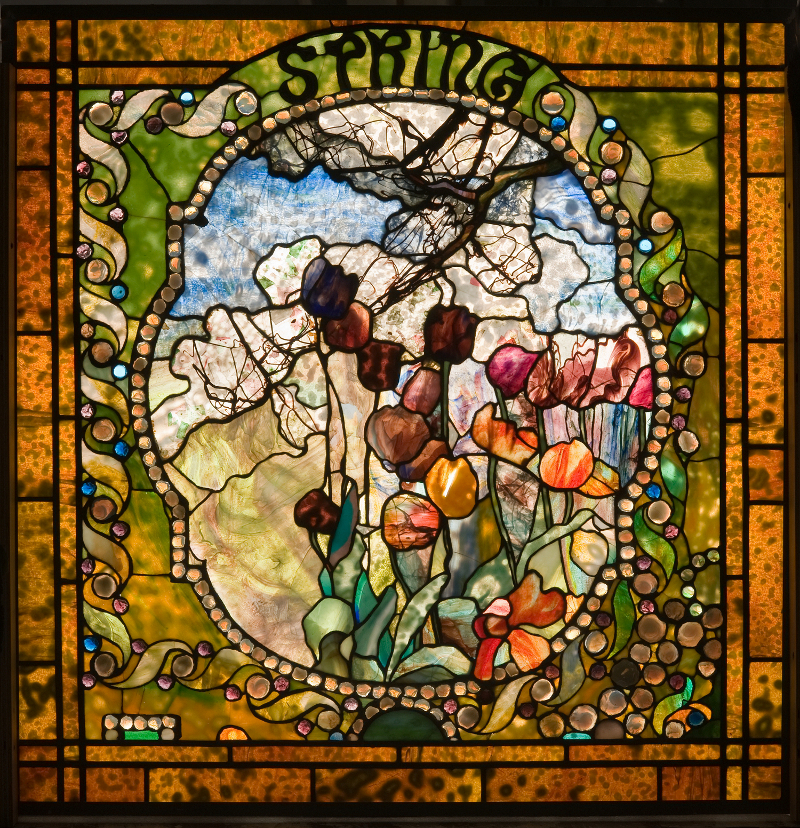
The Tiffany collection is staggering in both breadth and intimacy. Beyond the famous leaded glass windows, the museum holds jewelry, lamps, pottery, paintings, and decorative objects spanning Tiffany's entire career. The chapel from the 1893 World's Columbian Exposition, with its iridescent glass mosaics and elaborate altar, stands as the centerpiece -- a complete interior environment demonstrating Tiffany's belief that art should surround and uplift daily life. The leaded glass windows represent some of his finest work, capturing landscapes, religious scenes, and abstract patterns in thousands of pieces of hand-selected glass, each chosen for its color, texture, and ability to transform natural light into something almost liquid. These are not reproductions or fragments. They are the original works, pulled from a burning estate and painstakingly conserved, each pane still bending light the way Tiffany intended over a century ago.
Beyond the Glass
While Tiffany dominates the museum's identity, the collection reaches far wider. Leaded glass windows by William Morris, Louis Sullivan, Frank Lloyd Wright, John LaFarge, and Arthur J. Nash hang alongside Tiffany's work, offering a survey of the medium's finest practitioners. The decorative arts holdings include jewelry and silver by Rene Lalique and Peter Carl Faberge, furniture by Emile Galle, Louis Majorelle, and Gustav Stickley. Over 800 pieces of 19th-century American art pottery fill the galleries, including approximately 300 Rookwood pieces. The painting collection spans the American tradition from Samuel F.B. Morse -- a relative of Charles Hosmer Morse -- through George Inness, John Singer Sargent, Rembrandt Peale, Martin Johnson Heade, and Thomas Hart Benton. Sculptures by Daniel Chester French, the artist who carved the Lincoln Memorial, and Hiram Powers add another dimension. Prints by Mary Cassatt, Edward Hopper, and Grant Wood round out a collection that, taken together, offers a panoramic view of American artistic ambition from the 19th century through the early 20th.
A Quiet Treasure on Park Avenue
Winter Park is a town of oak-lined streets and Mediterranean-revival architecture just north of Orlando, a place where the pace is deliberately slower than the theme park corridor a few miles south. The Morse Museum fits this setting perfectly. It is not a blockbuster institution; it does not aim for the scale of the Met or the spectacle of a Disney attraction. What it offers instead is depth -- the chance to stand before a single Tiffany window for as long as you like and watch the Florida sunlight animate glass that was fired in a New York studio over a hundred years ago. The museum exists because two people saw ruins and imagined restoration, because a granddaughter wanted to honor a grandfather, and because a young art student remembered the beauty of a place he had visited decades before it burned. That chain of memory and devotion is as much a part of the collection as any object behind glass.
From the Air
Located at 28.60N, 81.35W in Winter Park, Florida, just north of downtown Orlando. The museum sits on East Welborne Avenue near the intersection with Park Avenue, Winter Park's main commercial street. Rollins College campus is visible nearby to the south, with its distinctive Spanish Mediterranean architecture along Lake Virginia. Recommended viewing altitude 2,000-3,000 feet AGL. Nearby airports: Orlando Executive Airport (KORL) approximately 5nm south, Orlando International Airport (KMCO) approximately 14nm southeast. Interstate 4 runs approximately 2nm to the west.