Charlesfort-Santa Elena Site
Twenty-eight men, abandoned by their commander on a marshy island in the South Carolina Lowcountry, grew so desperate they killed and ate one of their own on the open Atlantic. That was 1563, and the place was Charlesfort on present-day Parris Island. The story of what happened here -- and what came after -- reads like a fever dream of colonial ambition: French Huguenots, Spanish conquistadors, mutiny, cannibalism, hangings, and a succession of forts built one on top of the other like geological strata. Today the site sits quietly within the perimeter of Marine Corps Recruit Depot Parris Island, its archaeological remains remarkably preserved because the ground was never plowed for agriculture. In 2001, it was designated a National Historic Landmark, recognizing it as one of the most important early colonial sites in North America.
The Huguenot Gamble
In May 1562, Admiral Gaspard de Coligny -- the Huguenot leader seeking a refuge from religious persecution in France -- sent the Norman navigator Jean Ribault across the Atlantic to claim a foothold on the New World's southeastern coast. Ribault sailed into Port Royal Sound, declared the land for France, and left twenty-eight men on the island to build Charlesfort. Then he sailed home for supplies. He never came back. The French Wars of Religion erupted, Ribault was arrested in England, and the garrison was left to fend for itself. Their supplies burned, their captain died in a mutiny provoked by his harsh discipline, and relations with the local Native Americans deteriorated. All but one man built a crude boat and set sail for Europe without a compass. During that desperate crossing, a crewman named La Chere was killed and eaten by his starving companions. English sailors eventually rescued the survivors in the waters off Europe.
Empire Upon Empire
Shortly after the French abandoned Charlesfort, a Spanish force from Cuba under Hernando de Manrique de Rojas arrived and destroyed what remained. In 1566, Pedro Menendez de Aviles founded Santa Elena directly on the site of the old French fort, making it the first capital of Spanish Florida. Fort San Salvador went up first, a simple blockhouse, and then Fort San Felipe was constructed right on top of the old Charlesfort foundations, with a new moat dug where the French one had been filled. Fire destroyed the fort in 1570. The Spanish rebuilt, abandoned, returned, and rebuilt again. Fort San Marcos rose in 1577. A second Fort San Marcos followed by 1583. When word came that Sir Francis Drake was raiding St. Augustine in 1586, the Spanish dug a moat around their latest fortification in anticipation of attack. By 1587, they had abandoned Santa Elena for good. At its peak, the town had held about sixty dwellings and an estimated 400 to 450 inhabitants.
The French Return -- and Perish
The Spanish were not the only ones to come back. In January 1577, during a gap when the Spanish settlement lay in ruins, a French ship called Le Prince sailed into Port Royal Sound under the command of Nicholas Strozzi. The vessel was lost entering the sound, and the stranded crew built a triangular fort, 130 feet on each side, enclosing five buildings. It was a futile effort. Many were killed by Native Americans, and the rest were taken captive. When the Spanish returned in 1578, they obtained the French prisoners from the Native Americans over the following two years and hanged nearly all of them. The cycle of claim and counterclaim, construction and destruction, had come full circle.
Layers Beneath the Surface
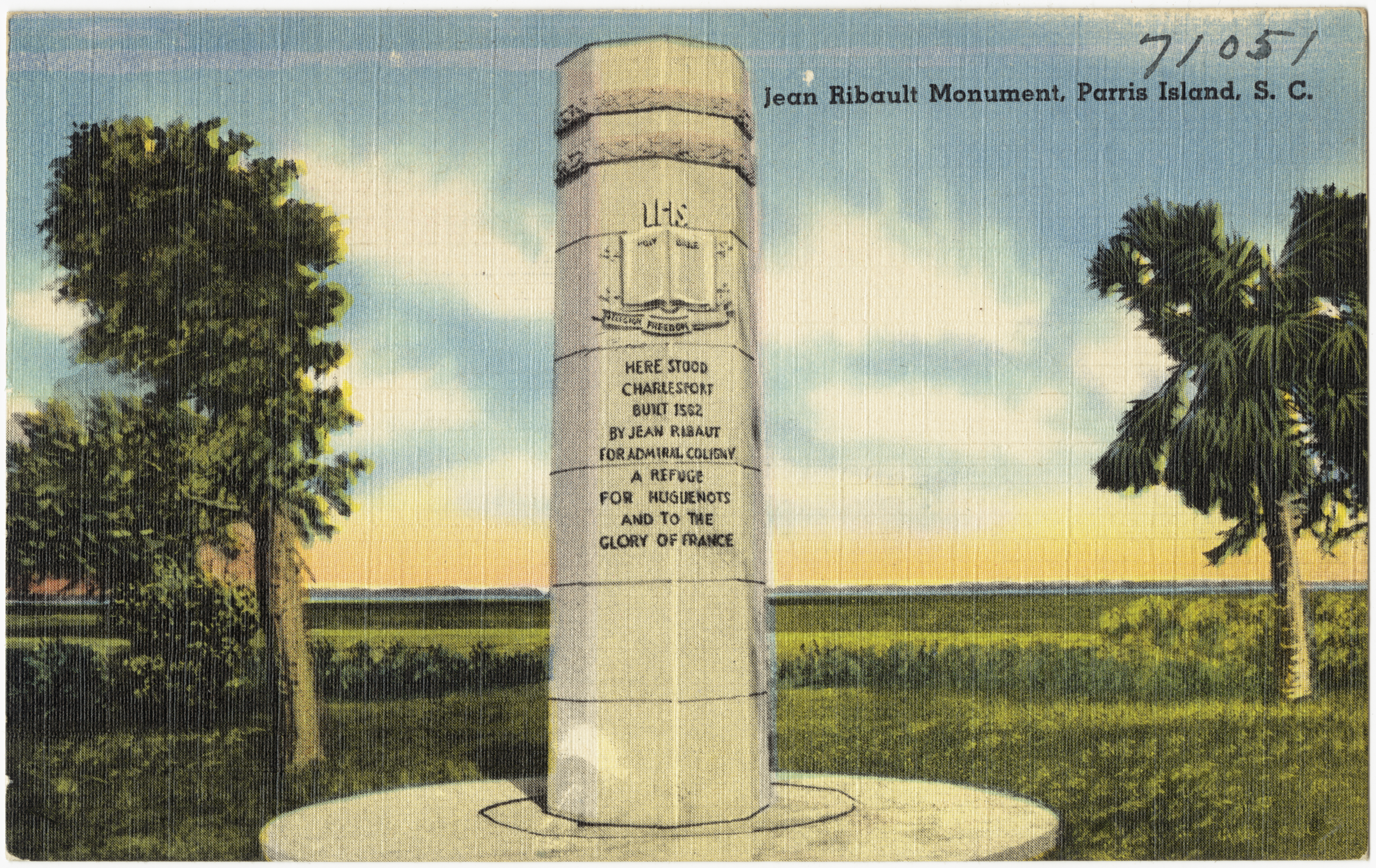
Amateur archaeologists first noticed the site's importance in the mid-19th century, pulling large hinges from the earth that suggested a fortified gate. In the 1920s, Major George Osterhout led an excavation and concluded he had found Charlesfort. A memorial marker went up. But by the 1950s, scholarly consensus had shifted: the ruins were Spanish Santa Elena. It took a series of excavations stretching from the 1970s through the 1990s to untangle the full picture. Distinctively French artifacts in a restricted area, combined with evidence of multiple moats dug around the first Fort San Marcos, finally revealed the layered truth. Finds include the only known early Spanish pottery kiln on the North American continent. Because the site was never developed for agriculture, artifacts continue to surface even at ground level -- a living archaeological record of the fierce European contest for control of the southeastern coast.
From the Air
Located at 32.306N, 80.676W on Parris Island within Port Royal Sound. The archaeological site sits within MCRD Parris Island, visible as a low island surrounded by marshland and tidal creeks. Best viewed at 2,000-3,000 feet AGL. Nearest airports: KNBC (Beaufort County Airport, 8nm NE), KSAV (Savannah/Hilton Head Intl, 30nm SW). The island's causeway connection to the mainland is a distinctive visual feature. Look for the geometric layout of the Marine base among the irregular coastal marshes.