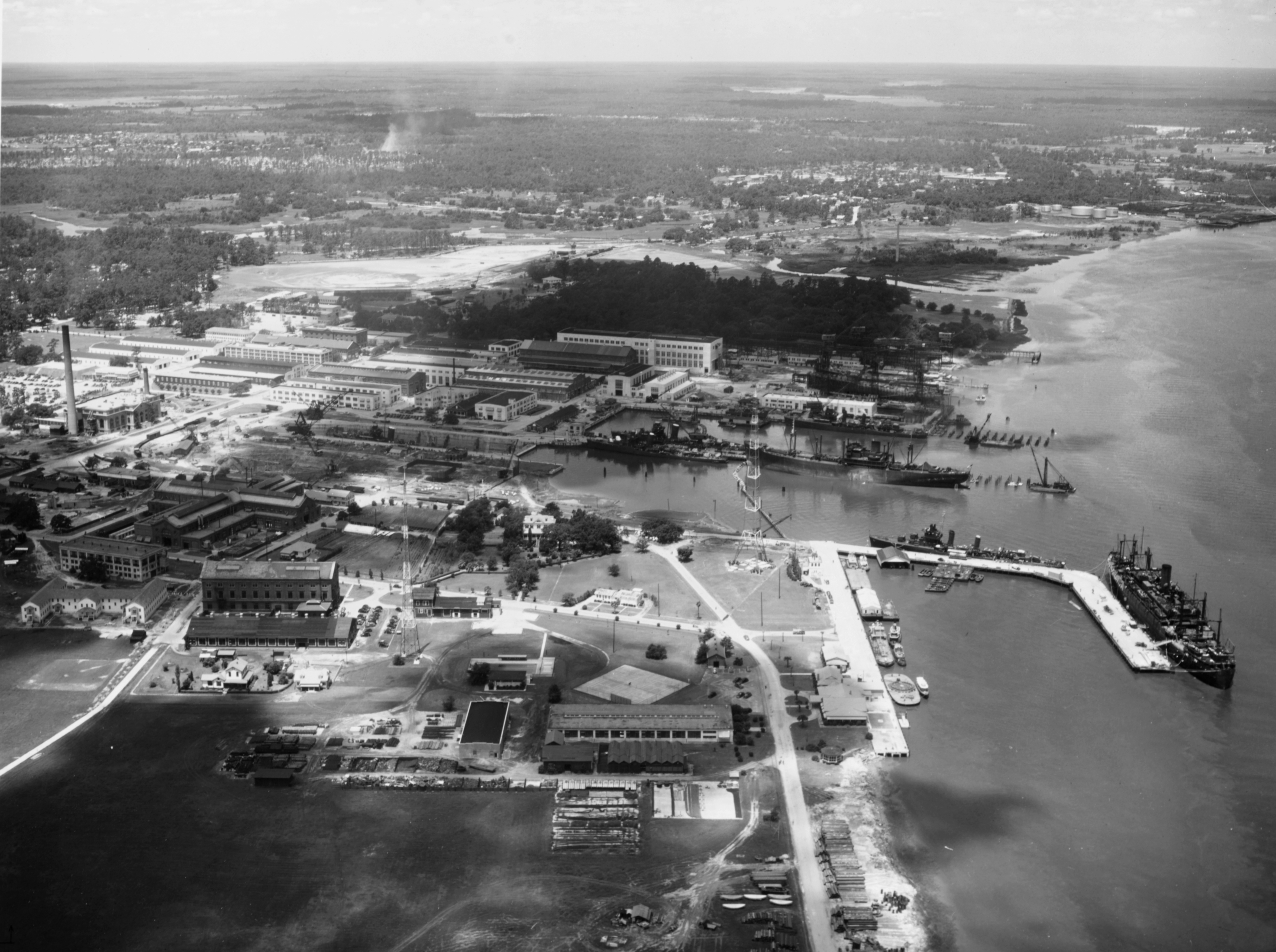
Charleston Naval Shipyard
At its peak in July 1943, 25,948 workers crowded the west bank of the Cooper River, welding steel hulls and fitting out warships at a pace that would have seemed impossible just a few years earlier. The Charleston Naval Shipyard -- originally called the Charleston Navy Yard -- opened in 1901 as a modest drydock in North Charleston, South Carolina. Over the next ninety-five years it would build destroyers, repair captured German U-boats, refuel nuclear submarines, and serve as a homeport for the U.S. Atlantic Fleet's most formidable vessels. When the gates finally closed in 1996, the yard left behind not just an industrial legacy, but an identity woven into the fabric of the entire Lowcountry.
Steel and Steam on the Cooper
The yard's first product was a destroyer, and by the 1930s the pace of construction was accelerating. A total of 21 destroyers were assembled along these riverbanks, joined by 26 destroyer escorts, 8 landing ship tanks, and a staggering 121 landing ship mediums. Two of the largest vessels ever built here were the destroyer tenders whose keels were laid in November 1944 and July 1945. Beyond the warships, the yard's output was remarkably varied: in 1931, Ellicott Dredges delivered a 20-inch cutter dredge named Orion that remained in service at the old shipyard for decades. The sheer volume of production during World War II transformed North Charleston from a quiet Southern town into a roaring industrial center.
From Surface Ships to Submarine Depths
After the war, the shipyard took on a new role that would define its Cold War identity: submarine overhaul. In April 1948, Secretary of the Navy John L. Sullivan informed Charleston's congressional delegation that the yard would become a dedicated submarine overhaul facility. The first submarine arrived for overhaul that August, and within a year the workforce had stabilized at nearly 5,000. When North Korea invaded South Korea in June 1950, the yard surged back to over 8,000 employees, activating forty-four vessels and converting twenty-seven others for active fleet duty. By the 1960s, the yard was building submarines and missiles, and in 1966 it completed the first-ever refueling of a nuclear submarine -- a milestone that cemented Charleston's place in the atomic age of naval warfare.
A Cold War Homeport
Throughout the decades of superpower tension, the Charleston Naval Shipyard served as homeport to a formidable roster of Atlantic Fleet warships: cruisers, destroyers, attack submarines, Fleet Ballistic Missile submarines, and the tenders that kept them operational. Captain Blake Wayne Van Leer led the expansion of Dry Dock No. 2 so it could accommodate the massive FBM submarines and destroyers fitted with sonar. The Atlantic Reserve Fleet opened on-site in 1946, mothballing surplus ships from World War II; many were reactivated for Korea, and some again for Vietnam. The yard was more than a repair facility -- it was a strategic anchor of American sea power on the East Coast.
The Gates Close, the Story Continues
The end of the Cold War brought the 1993 Base Realignment and Closure Commission, and the Charleston Naval Shipyard was among its casualties. Operations ceased in 1996 after ninety-five years of continuous service. But closure was not the end. Detyens Shipyards signed a long-term lease, inheriting three dry docks, one floating dock, and six piers to become the largest commercial shipyard on the East Coast. Much of the former base was transformed into a multiuse federal complex supporting Joint Base Charleston, with seventeen government and military tenants. Coast Guard National Security Cutters, NOAA research ships, and Military Sealift Command vessels now berth where wartime destroyers once took shape.
Reinvention and Remembrance
A 350-acre section was slated for redevelopment as a mixed-use urban hub called The Navy Yard at Noisette, but the developer went into foreclosure in 2010. Palmetto Railways eventually purchased the property, planning freight rail service to a new container port under construction at the former base's southern end. In February 2020, Coast Guard Admiral Karl Schultz announced plans for a consolidated Coast Guard "super base" in North Charleston, with construction beginning in 2024. Meanwhile, the Naval Hospital Historic District -- added to the National Trust for Historic Preservation's 11 Most Endangered Places list in 2016 -- stands as a reminder that even in reinvention, the past demands respect. The old shipyard continues to evolve, its story far from over.
From the Air
Located at 32.86N, 79.97W along the west bank of the Cooper River in North Charleston, SC. The former shipyard's dry docks and pier infrastructure are visible from moderate altitudes. Look for the distinctive waterfront industrial layout just north of downtown Charleston. Nearest airport: Charleston International / Joint Base Charleston (KCHS), approximately 3 nm northwest. Charleston Executive Airport (KJZI) lies about 12 nm to the southwest. Best viewed at 2,000-4,000 ft AGL on approach from the east over the Cooper River.