Charleston Sofa Super Store Fire
The first call came in at 7:08 p.m. on a Monday evening in June. Within three minutes, Charleston firefighters were on scene at the Sofa Super Store, a single-story furniture showroom and warehouse at 1807 Savannah Highway. What they found looked manageable -- a fire in the covered loading dock between two buildings. Thirty-three minutes later, nine of them were dead. The Charleston Sofa Super Store fire of June 18, 2007, became the deadliest single loss of firefighters in the United States since 343 perished in the collapse of the World Trade Center on September 11, 2001.
Thirty-Three Minutes
Crews entering the showroom at first encountered clear air, with only faint wisps of smoke curling near the ceiling at the back of the space. Then an exterior door near the fire was opened and could not be closed, feeding oxygen to the flames. Firefighters stretched hose lines into the showroom, but one pre-connected line was too short, forcing crews back outside to add sections of hose. A 9-1-1 call came in from a warehouse employee trapped inside, pulling firefighters in another direction. They breached an exterior wall to reach him, saving his life. But the fire was spreading faster than the few operating hose lines could control. At 7:41 p.m., the showroom experienced a flashover -- a sudden, catastrophic ignition of everything in the room. At least sixteen firefighters were inside. Minutes later, the roof collapsed.
What Went Wrong
The building had no fire sprinkler system. The Sofa Super Store sat on Savannah Highway, a major commuter artery, and for critical minutes car traffic continued unimpeded, vehicles driving over water supply hoses and cutting off pressure to the firefighters inside. Investigators from the ATF, NIOSH, NIST, and local agencies would spend months reconstructing what happened. The full report, published in 2008, identified a cascade of contributing factors. The most prominent finding: "failure to manage the incident according to accepted practices." Fire experts questioned the use of undersized booster lines, the breaking of exterior windows while crews were committed inside, and the absence of a pre-fire plan that noted the building's steel truss roof construction -- a known hazard that can mask a growing fire and collapse without warning.
The Charleston Nine
The nine firefighters who died that evening came from three different fire stations. According to Charleston County Coroner Rae Wooten, they died from a combination of smoke inhalation and burns, not from injuries sustained in the collapse itself. The tragedy was also the deadliest fire in South Carolina since a Lancaster County jail fire killed eleven people in 1979. Fire Chief Rusty Thomas initially blocked federal investigators from interviewing his firefighters, relenting only after the head of NIOSH wrote asking him to reconsider and Mayor Joe Riley intervened. Under sustained criticism over the department's handling of the fire, Chief Thomas retired roughly a year later, on June 27, 2008.
A City Mourns
On June 22, 2007, a procession of more than 300 fire engines, ladder trucks, ambulances, and command vehicles wound through Charleston, passing each of the three fire stations that lost members and the site of the fire itself, then proceeding along Interstate 526 to the North Charleston Coliseum. An estimated 30,000 people attended the memorial service, including 8,000 firefighters representing over 700 emergency services agencies from across the country. Funds established for the families raised nearly $1.2 million. Sofa Super Store owner Herb Goldstein created the Charleston Nine Scholarship Endowment with a $100,000 donation to support college tuition for first responders and their dependents. Captain Louis Mulkey had been an assistant basketball coach at Summerville High School; the team placed a memorial fire helmet on their bench for every game that season and went on to win the school's first-ever state championship.
Sacred Ground
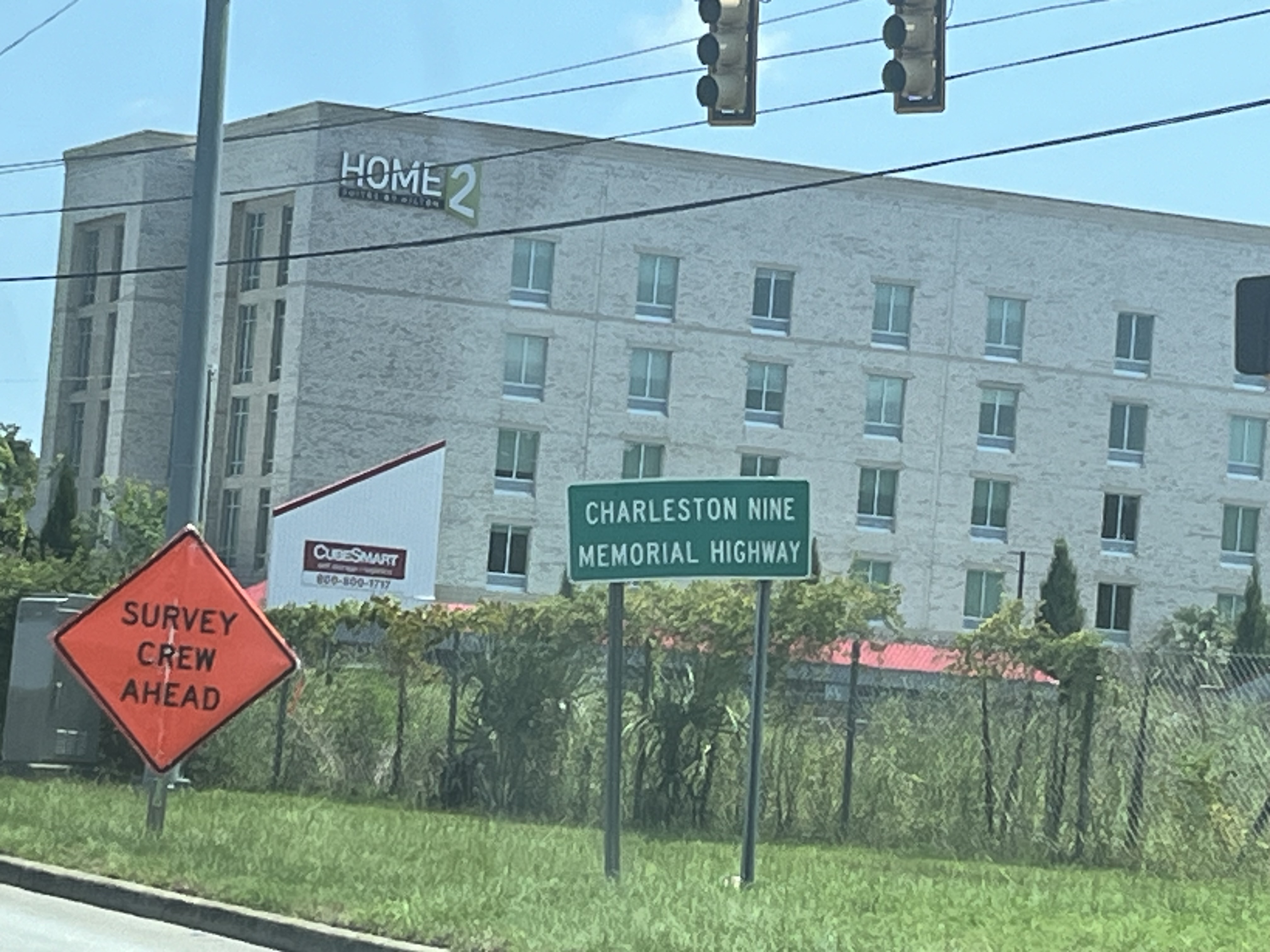
Mayor Riley reached an agreement with Goldstein to transform the fire site into a memorial park as large as the former store, directly opposite a nearby fire station. Plaques honor each fallen firefighter, placed where they fell. In March 2008, South Carolina lawmakers approved naming a 3.6-mile stretch of U.S. Route 17 the "Charleston Nine Memorial Highway," running from S.C. Highway 171 to Sam Rittenberg Boulevard and encompassing the site. A six-person expert panel convened by the city produced sweeping recommendations that reshaped the Charleston Fire Department: minimum staffing levels, mandatory incident command training, standardized hose sizes, and dedicated safety officers on every scene. Memorials are held annually on the anniversary of the fire. The reforms that followed are the Charleston Nine's lasting legacy -- lessons paid for at the highest cost.
From the Air
Located at 32.79N, 80.02W on Savannah Highway (US-17) in the West Ashley area of Charleston, SC. The memorial park occupies the former store site along the highway, visible from low altitude as a green space among commercial development. Nearest airport: Charleston International / Joint Base Charleston (KCHS), approximately 8 nm to the north-northeast. Charleston Executive Airport (KJZI) is about 5 nm south. The stretch of US-17 designated as Charleston Nine Memorial Highway runs 3.6 miles through this area. Best viewed at 1,500-3,000 ft AGL.