Charlottesville, Virginia
Three of the first five American presidents chose to live within a few miles of each other in the rolling Piedmont foothills below the Blue Ridge. Thomas Jefferson, James Madison, and James Monroe all made their homes in and around what became Charlottesville, and Jefferson went further, designing a university here that he considered his greatest achievement -- ranking it above the Declaration of Independence on his own tombstone. That concentration of early American ambition left a permanent mark. Charlottesville is a city of roughly 43,000 people that punches far above its weight in culture, education, and the complicated business of reckoning with history.
Mr. Jefferson's Village
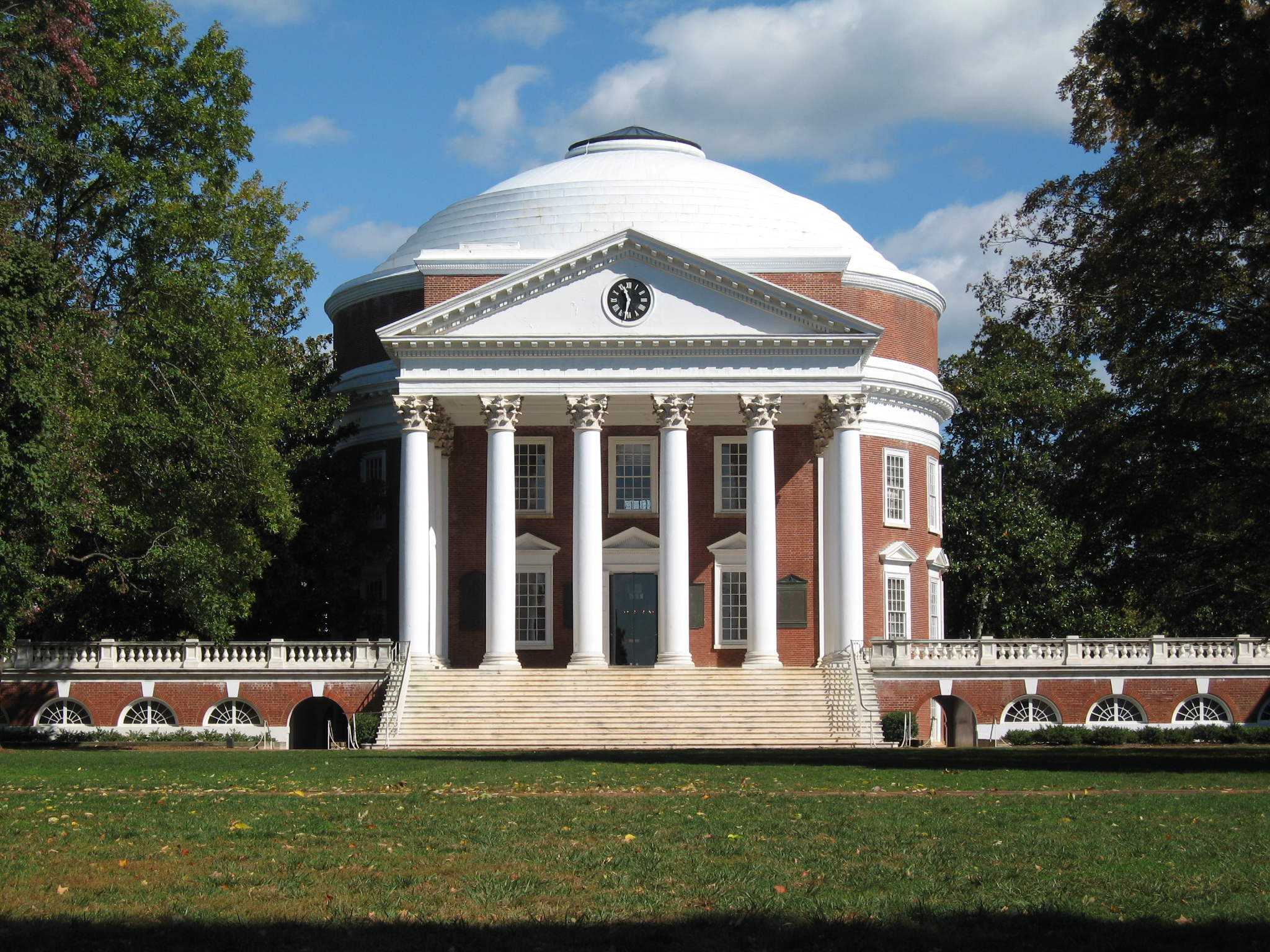
Founded in 1762, Charlottesville began as the seat of Albemarle County in Virginia's central Piedmont. The town grew slowly, a courthouse village serving the surrounding plantations. Jefferson's Monticello sits on a hilltop just south of downtown, and Monroe's Highland lies down the road from it. Madison's Montpelier is a short ride northeast. But Jefferson's most lasting contribution to the town was not residential. The University of Virginia, which opened in 1825, was designed from scratch by Jefferson himself. The Rotunda, modeled on the Pantheon in Rome, crowns the Lawn -- an elegant esplanade lined with colonnaded pavilions and dormitory rooms still reserved for distinguished students. The university now enrolls over 20,000 students and is consistently ranked among the top public universities in the country, a so-called "Public Ivy" that has shaped Charlottesville's identity as a college town for two centuries.
Where the Trains Crossed
Charlottesville became a railroad junction in the 1850s when the Chesapeake and Ohio Railway's east-west line crossed the Southern Railway's north-south tracks. The depot at that crossing was called Union Station, and it transformed the town. A major repair shop generated competition between the two rail companies and bolstered the local economy. The Queen Charlotte Hotel went up on West Main Street to serve the new railroad workers. Electric streetcars followed in the 1880s, organized as the Charlottesville and Albemarle Railway by 1903 and running until 1935. Today Amtrak still stops at the refurbished Union Station on West Main Street, where three routes converge: the Cardinal running between Chicago and New York, the Crescent connecting New York and New Orleans, and Northeast Regional trains linking Boston to Roanoke. Interstate 64 now carries the bulk of traffic, connecting east to Richmond and west to Staunton, but the city's bones were laid by rail.
A Walking Downtown
Charlottesville's Downtown Mall is one of the longest outdoor pedestrian malls in the nation, a brick-paved corridor of restaurants, theaters, shops, and civic buildings. The restored Paramount Theater hosts Broadway shows and concerts. The Ting Pavilion, a 3,500-seat outdoor amphitheater, draws summer crowds. Court Square, a few blocks away, is the city's original center, with buildings dating to the 1762 founding. Just west of downtown, The Corner lines University Avenue with college bars, bookshops, and eateries that fill with students during football season and empty out for summer. The city launched the Dave Matthews Band, hosts the Virginia Film Festival each October, and holds a naturalization ceremony at Monticello every Fourth of July. Wine and beer tours fan out into the surrounding countryside, where the Piedmont's climate supports a growing number of vineyards along gently sloping hillsides.
Under the Blue Ridge
The western horizon belongs to the Blue Ridge Mountains. Shenandoah National Park begins just west of the city, and the junction of Skyline Drive and the Blue Ridge Parkway lies within easy reach of downtown. Skyline Drive runs the length of Shenandoah, alternating between thick forest canopy and sweeping overlooks above the Shenandoah Valley. The Blue Ridge Parkway continues south for 469 miles to Great Smoky Mountains National Park in North Carolina. For hikers, cyclists, and pilots alike, this convergence of mountain scenery with a lively university town creates a rare combination. The Leander McCormick Observatory and the headquarters of the National Radio Astronomy Observatory add a scientific dimension: Charlottesville is a place where people study the stars as seriously as they study Jefferson.
Cavalier Country
With no professional sports teams, Charlottesville channels its athletic energy through the University of Virginia Cavaliers. The men's basketball team won the NCAA championship in 2019 at the 14,593-seat John Paul Jones Arena. The men's lacrosse program has claimed seven national titles since 1972. The soccer team won an unprecedented four consecutive NCAA championships from 1991 to 1994 under coach Bruce Arena, who later led the U.S. national team. Scott Stadium hosts football games and has doubled as a concert venue for the Rolling Stones, U2, and the hometown Dave Matthews Band. High school lacrosse thrives across the region, and the Charlottesville Tom Sox play summer collegiate baseball. Sports here carry the intensity of a place where the university is not just an institution but the heartbeat of the city.
From the Air
Charlottesville sits at 38.03N, 78.48W in Virginia's central Piedmont, nestled between the Blue Ridge Mountains to the west and the gently rolling farmland to the east. Charlottesville-Albemarle Airport (KCHO) has a 6,001-foot paved runway at 639 feet MSL, serving commercial and general aviation. The University of Virginia campus and Downtown Mall are visible from altitude as a compact urban area against green surroundings. Monticello's hilltop is identifiable just south of the city. The Blue Ridge and Shenandoah National Park dominate the western skyline. Interstate 64 cuts east-west through the area. Nearby airports include Shenandoah Valley Regional Airport (KSHD) to the west and Louisa County/Freeman Field (KLKU) to the east.