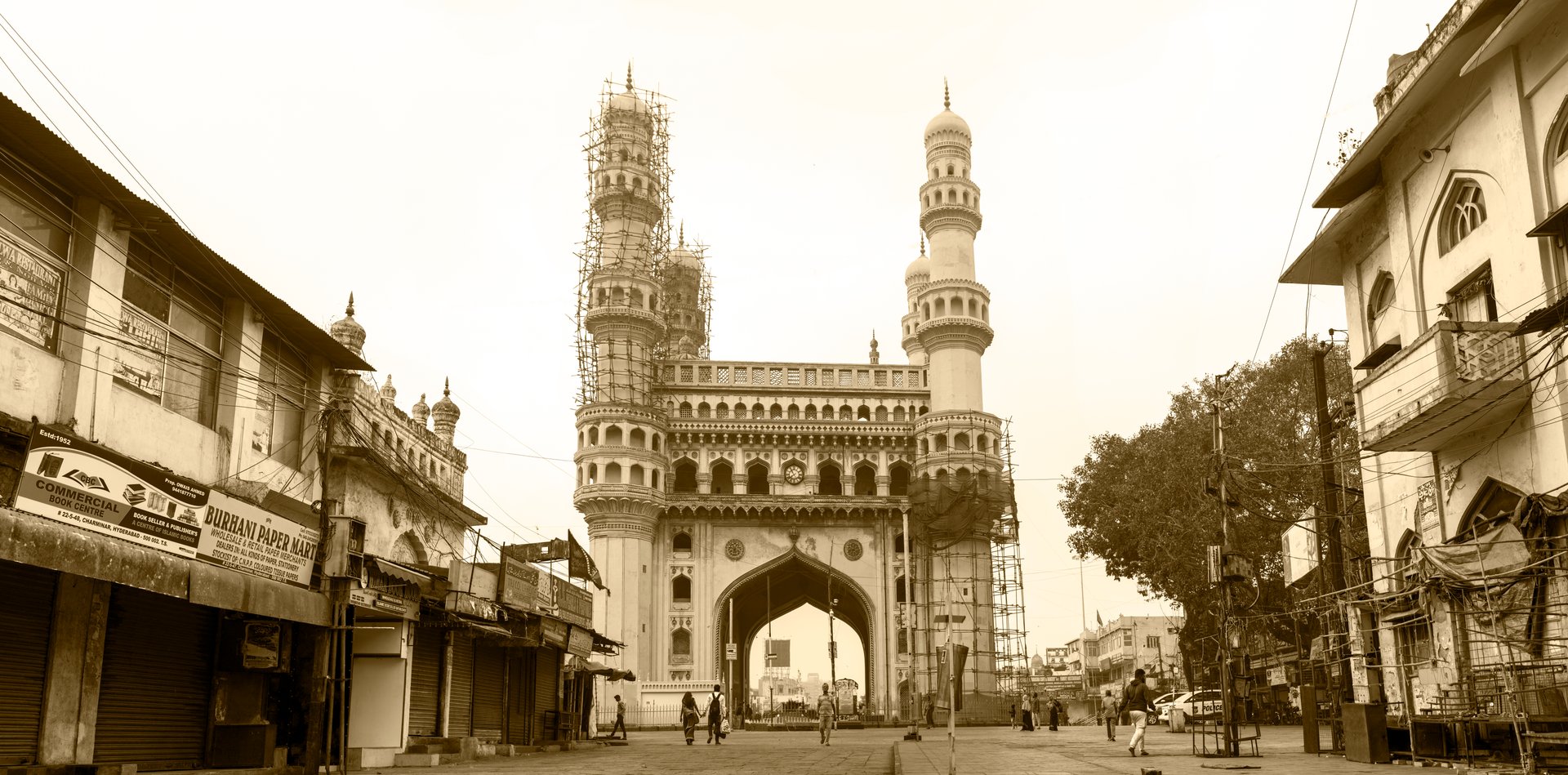
Charminar
When Muhammad Quli Qutb Shah laid the foundation of the Charminar in 1589, he spoke his prayers in Dakhini couplets -- a form of Urdu inflected by the languages of the Deccan. It was a fitting choice. The monument he was building would itself become a hybrid: a mosque that is also a madrasa, a triumphal arch that is also a city's geographic center, an emblem of Islamic faith that blends Persian architectural principles with Indian craftsmanship. The name means simply "four minarets" -- char for four, minar for tower -- but simplicity of name belies complexity of purpose. Completed in 1591 at the intersection of the city's main trade routes, the Charminar was designed so that standing beneath any of its four grand arches, you could see all four cardinal quarters of the new city of Hyderabad radiating outward. It was both monument and map.
A City Born from Plague and Prophecy
Why build it? The Archaeological Survey of India records multiple theories, but the most widely accepted holds that the Charminar commemorated the end of a devastating plague that had swept through the region. Muhammad Quli Qutb Shah, the fifth ruler of the Qutb Shahi dynasty, had recently shifted his capital from the fortress of Golconda to the newly planned city of Hyderabad, and the Charminar marked both a spiritual thanksgiving and an urban declaration. A separate tradition, recorded by the seventeenth-century French traveler Jean de Thevenot and supported by Persian texts, claims the monument was built to celebrate the beginning of Islam's second millennium -- the year 1000 AH, an event observed across the Islamic world. Perhaps both are true. Construction took two years and cost nine lakh rupees, or roughly 200,000 gold coins. Upon completion, the Charminar was the tallest structure in Hyderabad, weighing an estimated 14,000 tonnes on foundations at least thirty feet deep.
Granite, Limestone, and Four Grand Arches
The structure is made of granite, limestone, mortar, and pulverized marble. Four grand arches face the cardinal directions, each originally aligned with one of the city's busiest ancestral streets. Above the arches, four ornate minarets rise -- not freestanding towers but integral elements supported by the arch structure itself. A mosque occupies the western end of the top floor, the only part of the four-story building dedicated exclusively to worship. The remaining rooftop space served as a royal court during the Qutb Shahi era. Inside, a vault that reads as a dome from below supports two galleries stacked one above the other, and above those sits a terrace bordered by a stone balcony. The main prayer gallery contains 45 covered prayer spaces with open ground in front for Friday congregations. Clocks on all four faces were added in 1889. In 1670, lightning struck and toppled one minaret; it was repaired at a cost of 58,000 rupees. Sikandar Jah renovated portions again in 1820.
The Bazaar at the Monument's Feet
The Charminar has never been an isolated monument. From the beginning, the markets pressed close. Laad Bazaar wraps around the western side, famous for its bangles -- lac bangles in particular, stacked in glass cases that catch the light. Pathargatti boulevard, nearby, is the pearl traders' street. In its heyday, the Charminar market held some 14,000 shops. The poet Sarojini Naidu, who would become a leader of India's independence movement, immortalized these lanes in her poem "In the Bazaars of Hyderabad," cataloguing the sellers of turbans, mirrors, and perfumes. To the southwest stands the Makkah Masjid, one of India's largest mosques, its central arch built with bricks made from soil brought from Mecca itself. The Char Kaman -- four ceremonial gateways built alongside the Charminar in the sixteenth century -- frame the surrounding streets, though they now stand in need of restoration.
Icon, Emblem, and Living Monument
The Charminar's silhouette appears on the emblem of Telangana state, alongside the Kakatiya Kala Thoranam. It appeared on coins and banknotes of the now-defunct Hyderabadi Rupee during the era of the princely state. An express train running between Hyderabad and Chennai bears its name. In Karachi, Hyderabadi Muslims built a small replica at a neighborhood crossing in 2007 -- homage across borders to a monument that anchors a community's identity. For the millions who visit each year, the Charminar is both artifact and anchor: a sixteenth-century structure around which the life of a twenty-first-century city still orbits. The mosque on its top floor has held prayers continuously for more than four centuries. Festivals -- Eid-ul-Adha, Eid al-Fitr -- still fill the streets below with crowds drawn as much by the monument's presence as by the adjacent Makkah Masjid. The Charminar was built as the center of a city. It still is.
From the Air
Located at 17.3616N, 78.4747E on the east bank of the Musi River in the Old City of Hyderabad, Telangana, India. The four minarets and grand arches are distinctive from the air, surrounded by the dense urban fabric of the old city's bazaar streets. Best viewed at 1,500-3,000 feet AGL. The nearby Makkah Masjid, one of India's largest mosques, provides an additional visual reference. Nearest airport: Rajiv Gandhi International Airport (VOHS), approximately 22 km to the south. Golconda Fort is visible approximately 8 km to the west-northwest. The Musi River, running east-west, marks the boundary between the old and new cities.