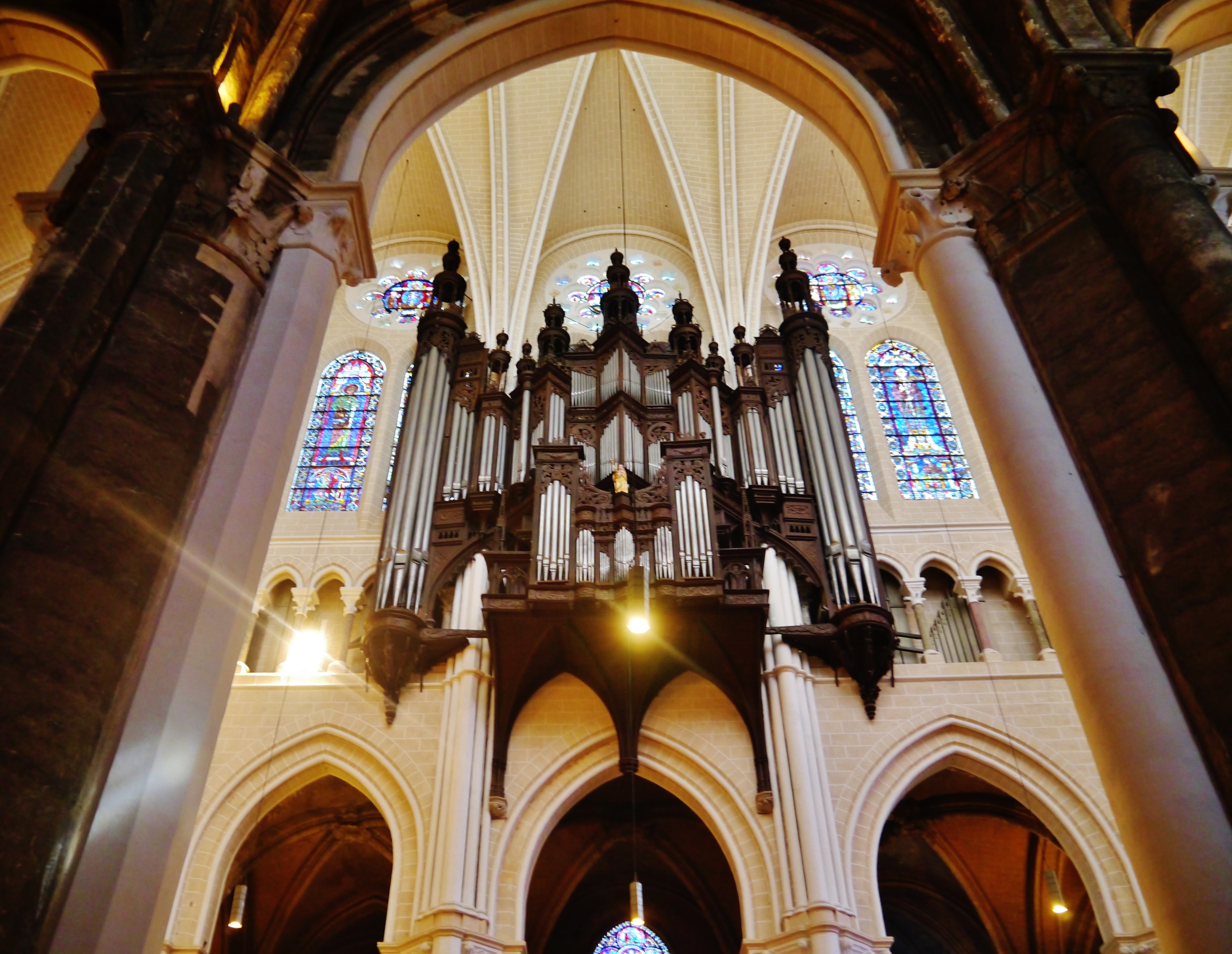
Chartres Cathedral
The password to entering Chartres Cathedral has always been light. Step through the Royal Portal and the outside world drops away, replaced by a darkness so saturated with color it feels liquid. Blue, ruby, emerald, and gold stream through 167 stained glass windows, most of them original to the 13th century, making this the largest and most complete collection of medieval glass anywhere on Earth. Built mostly between 1194 and 1220 on a hilltop above the wheat fields of the Beauce plain, the cathedral was designed not merely as a church but as a theological encyclopedia rendered in stone, glass, and geometry.
Fire and Faith
At least five cathedrals have stood on this spot since the Diocese of Chartres was established in the 4th century. Fire consumed them one after another: in 743, in 858 at the hands of Danish pirates, in 1020, and again in 1134. Each time, the faithful rebuilt. The catastrophe of June 10, 1194, should have ended the cycle. A devastating blaze gutted the Romanesque cathedral, melting lead and cracking stone. But workers discovered the cathedral's most precious relic, the Sancta Camisa, said to be the tunic worn by the Virgin Mary, had survived unharmed in the crypt. The people of Chartres took this as a divine command to build something the flames could never touch. Within 26 years they raised the cathedral that still stands, a building that pioneered the use of flying buttresses to support unprecedented expanses of glass.
Walls of Light
What makes Chartres unique among Gothic cathedrals is not just the quantity of its stained glass but its density. Later cathedrals at Reims and Amiens installed more plain grisaille glass to brighten their interiors. Chartres refused that compromise. The result is an atmosphere unlike any other, dimmer but richer, where the light itself seems to have weight and color. The famous "Chartres blue," a deep cobalt achieved with trace amounts of cobalt oxide, dominates the palette. Three lancet windows above the Royal Portal, dating to around 1145, depict the genealogy, life, and passion of Christ. The great west rose window shows the Last Judgment. The south rose, donated by the Dreux-Bretagne family, shows the 24 Elders of the Apocalypse carrying phials and musical instruments around a central Christ figure, while below, four evangelists sit on the shoulders of four prophets in a rare literal rendering of the idea that the New Testament builds upon the Old.
The Encyclopedia in Stone
If the windows tell stories to those inside, the sculpted portals address everyone who approaches. The Royal Portal on the west facade, completed around 1150, is among the finest surviving examples of Early Gothic sculpture. Its central tympanum depicts Christ enthroned, flanked by the symbols of the four evangelists. The jamb figures, elongated kings and queens of the Old Testament, stand with a serene dignity that influenced sculptors across northern France for generations. The north transept portals, added in the 13th century, celebrate the Virgin Mary with scenes of her Dormition, Assumption, and Coronation. Around and among these sacred figures lurk gargoyles, chimeras, and demons, some purely decorative, others serving the practical function of projecting rainwater away from the walls. The cathedral contains over 4,000 sculpted figures in total, making it one of the richest programs of architectural sculpture in existence.
The Colonel Who Listened
On August 16, 1944, as Allied forces pushed through northern France, American command ordered an artillery strike on Chartres Cathedral, suspecting the Germans were using its towers as an observation post. Colonel Welborn Barton Griffith Jr. refused to fire without confirmation. Accompanied by a single volunteer, he made his way to the cathedral and found it empty. He rang the bells as a signal, and the American command rescinded the order. Griffith was killed in combat later that same day in the nearby town of Leves. France posthumously awarded him the Croix de Guerre and the Légion d'Honneur. The cathedral he saved stands as it has for eight centuries, its windows still throwing colored light across the same stone floor where medieval pilgrims once walked a labyrinth on their knees.
Pilgrimage and Controversy
The labyrinth set into the nave floor, dating to around 1205, remains one of the cathedral's most visited features. Measuring about 12.9 meters in diameter, its winding path stretches over 260 meters, and pilgrims have walked it for centuries as a symbolic journey to Jerusalem. In 2009, the French Ministry of Culture began an 18.5-million-dollar restoration campaign that cleaned the interior masonry and repainted it in creamy white with trompe-l'oeil marbling and gilded details, recreating what researchers believe was the 13th-century appearance. The project divided opinion sharply. Supporters say the cleaned cathedral reveals the original architects' intentions: a bright, luminous space. Critics argue the patina of centuries was itself a form of heritage. What remains beyond dispute is the building's continuing power. Chartres receives pilgrims and tourists alike, drawn by the same quality that has defined the place since the 12th century: light, transformed by human hands into something that feels sacred.
From the Air
Coordinates: 48.448N, 1.488E. The cathedral's twin spires are visible from considerable distance above the flat Beauce plain, making it easy to spot from altitude. Recommended viewing at 3,000-5,000 ft AGL. Nearest airport: Chartres-Champhol (LFOR). Paris Orly (LFPO) is about 80 km to the northeast.