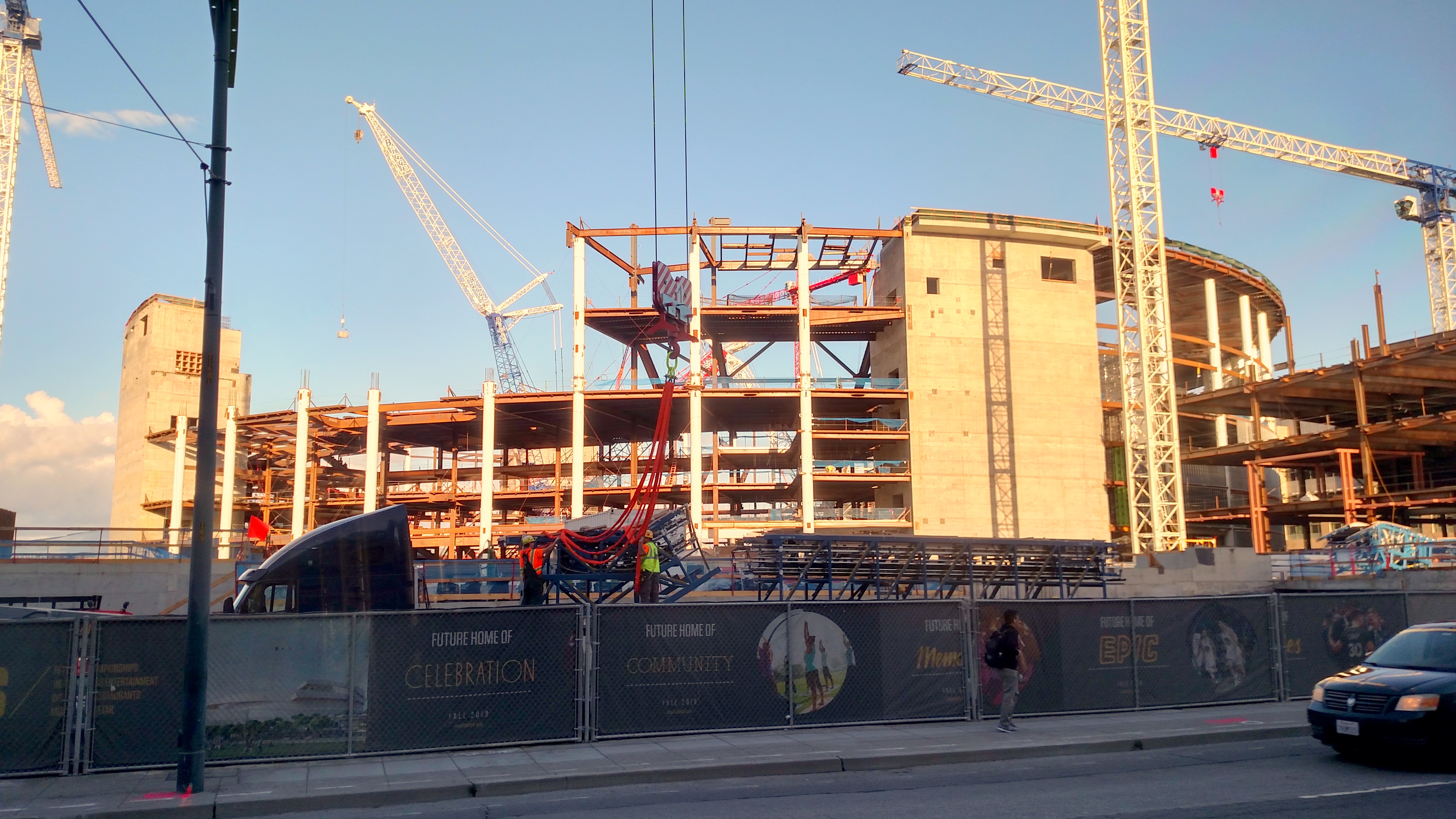
Chase Center
When the Golden State Warriors announced they were leaving Oakland for a new arena in San Francisco's Mission Bay, longtime Oakland residents heard a familiar story: another institution cashing in, another piece of the city's identity crossing the bridge. The Warriors had called Oakland home since 1971 -- first at the Coliseum, then at Oracle Arena -- and their departure symbolized the broader economic forces reshaping the Bay Area. Chase Center opened in 2019, a gleaming 18,064-seat arena on the San Francisco waterfront, and it immediately became both a world-class venue and a lightning rod for the tensions between sports, money, and community.
Mission Bay Rising
Chase Center sits at Third and 16th Streets in Mission Bay, a neighborhood that barely existed as a residential district two decades ago. The arena is composed of multiple layers of seating wrapped around a basketball court, with a surrounding entertainment complex that includes restaurants, retail, and public plazas. The design places the building at the edge of San Francisco Bay, offering views of the water and the East Bay hills that Oakland's Oracle Arena never could. The Warriors sold naming rights to JPMorgan Chase, and the arena became the team's home for the 2019-2020 NBA season. In 2025, it hosted the NBA All-Star Game, confirming its status as one of the premier sports and entertainment venues in North America.
The Oakland Question
The Warriors' move from Oakland to San Francisco was not just a change of address. Many longtime Oakland residents viewed the relocation as a manifestation of gentrification -- the same economic forces that were driving up rents and displacing communities across the East Bay were now taking their basketball team too. Oakland had supported the Warriors through lean decades, cheering in a concrete arena while the team lost year after year. When the championships finally came in 2015, 2017, and 2018, the celebrations belonged to Oakland. The move to San Francisco felt, to many, like the spoils of victory being carried across the bay.
More Than Basketball
Chase Center was designed to function as a full-time entertainment venue, not just a basketball arena. When the Warriors and the Valkyries -- the WNBA expansion team that began play in 2025 -- aren't on the court, the arena hosts concerts, conferences, and corporate events. The University of San Francisco plays basketball games here. The facility's location in Mission Bay, surrounded by biotech offices, UCSF medical campus buildings, and new housing, integrates the arena into the fabric of a neighborhood that is still being written. The surrounding public spaces and waterfront access attempt to make Chase Center feel less like a fortress and more like a community asset.
A Bridge Between Eras
Professional basketball first came to San Francisco in 1962, when the Warriors moved from Philadelphia and played at the old Civic Auditorium and the Cow Palace before crossing the bay to Oakland. Chase Center represents a return that took more than fifty years. The arena's existence raises questions that extend beyond sports: Who benefits when a team moves? What does a community lose when its cultural institutions are portable? The Warriors play in one of the most expensive buildings in NBA history, in one of the most expensive cities in the world, for fans who pay some of the highest ticket prices in professional sports. Whether Chase Center belongs to San Francisco or simply occupies it remains an open question.
From the Air
Located at 37.7678°N, 122.3874°W in San Francisco's Mission Bay neighborhood, at Third and 16th Streets along the waterfront. The arena's distinctive curved roof is clearly visible from the air along the bay shore. Best viewed at 1,500-3,000 feet AGL. Nearest airports: KSFO (8 nm south), KOAK (9 nm east). Look for the large circular structure near the UCSF Mission Bay campus.