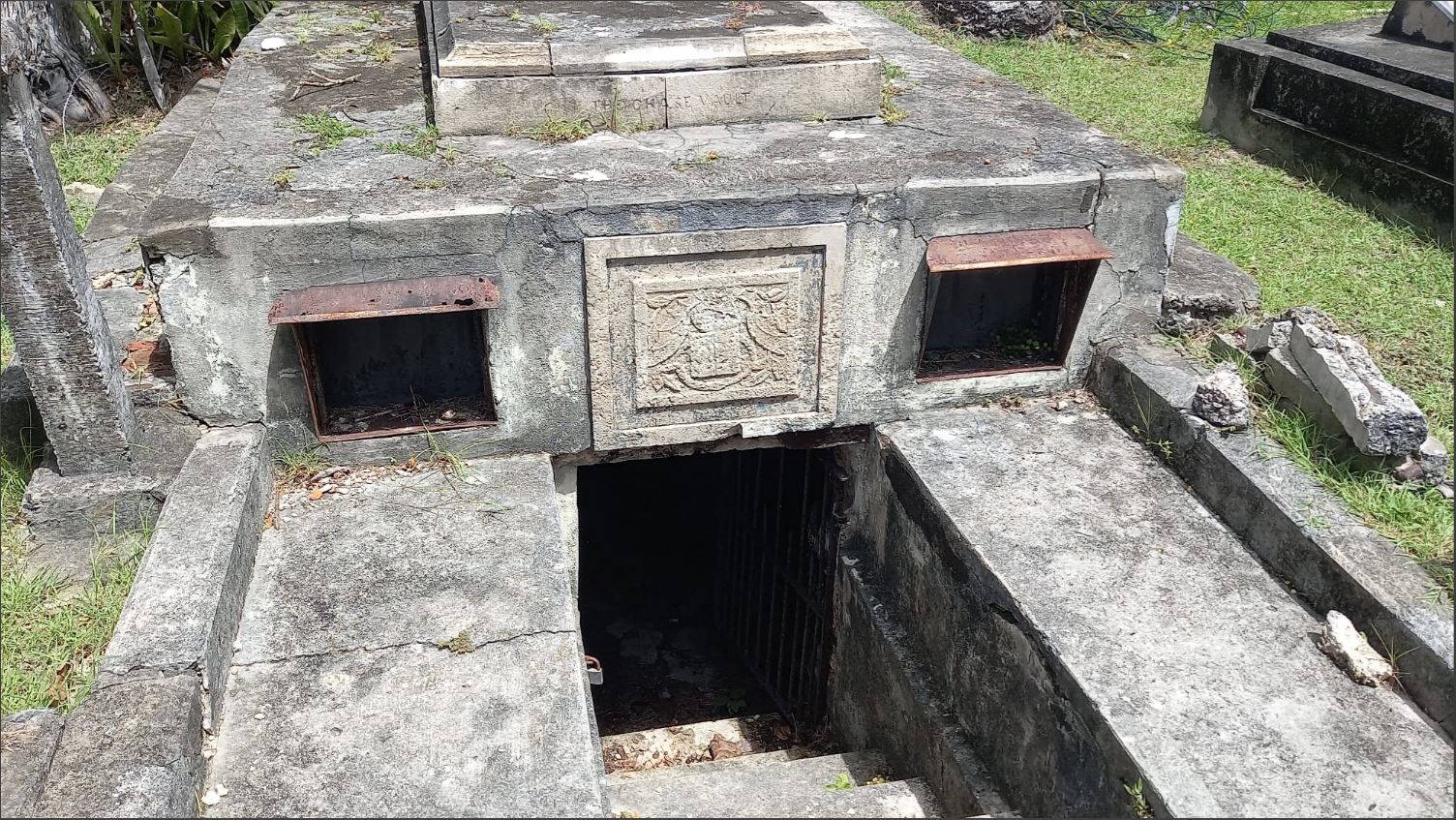
The Chase Vault: Barbados's Coffins That Refused to Stay Put
Every good ghost story needs a locked room. The Chase Vault provides one -- a sealed marble burial chamber beneath the cemetery of Christ Church Parish Church in Oistins, Barbados, where heavy lead coffins allegedly rearranged themselves behind a door that no living person could have opened. The story captivated Victorian society, drew commentary from Arthur Conan Doyle himself, and has been retold in countless variations for over two centuries. There is only one problem: none of it can be verified.
The Legend as Told
The story goes like this. The vault belonged to the Chase family, wealthy planters on the island. Each time it was opened for a new burial -- in 1808, twice in 1812, then in 1816 and 1819 -- the coffins already inside had shifted from their original positions. These were lead coffins, enormously heavy, sealed inside a marble vault with a massive stone door. No signs of flooding or forced entry. No rational explanation. The Governor of Barbados reportedly ordered an investigation, had the vault sealed with his personal seal pressed into cement, and when it was opened again in April 1820, found the coffins once more in disarray and the seals undisturbed. He ordered the bodies reinterred in separate burial plots. The vault has remained sealed and empty ever since.
The Unraveling
The trouble begins when you look for evidence. The folklorist Andrew Lang, investigating the story, could find nothing to substantiate it in the burial register of Christ Church or in contemporary Barbadian newspapers. The sole firsthand account came from a Nathan Lucas, who claimed to have been present at the vault's final opening in 1820 -- but even this account was attributed to Lucas by an unidentified third party rather than written in his own hand. No direct testimony from any self-described eyewitness has ever surfaced. Different published versions of the story, appearing in 1833, 1844, and 1860, contradict one another on significant details. The moving coffins are, as far as documented evidence is concerned, a story about a story about a story.
Freemasons, Conan Doyle, and the Life of Legends
The tale attracted some remarkable attention. Arthur Conan Doyle, creator of Sherlock Holmes and enthusiastic spiritualist, speculated that "animal magnetism" might explain the phenomenon. Skeptical investigator Joe Nickell found a more earthbound explanation. Two men named in the Chase Vault story were members of the Ancient Free and Accepted Masons, and the narrative bears striking resemblance to the Masonic allegory of a "secret vault" -- in Masonic tradition, a place symbolic of death where divine truth awaits discovery. Nickell also discovered that a nearly identical tale of "restless coffins" circulated in 1943, this version explicitly involving a party of Freemasons and a vault containing the founder of Freemasonry in Barbados. Folklorist Benjamin Radford placed the Chase Vault within a broader tradition of moving-coffin legends around the world, some from Barbados itself and predating the Chase case.
What Remains at Christ Church
Christ Church Parish Church still stands in Oistins, on the south coast of Barbados, its cemetery sloping toward the sea. The vault is there, sealed and empty, its stone door shut since 1820. Visitors come looking for the supernatural and find something arguably more interesting: a case study in how stories propagate, mutate, and acquire the weight of truth through repetition. Radford wrote that the people who passed the story along were not hoaxers but simply humans doing what humans do -- retelling a good tale, emphasizing and adding elements according to their beliefs. The Chase Vault may hold no restless dead, but it holds something durable: a legend that has outlived every attempt to either prove or debunk it, still drawing the curious to a quiet churchyard on the Barbadian coast.
From the Air
Located at 13.07°N, 59.54°W at Christ Church Parish Church in Oistins, on the southern coast of Barbados. From the air, Oistins is visible as a fishing town on the island's south coast, with Christ Church's cemetery near the shoreline. Grantley Adams International Airport (TBPB) is approximately 3 miles to the northeast. The southern coastline of Barbados stretches east-west at this point, with the Atlantic to the south. Recommended viewing altitude: 2,000-3,000 feet.