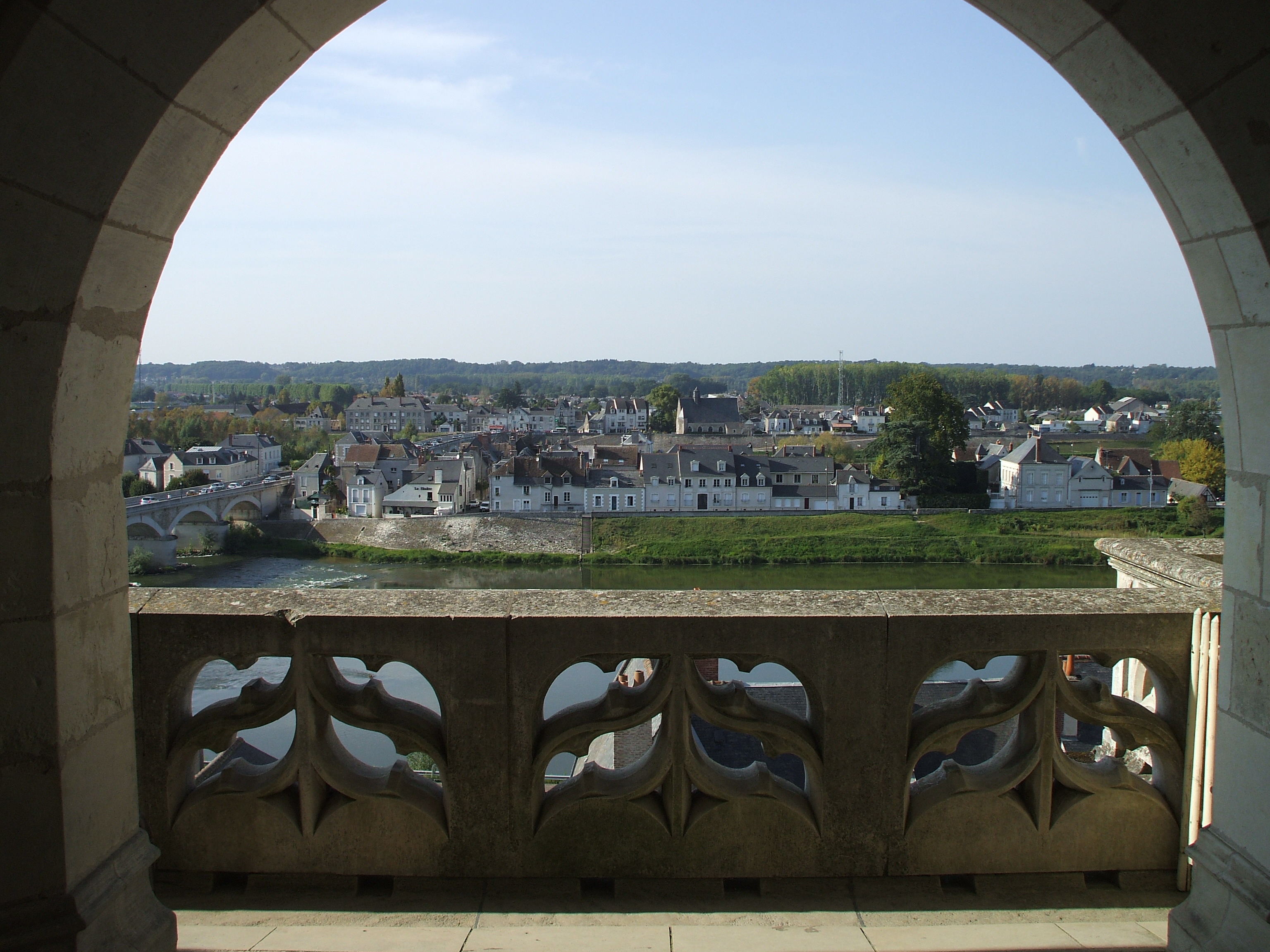
Chateau d'Amboise
King Charles VIII died at the Chateau d'Amboise in 1498 after hitting his head on a door lintel. It is one of the stranger royal deaths in French history, and somehow fitting for a chateau where the extraordinary and the grotesque have always stood side by side. This is the place where Leonardo da Vinci lived out his final years, connected to the chateau by an underground passage from the nearby Clos Luce. It is also the place where, in 1560, some 1,200 Protestants were hanged from the walls, the balconies, and the iron hooks that normally held festive banners, until the stench of corpses forced the court to abandon the town. Amboise contains the full range of French history, from its greatest genius to its most brutal sectarian violence.
Angevin Stronghold on the Loire
The site's strategic value was recognized long before the medieval chateau existed. A Gallic oppidum occupied the spur above the Loire before the Counts of Anjou built their fortress. In the late 9th century, Ingelger married Adelais of Amboise and gained control of the castle, founding a dynasty that would shape the region. His grandson Fulk the Red made Amboise, along with Loches and Villentrois, the core of Angevin territory. By 987, the castle had passed to Fulk Nerra, who had to defend it against the Count of Blois and his allies, who erected rival fortifications at Chaumont and Montsoreau to threaten Amboise's position. The chateau changed hands decisively in 1434, when Charles VII seized it after its owner, Louis d'Amboise, was convicted of plotting against the crown. From that moment, Amboise belonged to the kings of France.
The Renaissance Arrives in France
Once in royal hands, the chateau became a favorite residence from Louis XI through Francis I. Charles VIII began a massive rebuilding program in 1492, first in the French late Gothic Flamboyant style, then after 1495 employing Italian mason-builders Domenico da Cortona and Fra Giocondo, who introduced some of the first Renaissance decorative motifs seen in French architecture. Charles had returned from the Italian War of 1494-1495 besotted with Italian art and culture, and he brought architects, artisans, and the garden designer Pacello da Mercogliano back to France to transform Amboise into what contemporaries called the first Italianate palace in France. His death by doorframe in 1498 cut the project short, but the Renaissance seed he planted would flourish under Francis I, who was raised at Amboise and in 1515 invited Leonardo da Vinci to live nearby at Clos Luce.
Leonardo's Last Home
Leonardo arrived at Amboise in December 1515, a guest of the young king who admired him deeply. He lived and worked at Clos Luce, connected to the chateau by a passage that allowed Francis to visit his conversations with the aging polymath. Leonardo died on 2 May 1519 and was buried in the Chapel of Saint Florentin within the chateau grounds. After the French Revolution, the chapel fell into ruin and was demolished, its stones used to repair the chateau. Some sixty years later, the chapel's foundations were excavated. Accounts of what was found vary -- some describe a complete skeleton alongside fragments of a stone inscription bearing letters of Leonardo's name; others mention heaps of bones and children kicking skulls around the site. Today, bones identified as possibly his rest in the Chapel of Saint Hubert, beneath a marble stone bearing his name. The identification remains uncertain, but the memorial draws visitors from around the world.
The Conspiracy and the Corpses
In 1560, during the French Wars of Religion, Amboise became the site of one of the era's most horrifying episodes. A Huguenot conspiracy by members of the House of Bourbon against the House of Guise, which effectively ruled France in the name of the young Francis II, was uncovered by Francis, Duke of Guise. The reprisal took a month to carry out. Twelve hundred Protestants were gibbeted, strung from the town walls, hung from the iron hooks meant for pennants and tapestries on festive days, and suspended from the balcony of the Logis du Roy. The court eventually abandoned the town because of the smell. Three years later, an attempted peace was signed at Amboise, authorizing limited Protestant worship -- a compromise that satisfied neither side and was widely ignored.
Decline, Prison, and the Long Restoration
Amboise never regained royal favor after the Wars of Religion. It passed through various hands, served as a prison during the Fronde, held the disgraced minister Nicolas Fouquet under Louis XIV, and was largely demolished by a Napoleonic-era owner who wanted to reduce maintenance costs. The captive Emir Abd al-Qadir, who had resisted the French colonization of Algeria, was held at Amboise from 1848 until his release by Louis-Napoleon Bonaparte in 1852. Restoration began under Louis-Philippe and continued under the direction of Eugene Viollet-le-Duc after 1873. The chateau suffered further damage during the German invasion of 1940. Today the Count of Paris, a descendant of Louis-Philippe, maintains the property through the Fondation Saint-Louis. What survives is a fraction of the original chateau, but that fraction holds more history per stone than almost any building in France.
From the Air
Located at 47.41N, 0.99E on a prominent spur above the Loire river in the Indre-et-Loire department. The chateau is highly visible from the air, perched on the river bluff with the town of Amboise below. Tours Val de Loire Airport (LFOT) is approximately 22 km to the west. The Loire provides a clear navigational corridor. The nearby Clos Luce, Leonardo da Vinci's final residence, is visible just south of the chateau grounds. Best viewed from 1,500-2,500 feet.