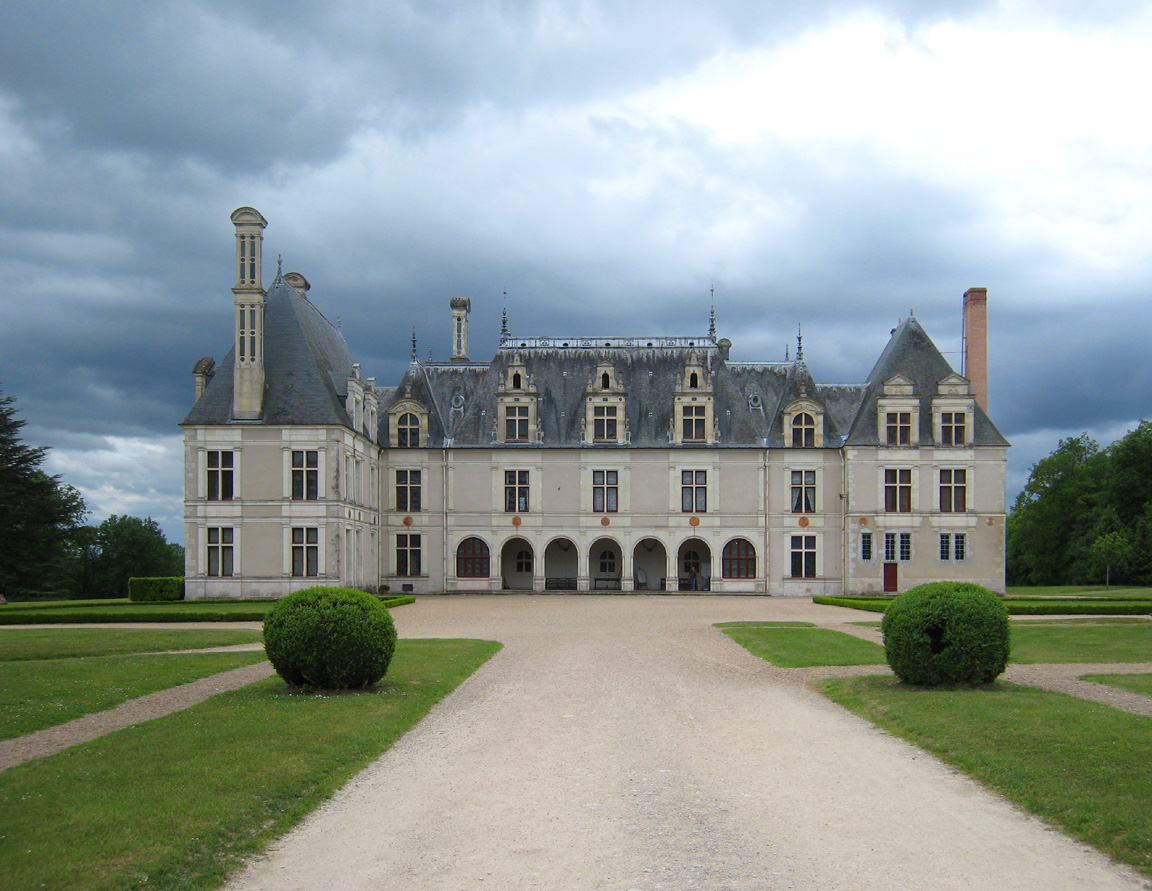
Château de Beauregard, Loire Valley
Three hundred and twenty-seven faces stare down from the walls of the Château de Beauregard. Kings and queens, cardinals and generals, diplomats and spymasters -- fourteen reigns of French history arranged in twelve painted panels, each figure identified by name and title. Beneath them, 5,500 Delft tiles form a parade ground in miniature, with seventeen regiments marching across the gallery floor in costumes inspired by engravings of Jacques De Gheyn. It is the largest such portrait gallery surviving in Europe, and it exists because a 72-year-old civil servant named Paul Ardier retired to the countryside in 1617 and decided to build a monument to the political world he had served for fifty-five years.
From Hunting Lodge to Renaissance Jewel
The estate sits on the edge of the Russy Forest in the commune of Cellettes, just south of Blois and within easy reach of Cheverny and Chambord. Its origins are modest: in the late fifteenth century, the Doulcet family built a manor house here, and Louis XII elevated the property to a lordship in 1495. When the Doulcets fell from favor after defrauding the Crown during the Italian campaigns, Beauregard was confiscated and folded into the royal domain. Francis I used it as a hunting rendezvous before gifting it to his uncle René de Savoie, who died at the Battle of Pavia in 1525. The estate changed hands again before Jean du Thiers, Secretary of State for Finance under Henri II and a passionate humanist, purchased it in 1545 for 2,000 gold crowns. Du Thiers was the château's true builder. He incorporated the old house into a new Renaissance structure centered on a long gallery connecting two residential wings, and he filled his study -- the Cabinet of Bells -- with oak paneling carved by Francisque Scibec de Carpi, the same Italian craftsman who had worked for Francis I at Fontainebleau.
A Statesman's Grand Obsession
Paul Ardier arrived at Beauregard in 1617 after decades serving Henry III, Henry IV, and Louis XIII as Comptroller General of War and Grand Treasurer. At an age when most men of his era had long since died, Ardier embarked on an extraordinary project. He demolished the original house, flanked the central gallery with symmetrical modern wings, and then devoted the remaining years of his life to filling the gallery with portraits that would tell the political history of France from 1328 to 1643. The collection follows a rigorous logic: each of the fourteen kings from Philip VI to Louis XIII appears surrounded by the ministers, marshals, and foreign rulers who shaped his reign. Twenty-six countries are represented across the 327 canvases. Twenty-one of the subjects are women -- queens and regents who managed to exercise power in an era that rarely permitted it. Catherine de' Medici, Marie de' Medici, and Anne of Austria appear in their official roles as regents. Mary, Queen of Scots is identified simply as 'Queen of France and Scotland.' Three generations of the Ardier family worked for sixty years to complete the ensemble.
A Floor That Marches
The gallery's most unexpected element lies underfoot. Paul Ardier the Younger oversaw the installation of the Delft tile floor, ordering more than five thousand pieces from the famous Dutch workshops. Each tile depicts a soldier -- infantrymen, cavalrymen, officers -- arranged in seventeen regiments in full marching order, their costumes drawn from military engravings of the period. At 150 square meters, it remains the largest surviving Delft tile pavement in the world. Above, the coffered ceiling was painted by Jean Mosnier and his family, the same workshop responsible for the interiors at the nearby Château de Cheverny. The dominant blue of the ceiling was achieved with powdered lapis lazuli, a pigment so precious in the seventeenth century that its cost was estimated at seven times the price of gold. Walking through the gallery means moving through three registers of ambition simultaneously: the kings on the walls, the army on the floor, and a sky of crushed gemstone overhead.
Gardens as Living Portraits
The seventy-hectare walled park has been reinvented across five centuries. Jean du Thiers created a geometrically ordered Renaissance garden with wooden galleries ending in small temples, a central fountain, and beds of rare plants -- his botanical passions were celebrated by contemporaries. Paul Ardier walled the park in 1619, reoriented the entrance, and planted fruit trees along a new central axis. By 1661 an orangery sheltered seventy-four orange and lemon trees. The English landscape fashion arrived in the late eighteenth century, and cedars of Lebanon, tulip trees, and magnolias enriched the grounds. In 1992, landscape designer Gilles Clément created the Jardin des Portraits: twelve garden 'rooms' echoing the twelve portrait panels inside the château, each defined by a dominant color and planted with over 400 species of perennials and shrubs. A red room symbolizes the blood of the St. Bartholomew's Day Massacre. The park was listed as a historical monument in 1992 and carries the designation 'Remarkable Garden.'
The View from Above
Beauregard remains privately owned and inhabited, a rare distinction among the great Loire châteaux. The current owners, descendants of the Gosselin family who acquired the estate in 1925, continue restoring the gallery and its portraits. Unlike the tourist crush at Chambord or Chenonceau, Beauregard offers something quieter: the chance to stand in a room conceived as a single argument about power and to read three centuries of European history face by face, tile by tile. From the air, the château is visible as a pale rectangle against the dark expanse of the Russy Forest, its formal gardens radiating outward in the geometric patterns that sixteenth-century designers believed reflected the order of the cosmos.
From the Air
Located at 47.537°N, 1.384°E, in the commune of Cellettes south of Blois. The château sits on the edge of the Russy Forest and is visible as a light-colored structure against dense woodland. Nearest airports: Blois-Le Breuil (LFOQ) approximately 10 km north. Best viewed at 2,000-3,000 ft AGL in clear weather. The Loire River is a reliable navigation reference running east-west to the north.