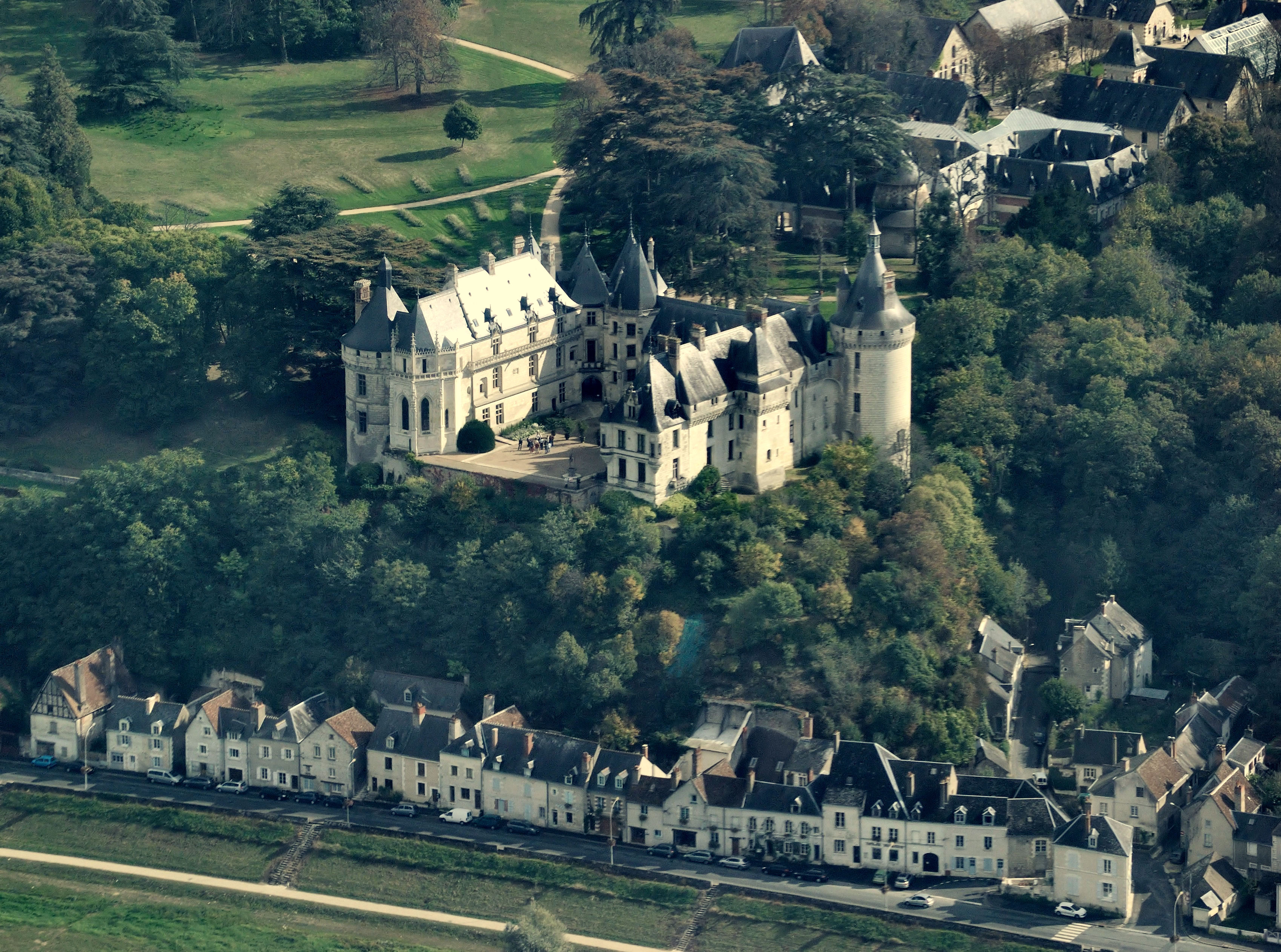
Château de Chaumont
Catherine de' Medici consulted Nostradamus here. When her husband Henry II died in 1559, she used this castle as a weapon -- forcing the king's mistress, Diane de Poitiers, to surrender the far more beautiful Château de Chenonceau in exchange for Chaumont. The swap was an act of revenge dressed as generosity, and Diane lived at Chaumont only briefly before leaving for good. The château's name comes from chauve mont, 'bald hill,' and over a thousand years the castle perched on that hill has been built, destroyed, rebuilt, sold, seized, decorated, neglected, and finally given to France -- its turbulent history mirroring the country's own.
Fortress Between Rivals
Odo I, Count of Blois, built the first castle on this hill in the tenth century for a single strategic purpose: to guard his lands against his feudal enemy Fulk Nerra, Count of Anjou. Situated between Blois and Amboise on a commanding bluff above the Loire, the site controlled river traffic and the road between the two rival territories. The Norman lord Gelduin received the castle, improved it, and held it as his own. Through marriage, it passed to the Amboise family, who would keep it for five centuries -- until Pierre d'Amboise chose the wrong side in a rebellion against Louis XI. The king ordered the castle dismantled in 1465. But the Amboise family was resilient. Charles I d'Amboise rebuilt from 1465 to 1475, and his son Charles II continued the work through 1510 with help from his uncle Cardinal Georges d'Amboise, blending Renaissance touches into a structure that never fully abandoned its medieval character.
Queens, Astrologers, and a Reluctant Mistress
Catherine de' Medici acquired the château in 1550 and transformed it into a court where astrologers and mystics were welcome guests. Nostradamus himself visited. But the château's most dramatic chapter came after Henry II's death. Catherine had endured years of humiliation while her husband lavished affection and property on Diane de Poitiers, including the exquisite Château de Chenonceau. As queen dowager, Catherine finally had the authority to act. She compelled Diane to accept Chaumont in exchange for Chenonceau -- technically a fair trade, practically an exile. Diane departed quickly. The château drifted through a succession of owners: a tax farmer named Largentier who grew rich on the gabelle salt tax before being arrested for peculation, a family from Lucca, and eventually Paul de Beauvilliers, who decorated the interiors lavishly enough to host the Duke of Anjou on his way to become king of Spain in 1700.
An American Revolutionary's Country House
In 1750 Jacques-Donatien Le Ray purchased Chaumont as a country retreat and promptly established a glassmaking and pottery factory on the grounds. Le Ray's true passion, however, was America. He became one of the most committed French supporters of the American Revolution, and the French came to call him a 'Father of the American Revolution.' Franklin lived at Le Ray's estate at Passy outside Paris while working on behalf of the American cause, and his grandson Temple visited Chaumont itself. But Le Ray's devotion to liberty proved ironic: when the French Revolution arrived in 1789, the new government seized his assets, including the château he loved. The property changed hands several more times before Marie-Charlotte Say, heiress to the Léon Say sugar fortune, acquired it in 1875. She married Prince Amédée de Broglie, a descendant of Madame de Staël (who had briefly owned Chaumont in 1810), and together they commissioned the architect Paul-Ernest Sanson to build luxurious stables in 1877 and to replant the park in the English landscape style. Marie-Charlotte donated the château to the French government in 1938.
Shelter in Darkness
During World War II, the château served a purpose its medieval builders could never have imagined. The French Jewish organization Oeuvre de secours aux enfants -- the Children's Aid Society -- brought more than 200 Jewish children to the property during the Holocaust. Behind the castle walls that had once shielded feudal lords from their rivals, children were hidden from a far more systematic evil. The story remained little known for decades. As of 2023, only a few of the refugees were still living -- the last witnesses to a chapter of the château's history that was as quiet as its feudal and royal dramas were loud.
Gardens on the Bald Hill
Today the Château de Chaumont operates as a museum and hosts an International Garden Festival from April to October each year. Contemporary landscape designers from around the world install their work in an English-style garden setting, transforming the grounds into a laboratory of horticultural ideas. The festival has run annually since 1992, making it one of the longest-running events of its kind in Europe. The château itself -- its chapel, its stables, the lounge of Prince de Broglie with its ornate floor -- draws visitors who come for the architecture and stay for the views across the Loire. From the garden terraces, the river curves below the 'bald hill,' and the landscape looks much as it must have looked to Odo I a millennium ago, minus the approaching armies.
From the Air
Located at 47.479°N, 1.182°E, on a prominent bluff above the south bank of the Loire River between Blois and Amboise. The château and its gardens are visible from the air as a distinct complex on a wooded hilltop overlooking the river. Nearest airports: Blois-Le Breuil (LFOQ) approximately 15 km east, Tours Val de Loire (LFOT) approximately 35 km southwest. Best viewed at 1,500-3,000 ft AGL. The Loire River provides excellent visual navigation along the valley.