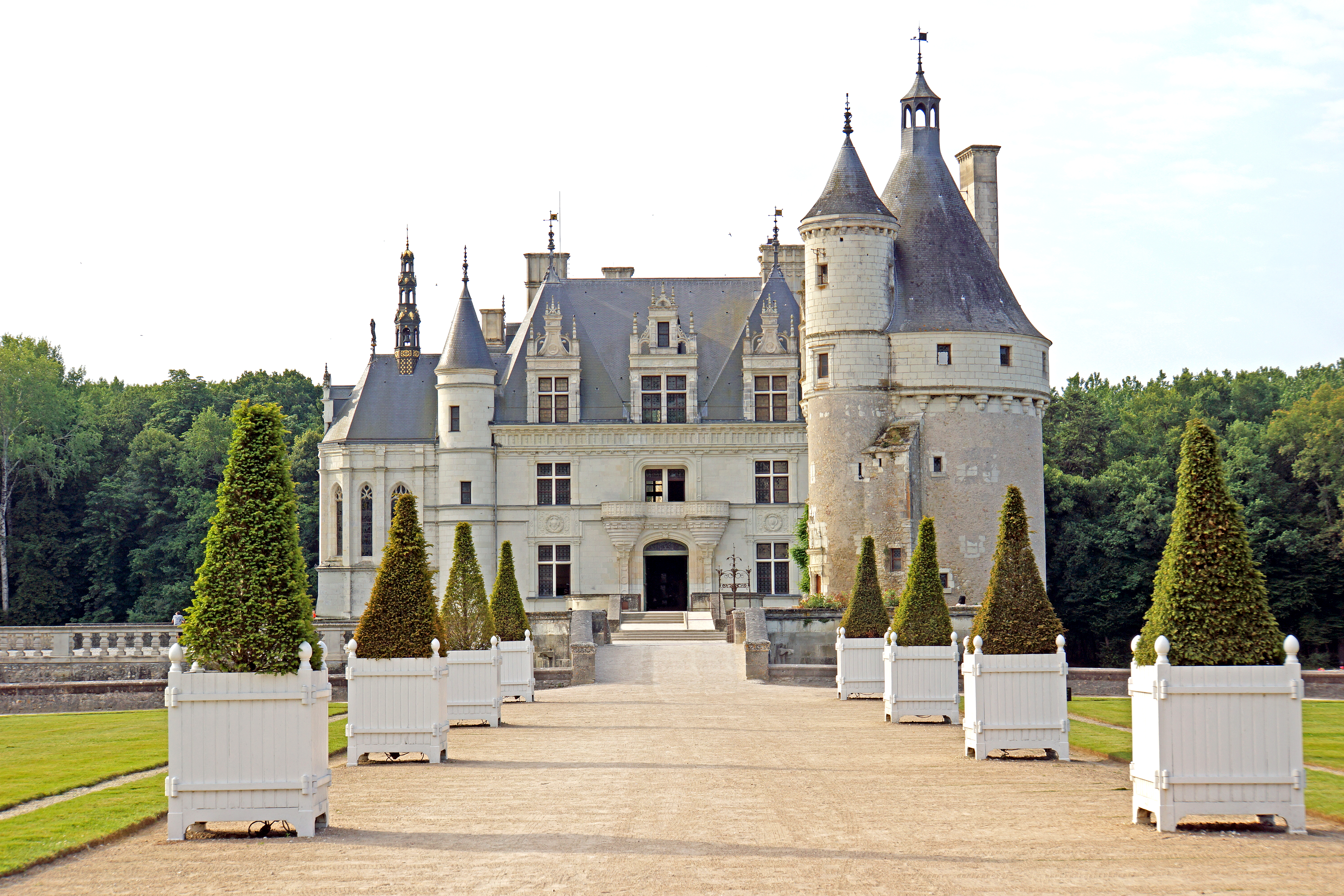
Chateau de Chenonceau
After King Henry II died in 1559, his widow Catherine de' Medici forced his mistress Diane de Poitiers to give up Chenonceau. It was not a gentle request. Catherine had waited years for this moment, enduring the humiliation of watching Diane preside over the most beautiful chateau in the Loire Valley while she, the queen, made do with lesser residences. The exchange of Chenonceau for the comparatively modest Chateau Chaumont was Catherine's first act of reclaimed power. It would not be her last. The Chateau de Chenonceau, spanning the river Cher on a gallery bridge of elegant arches, is the most visited chateau in France after Versailles, and its history is inseparable from the women who built it, fought over it, and saved it from destruction.
A Castle Built on Water
The current chateau was built between 1514 and 1522 on the foundations of an old mill, its position on the Cher making it unique among Loire Valley properties. The bridge spanning the river was added between 1556 and 1559, designed by the Renaissance architect Philibert de l'Orme at the direction of Diane de Poitiers, who had received Chenonceau from Henry II. Diane oversaw the planting of extensive flower and vegetable gardens on stone terraces buttressed against flooding, laid out in four triangles along the riverbank. The grand gallery that extends along the bridge was built from 1570 to 1576 to designs by Jean Bullant, commissioned by Catherine de' Medici after she claimed the chateau. The architectural result is an extraordinary hybrid of late Gothic and early Renaissance -- a building that seems to float on the water it crosses.
Catherine's Spectacles and Sorrows
As regent of France, Catherine de' Medici poured a fortune into Chenonceau and its entertainments. In 1560, the first fireworks display ever seen in France lit up the sky above the river during celebrations for the ascension of her son Francis II. The grand gallery, dedicated in 1577, transformed the bridge into an architectural statement of power -- a covered walkway spanning an entire river, its checkerboard floor stretching nearly 60 meters from bank to bank. Catherine dreamed of even greater expansions, commissioning plans from the architect Jacques Androuet du Cerceau that would have made the existing chateau merely one wing of an enormous complex. When she died in January 1589, the chateau passed to her daughter-in-law Louise of Lorraine, who learned at Chenonceau of her husband Henry III's assassination. Louise spent her remaining eleven years wandering the corridors in mourning clothes, surrounded by black tapestries stitched with skulls and crossbones.
Enlightenment on the Cher
The chateau's later history brought new chapters. After passing through the Bourbon dukes of Vendome and being stripped of its contents by the Duke of Bourbon in 1720 -- many statues ended up at Versailles -- Chenonceau found an unlikely savior in Louise Dupin. She transformed it into one of the most celebrated literary salons of the Enlightenment, attracting Voltaire, Montesquieu, Buffon, the playwright Marivaux, and the philosopher Condillac. Jean-Jacques Rousseau served as her secretary, tutored her son, and worked on his treatise Emile in the chateau. Rousseau wrote in his Confessions that they played music there, staged comedies, and that he wrote a verse play named after a path along the Cher. When the Revolution came, Louise Dupin saved Chenonceau from the mob by arguing that it was essential to travel and commerce -- the only bridge across the river for many leagues.
Chocolate, War, and Escape
In 1913, Henri Menier of the famous chocolate-making family purchased Chenonceau, and the Menier family still owns it today. During World War I, the gallery was converted into a hospital ward -- the long, light-filled space that had once hosted Catherine de' Medici's fireworks parties now held rows of wounded soldiers. During World War II, the chateau's unique position spanning the Cher gave it a singular role: the river marked the boundary between the German-occupied zone and Vichy France, and the gallery became a means of escape, a bridge from occupation to nominal freedom. The Germans bombed the chateau in June 1940; the Allies bombed it on 7 June 1944, destroying the chapel windows. Restoration by Bernard Voisin beginning in 1951 brought both building and gardens back from the damage of war and flooding. The chateau endures as it began -- poised on the water, shaped by the determination of the women and families who refused to let it fall.
From the Air
Located at 47.33N, 1.07E spanning the Cher river near the village of Chenonceaux, Indre-et-Loire department. The chateau is one of the most visually distinctive landmarks in the Loire Valley from the air -- its gallery bridge crossing the Cher is unmistakable. Tours Val de Loire Airport (LFOT) is approximately 30 km to the northwest. The formal gardens on the south bank and the tree-lined approach are clearly visible. Best viewed from 1,500-3,000 feet for full appreciation of the river-spanning architecture.