Chateau de Cheverny
Tintin fans recognize it instantly: the symmetrical white facade, the two flanking wings, the formal gardens. The Belgian cartoonist Herge drew Marlinspike Hall -- Captain Haddock's ancestral home -- by sketching the Chateau de Cheverny and simply removing its two outermost pavilions. What remains on the comic page is almost architecturally exact. But while Marlinspike Hall is fiction, Cheverny is emphatically real -- a chateau that has been continuously furnished and inhabited for nearly four centuries, its rooms still hung with the tapestries and paintings that the same family has collected since the 1600s.
The King's Mistress Turned It Down
Cheverny's story begins with scandal. The Hurault family had owned the estate since the late 14th century, but they lost it when a fraud against the state cost them the property. King Henri II gave it to his famous mistress, Diane de Poitiers -- who took one look and decided she preferred Chenonceau. She sold it back to the former owner's son, Philippe Hurault, and he built the chateau that stands today between 1624 and 1630. The architect was Jacques Bougier of Blois, trained in the atelier of Salomon de Brosse, whose design for Cheverny consciously echoes the Palais du Luxembourg in Paris. The interiors were completed by 1650 under the direction of the marquise de Montglas, Philippe's granddaughter, who filled the rooms with paintings, Flemish tapestries, and furnishings that remain in place to this day.
Rooms That Time Barely Touched
What makes Cheverny extraordinary among Loire chateaux is not its architecture but its contents. Most chateaux were stripped during the Revolution, rebuilt in the 19th century, or turned into museums furnished with borrowed pieces. Cheverny survived intact. The Grand Salon still displays paintings from the school of Raphael alongside portraits by Pierre Mignard. The Petit Salon is hung with five Flemish tapestries and a portrait attributed to Maurice-Quentin de La Tour. In the library, works by Jean Clouet and Hyacinthe Rigaud line the walls. Upstairs, the Chambre du Roi is draped with five Paris tapestries designed by Simon Vouet, depicting the wanderings of Ulysses. The stone staircase that connects the floors is carved with trophies of arms and allegories of the arts -- decoration as confident and permanent as the family that commissioned it.
The Hounds of Cheverny
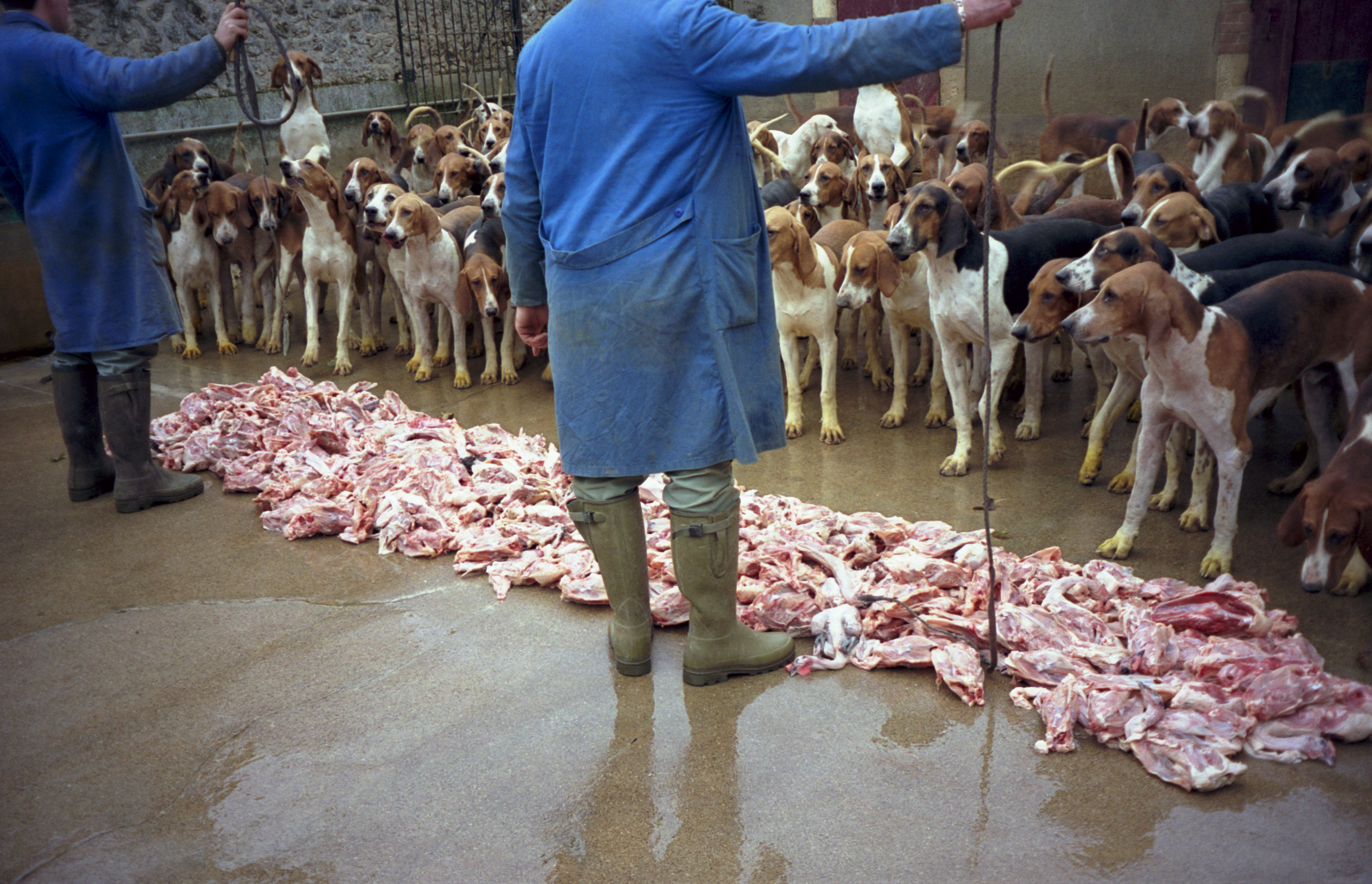
Twice a week, roughly 120 hunting hounds -- a carefully maintained pack of 60 males, 40 females, and 20 pups -- are taken out from their kennels on the grounds for organized hunts. The feeding of the pack has become a spectacle in itself, drawing crowds who come to watch the dogs eat with trained discipline. This is not an affectation. Hunting with hounds has been part of Cheverny's identity for centuries, reflecting the estate's origins as an aristocratic country seat where the social calendar revolved around the chase. The kennels sit within the park alongside formal gardens and woodland, a landscape designed for both beauty and sport. It is a living reminder that Cheverny was never merely a building -- it was, and remains, the operational center of a way of life.
Survival Through Stubbornness
The French Revolution forced the Hurault family to sell in 1802, having forfeited much of their wealth. But they bought the chateau back in 1824, during the Bourbon Restoration, when the aristocracy briefly regained its economic footing. In 1914, the family opened the chateau to the public -- one of the first in France to do so -- and the Marquis de Vibraye's descendants still operate it today. Queen Elizabeth the Queen Mother visited in 1963 during a four-day holiday in the Loire Valley. The permanent Tintin exhibition, installed in a wing of the chateau, draws a younger crowd who come for Captain Haddock and stay for the tapestries. It is an unlikely pairing -- seventeenth-century aristocratic taste and twentieth-century Belgian comics -- but at Cheverny, where continuity is the point, even the contradictions feel deliberate.
From the Air
Located at 47.500N, 1.458E, approximately 13 km south-southeast of Blois in the Loire Valley. The chateau is visible from the air as a symmetrical white limestone structure flanked by formal gardens and parkland. Best viewed from 2,000-3,000 feet AGL. Nearest airport is Blois-Le Breuil (LFOQ), approximately 13 km to the northwest. Tours Val de Loire (LFOT) is approximately 75 km to the southwest. The Loire River, running roughly east-west, provides a reliable visual navigation reference to the north.