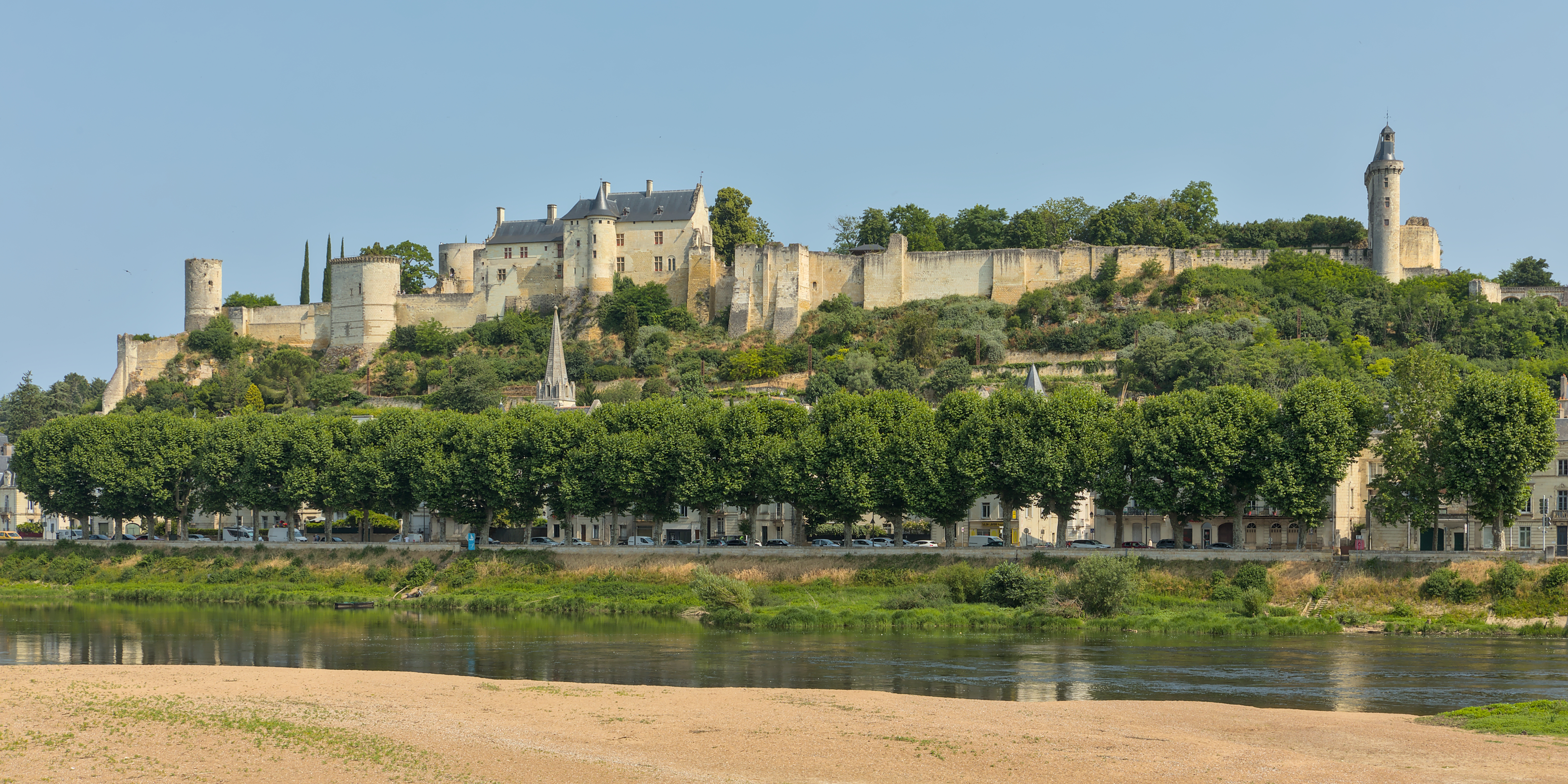
Château de Chinon
Henry II of England died here on 6 July 1189, abandoned by his sons, his empire fraying. Two centuries later, a seventeen-year-old peasant girl arrived at these same walls claiming heavenly voices had sent her to save France. Between those two moments — a king's lonely death and a saint's impossible audacity — the Château de Chinon witnessed more pivotal scenes in medieval history than almost any other fortress in Europe. Perched on a rocky outcrop above the river Vienne, its three enclosures stretch along the ridgeline like a stone spine, commanding the valley below.
A Stronghold Between Empires
Chinon's strategic value was apparent long before castles existed here. A Gallo-Roman castrum occupied the site by the fifth century, controlling the point where the Vienne connects the southern plains of Poitou to the thoroughfare of the Loire. Theobald I, Count of Blois, built the first known castle in the tenth century. After his successor Odo II fell in battle in 1037, Fulk III, Count of Anjou, marched into Touraine and took Chinon without a fight — the garrison simply surrendered on his arrival. From that moment, the fortress passed through the counts of Anjou to their heirs, the Plantagenets, who would transform it into one of the most important castles in their cross-Channel domain.
The Plantagenet Crucible
Henry II made Chinon his primary residence and rebuilt nearly the entire fortress. He kept his treasury here, along with one of his main arsenals — marks of a castle that was not merely a home but a seat of power. The family drama that played out within these walls reads like Shakespeare. In 1173, Henry's eldest son escaped from Chinon under cover of darkness to join a rebellion against his father. His brother Richard later raided the castle's treasury to fund his own fortifications in Aquitaine. By 1189, ill and besieged by the combined forces of Richard and Philip II of France, Henry retreated to Chinon for the last time. He died here on 6 July, and his body was carried to nearby Fontevraud Abbey for burial. Richard became king, and Chinon entered a new chapter.
Templars in the Tower
After Philip II of France captured Chinon in 1205, following a siege that lasted months, he built the cylindrical Tour du Coudray — a round keep in the French style that departed from the square towers the English had favored. A century later, that same tower became a prison for the most dramatic trial of the medieval era. King Philip IV had the Knights Templar arrested across France, accusing them of heresy. The order's leaders, including Grand Master Jacques de Molay, were imprisoned in the Tour du Coudray. In August 1308, Pope Clement V sent three cardinals to hear their confessions. The outcome was devastating: the pope suppressed the order entirely in 1312, and de Molay was eventually burned at the stake.
Joan at the Gate
By the 1420s, Chinon had become the last refuge of a king who controlled almost nothing. Charles VII, the uncrowned Dauphin, held court here because Touraine was virtually the only territory left to him — the rest of France was occupied by the Burgundians or the English. On 6 March 1429, Joan of Arc arrived at the château. She lodged in the Tour du Coudray, the same tower that had held the Templars, and met Charles two days later. He sent her to Poitiers to be examined, and when she returned, he granted her an army. Within months she had lifted the siege of Orléans and reversed the momentum of the Hundred Years' War.
Ruins Reclaimed
After Joan's departure, Chinon slipped into centuries of decay. Prosper Mérimée, the writer better known for Carmen, became Inspector-General of Historic Monuments in 1834 and helped halt the deterioration. The castle was recognized as a monument historique in 1840. Between 2003 and 2010, a massive restoration costing 14.5 million euros brought the fortress back to life. Archaeologists excavated nearly 4,000 square meters of the Fort St-George, unearthing the entire interior. The royal lodgings, roofless for two hundred years, were restored and given a reconstructed fifteenth-century interior. Today the château is owned by the Indre-et-Loire General Council and draws visitors who come to walk the same stones where Plantagenets plotted, Templars suffered, and a teenage girl changed history.
From the Air
Located at 47.17°N, 0.24°E on a rocky outcrop above the river Vienne. The castle's three distinct enclosures are clearly visible stretching along the ridgeline. Nearest airport: Tours Val de Loire (LFOT), approximately 45 km northeast. The medieval town of Chinon sits below the fortress walls. Best viewed at 1,500–2,500 ft AGL. The Vienne River provides an excellent approach corridor from the west.