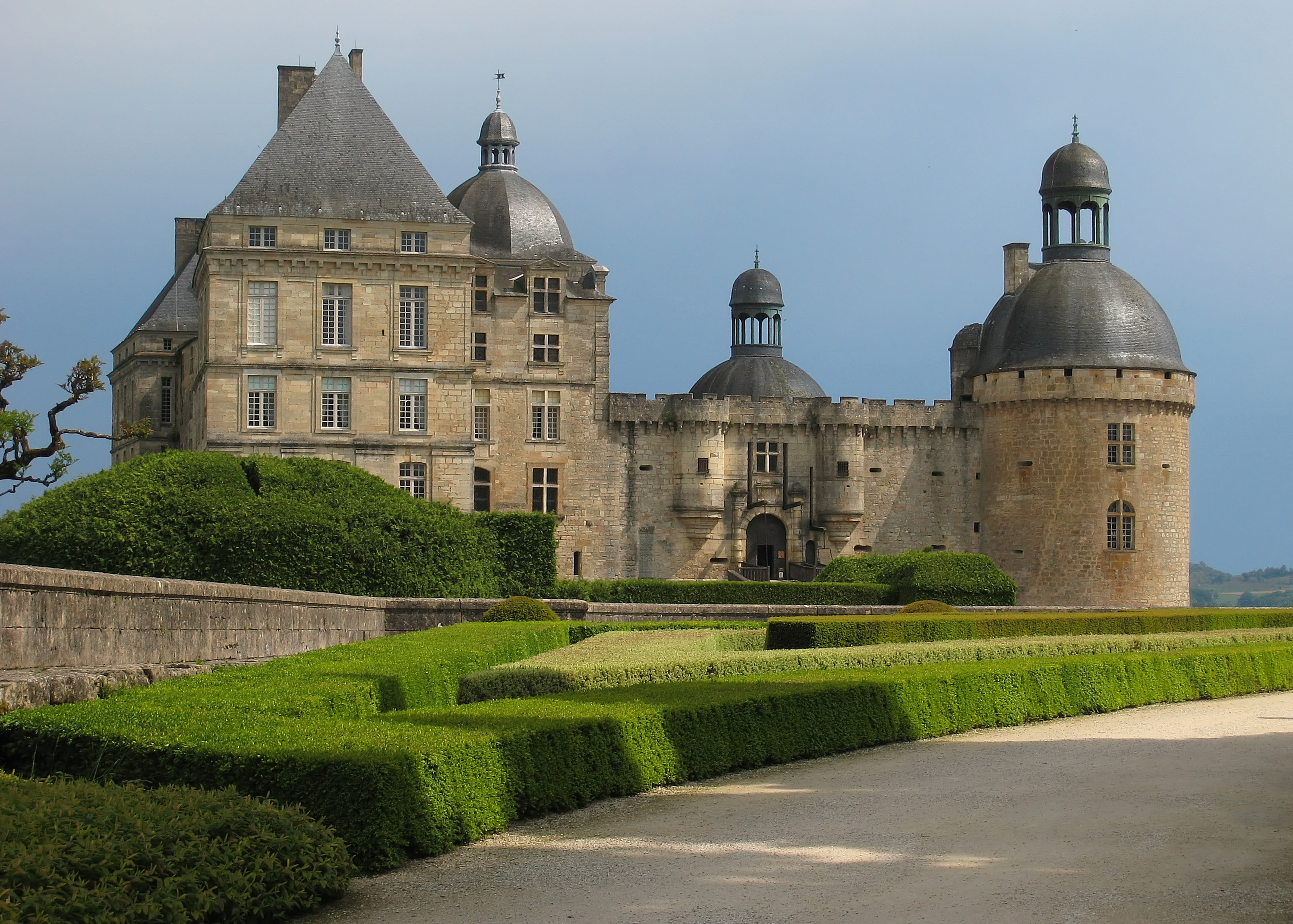
Chateau de Hautefort
Dante placed Bertran de Born in the eighth circle of Hell, condemned to carry his own severed head as a lantern for the sin of sowing discord between kings. Before that literary damnation, the twelfth-century troubadour had lived at Hautefort, composing poems that incited wars and mourning the ones he helped cause. The castle where he schemed and sang has been destroyed and rebuilt more than once since then. Its most recent resurrection belongs to a woman who, at sixty-seven years old, watched her life's work burn to the ground and decided the next morning to start over.
The Troubadour's Fortress
Around the year 1000, Guy de Lastours built the first fortress on the hilltop at Hautefort. By the twelfth century, the castle had passed to the de Born family, and Bertran de Born made it famous -- or infamous. His poems in Old Occitan celebrated warfare with an enthusiasm that alarmed even his contemporaries. He feuded bitterly with his own brother over control of Hautefort, and the conflict drew in Richard the Lionheart, who besieged the fortress in 1183. According to legend, Richard was so moved by Bertran's eloquent eulogy for his recently dead son, Henry the Young King, that he returned the castle to the troubadour. Dante was less forgiving. In the Inferno, Bertran wanders the ninth ditch of the eighth circle among the sowers of division, his body separated from his head as punishment for separating father from son.
From Stronghold to Chateau
The medieval fortress gave way to something grander in the seventeenth century, when the Marquis de Hautefort transformed the castle into a classical residence inspired by the great chateaux of the Loire Valley. The medieval walls yielded to elegant symmetry. A jardin a la francaise replaced rougher grounds. In 1853, a landscape architect further reimagined the gardens, adding geometric flower beds, topiary sculpted to echo the chateau's domes, and a long tunnel of greenery. An Italian garden climbed a neighboring hill with winding shaded paths. Notable trees -- a Magnolia grandiflora, a Cedar of Lebanon -- lent the grounds a botanical distinction that eventually earned them a place on the Ministry of Culture's list of Notable Gardens of France.
The Night Everything Burned
On the night of August 30, 1968, fire consumed the main residential wing of the Chateau de Hautefort. Baroness Simone de Bastard, who with her husband Henry had purchased and begun restoring the property in 1929, was now a widow of sixty-seven. She had spent nearly four decades bringing the chateau back to life, moving into the restored building in 1965 after years of painstaking work. Three years later, she watched it all burn. The very next morning, she decided to rebuild. With the support of Andre Malraux, a national committee, local authorities, and the French Ministry of Culture, the Baroness undertook a second restoration that consumed the rest of her life. She died in 1999 at ninety-eight, having seen the chateau rise from its ashes.
A Castle on Screen and in Memory
Hollywood discovered Hautefort twice. In 1966, the chateau appeared as the fictional Chateau Bellenac in Eye of the Devil, a British horror film starring David Niven, Deborah Kerr, and a young Sharon Tate. In 1998, it stood in for Prince Henry's castle in Ever After, the Cinderella retelling with Drew Barrymore, Anjelica Huston, and Jeanne Moreau. Today the Fondation du Chateau de Hautefort, created in 1984 and recognized as a public utility in 1990, maintains the estate and opens it to visitors. The Baroness's restoration endures. From the gardens, with their dome-shaped topiary mirroring the chateau's own silhouette, Hautefort looks as permanent as the Dordogne hills beneath it -- a castle that has survived troubadours, revolutions, fire, and time.
From the Air
Located at 45.26N, 1.15E on a prominent hilltop in the Dordogne department, approximately 40 km east of Perigueux. The chateau is highly visible from the air, its classical symmetrical form and formal gardens standing out sharply against the surrounding agricultural landscape. The terraced gardens and topiary are distinctive from above. Nearest airports: Brive-Souillac (LFSL) approximately 45 km east, Bergerac Dordogne Perigord (LFBE) approximately 60 km southwest. Best viewed at 2,000-4,000 feet AGL for full appreciation of the hilltop setting and garden layout.