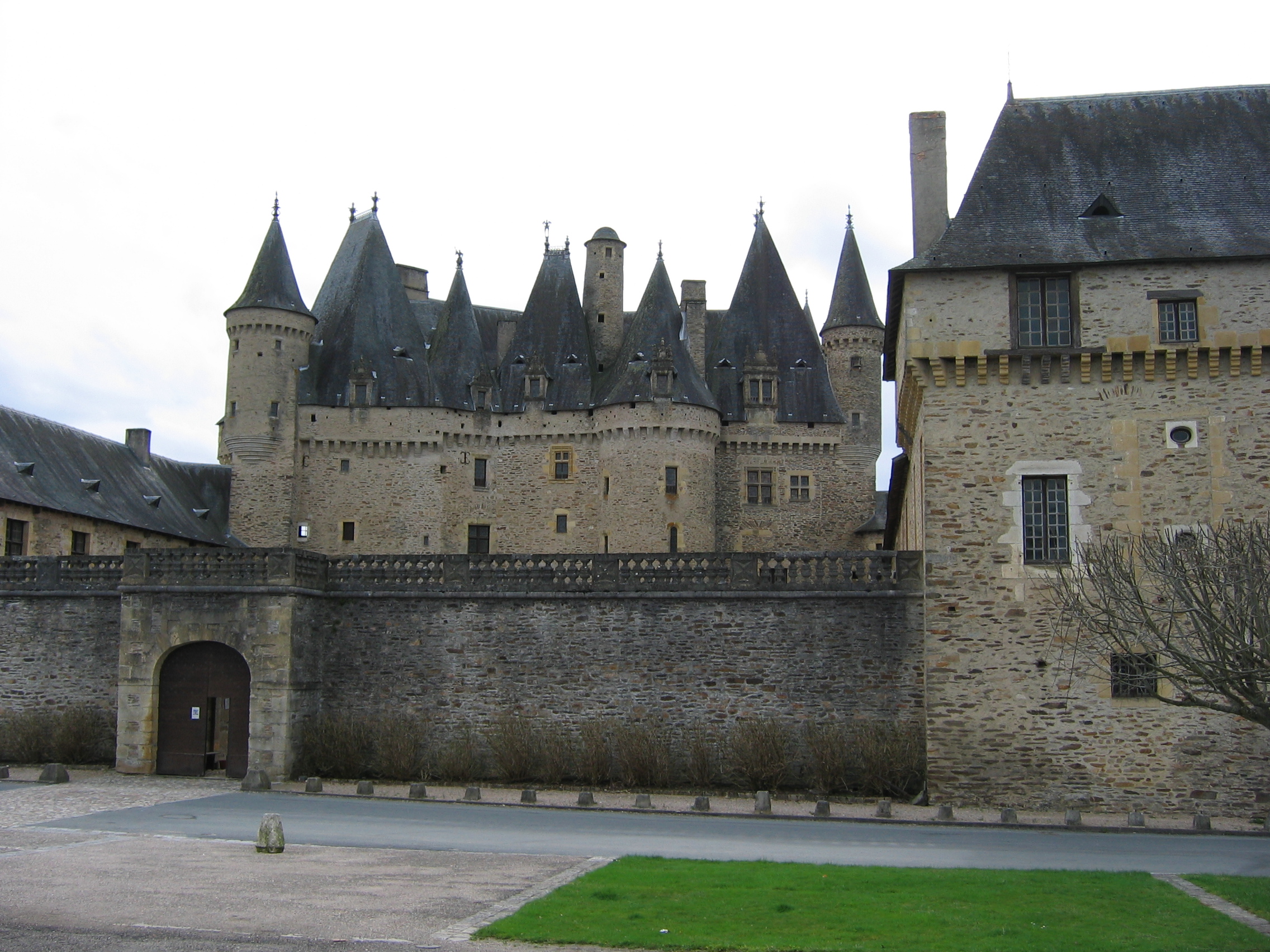
Chateau de Jumilhac
From a distance, the rooftops of the Chateau de Jumilhac look like a fever dream in slate. Cones, pepperboxes, pyramids, and spires crowd the skyline, each capped with finials bearing allegorical figures -- angels, lions, birds -- that seem to be telling a story the viewer cannot quite read. They are, in fact, telling exactly that. The first Count of Jumilhac practiced alchemy in an era when it was illegal, and the rooftop ornaments are thought to encode alchemical symbols and seigniorial allegories. Three angel statues and a tall chimney-like turret that may have concealed an alchemist's furnace complete a skyline so distinctive that Jumilhac has been called the most romantic roof in France, and the castle itself the "Black Pearl of the Haut Perigord."
Five Centuries of Stone and War
The castle's history spans the fifteenth through seventeenth centuries, though a fortress has occupied this site since at least the thirteenth century. That earlier stronghold was destroyed by King Philippe Auguste in the early 1200s. During the Hundred Years' War, the French commander Bertrand du Guesclin besieged the rebuilt fortress in 1370 and defeated the English troops of Edward, the Black Prince. The edifice that stands today dates to the fifteenth century at its core, with two wings added during the reign of Louis XIV. A covered porch and two arcaded walls connect the wing ends to form an almost rectangular court of honor. Behind the main facade, a terraced lawn slopes toward an orangery, and parkland surrounds the complex.
The Alchemist Count
In 1579, Antoine Chapelle married Marguerite de Vars, heiress to half the domain of Jumilhac, and two years later bought the other half. King Henri IV elevated him to Count of Jumilhac in 1597, and it was during this period that the castle received its extraordinary roofline. Antoine Chapelle's fascination with alchemy -- the quest to transmute base metals into gold -- was more than decorative. The region around Jumilhac-le-Grand has been associated with gold mining since antiquity, and the terraced gardens have been renovated around themes of gold and alchemy. Inside the castle, clues to the Count's forbidden pursuits are woven into the decor. The tall turret that rises above the rest could have housed an alchemist's furnace, hidden in plain sight as domestic architecture. Whether Chapelle ever succeeded in his experiments is not recorded. What he left behind was something more durable than gold: a building that encodes its owner's obsessions in stone and slate.
The Black Pearl Endures
The French Ministry of Culture classified the central part of the castle as a monument historique in 1922, the right wing in 1923, and the left wing in 1924 -- a piecemeal recognition that mirrors the building's own layered construction. The castle has remained in the same family since the sixteenth century, still privately owned by descendants who carry the title Marquis of Jumilhac. After years of renovation, it opened to the public in 1964. Visitors today can walk through rooms that blend medieval military architecture with Renaissance refinement, explore gardens themed around the gold and alchemical heritage of the site, and study the rooftops that draw the eye upward. From below, those slate peaks and allegorical figures catch the light of the Perigord sun. From above, they form a jagged crown on a hilltop in the green countryside, marking a place where a count once chased the secret of transformation and left his castle permanently transformed instead.
From the Air
Located at 45.49N, 1.06E in the commune of Jumilhac-le-Grand, in the northern Dordogne department (Haut Perigord). The castle's distinctive multi-peaked roofline of cones, pyramids, and spires makes it unusually identifiable from the air -- a cluster of slate points rising from a hilltop in otherwise rolling green countryside. Nearest airports: Brive-Souillac (LFSL) approximately 65 km southeast, Limoges-Bellegarde (LFBL) approximately 45 km north. Best viewed at 2,000-3,000 feet AGL for the roofline to be fully appreciated against the surrounding terrain.