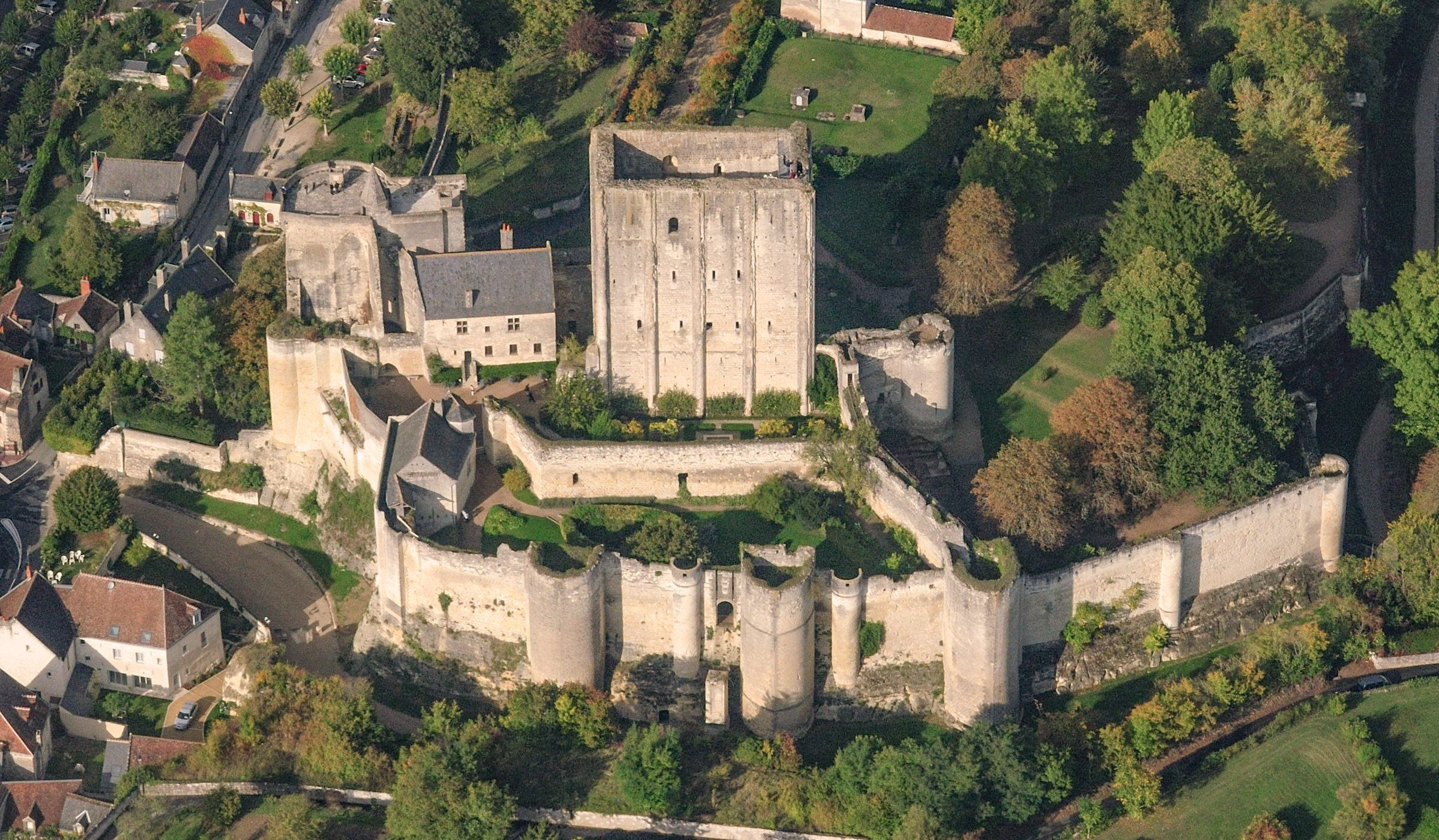
Chateau de Loches
Agnes Sorel was the most beautiful woman in France -- at least, that is what Charles VII believed. He installed her at the Chateau de Loches, making her the first woman to be officially recognized as a royal favorite, a status that would become a peculiar French institution for centuries to come. But the massive fortress overlooking the town of Loches and the Indre river had been accumulating stories long before Agnes arrived, and it would accumulate darker ones after she left. Built in the 9th century, occupied by Plantagenet kings, besieged by Philip II, and eventually converted into one of France's most feared prisons, Loches compresses the full sweep of medieval and early modern French history into a single hilltop.
Plantagenets and the Prize of the Indre
The castle's strategic value was obvious from the beginning: it commanded the Indre valley from a position roughly 500 meters from the river, its massive square keep visible for miles across the Touraine countryside. Henry II of England and his son Richard the Lionheart occupied Loches during the 12th century, making it a cornerstone of the Angevin empire's holdings in France. The French king Philip II besieged it repeatedly during the wars for control of the French crown, finally capturing it in 1204. Philip immediately upgraded Loches into a formidable military fortress. The 11th-century keep, built by Fulk III, Count of Anjou, still stands as testament to the engineering of that era: four storeys rising 37 meters high, with walls 2.8 meters thick, each floor a single enormous room.
The King's Favorite
Loches reached its most glamorous period under Charles VII, who made it a favorite royal residence. It was here that he installed Agnes Sorel, granting her a status no woman had publicly held before at the French court. Agnes was celebrated for her beauty, her political influence, and her taste -- she set fashions that the court followed and bore the king four daughters. Her presence at Loches transformed the fortress from a purely military stronghold into something approaching a palace, though the thick walls and defensive towers never let visitors forget what the building was originally for. The chateau's dual identity -- elegant residence wrapped around a military core -- would define it through the Renaissance.
From Palace to Prison
Charles VII's son, Louis XI, had grown up at Loches but preferred the Chateau d'Amboise. He found a different use for his childhood home: converting it into a state prison. The same massive walls and isolated position that had made Loches defensible now made it inescapable. Among its later inmates was the writer Henriette-Julie de Murat, exiled there in 1702 after a scandal involving accusations of lesbianism and other transgressions that had estranged her from her husband and led her mother to disinherit her. The chateau held prisoners of various ranks and offenses through the centuries, its reputation growing darker with each generation. The dungeons beneath the keep became particularly notorious, their cramped stone cells a stark contrast to the royal apartments above.
Stone Memory Above the Indre
Today Loches dominates its small town much as it has for a thousand years. The keep remains one of the finest surviving examples of Romanesque military architecture in France, its square profile unmistakable from the air or the ground. The royal apartments, the collegiate church within the fortified enclosure, and the dungeons below create a vertical cross-section of medieval society: prayer, power, and punishment stacked on a single hilltop. The town that clusters at the chateau's base grew up in its shadow and never outgrew it. From the Indre valley, the silhouette of the keep against the Touraine sky looks much as it must have when Richard the Lionheart rode through the gates, or when Agnes Sorel first surveyed her new domain from the windows above.
From the Air
Located at 47.12N, 1.00E in the Indre valley, Indre-et-Loire department. The chateau's massive square keep is a prominent visual landmark, dominating the town of Loches from its hilltop position. Tours Val de Loire Airport (LFOT) is approximately 40 km to the northwest. The Indre river valley provides a navigational corridor through gently rolling agricultural terrain. Best viewed from 1,500-3,000 feet for full appreciation of the fortified hilltop complex.