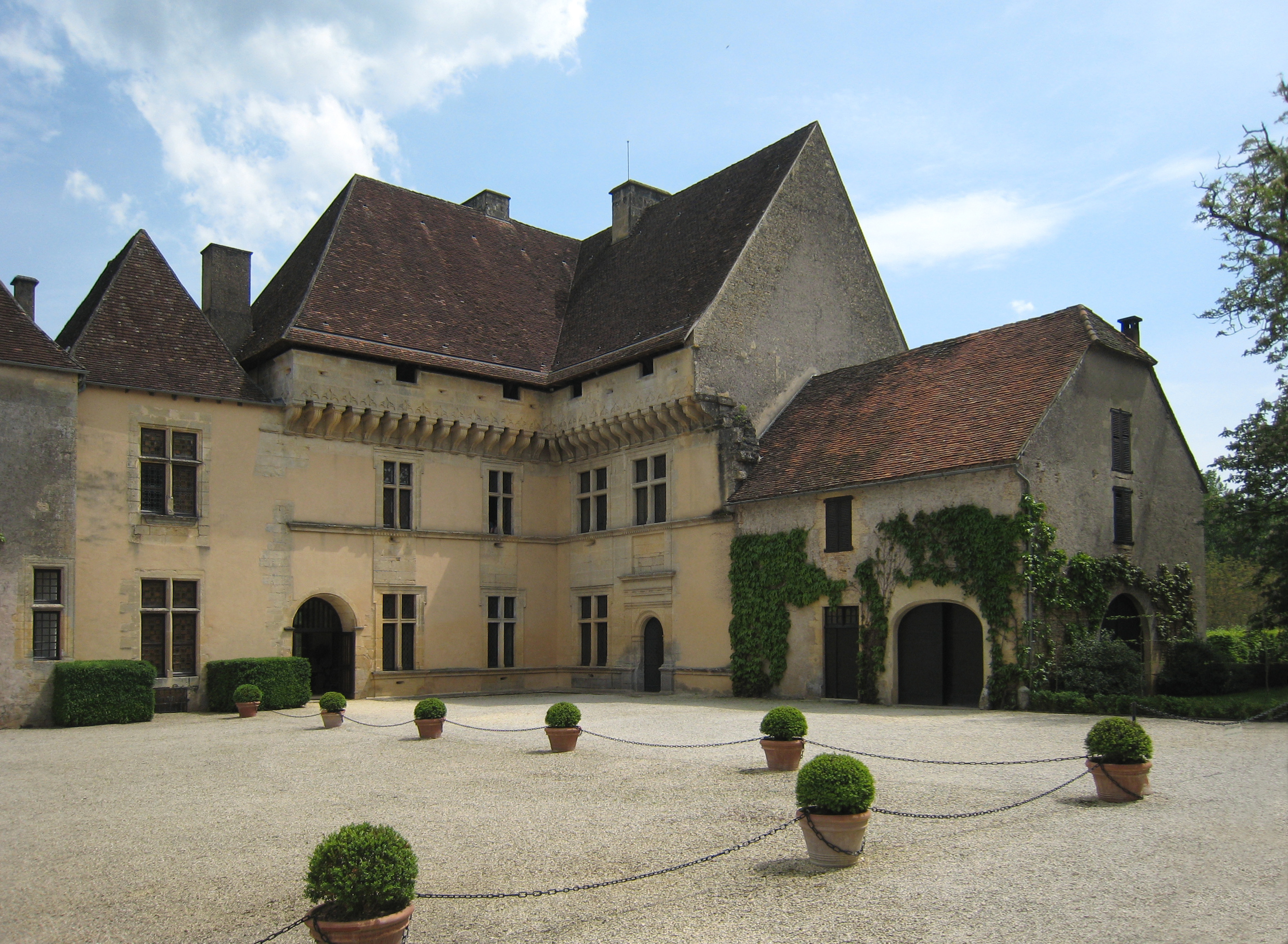
Chateau de Losse
Over the entrance to the Chateau de Losse, carved into the golden limestone of the Perigord, a motto reads: "Man does as he may, Fortune as she will." Jean II, Marquis de Losse, put it there in the 1570s after a lifetime of doing as he could across half the battlefields of France. Page to Francois I, soldier to all the sons of Catherine de' Medici, tutor to the future Henri IV, and finally governor of Limousin and Guyenne -- Losse retired to his family's ancestral stronghold on the Vezere and rebuilt it to suit a man who had seen both the Renaissance and the religious wars up close.
A Fortress Above the River
The Losse family arrived from Flanders in the eleventh century and built their first stronghold on the right bank of the Vezere, pledging themselves into the feudal hierarchy. The site they chose commands the river from a cliff, and the medieval fortress that grew there over the centuries exploited every advantage of the terrain. A deep dry moat surrounds the walls. The sole access crosses a bridge and passes through a fortified gatehouse -- reportedly the largest of its kind in France. From the riverside, a grandiose terrace built directly on the cliff face looks down the length of the Vezere valley. The castle has remained essentially unaltered since the sixteenth century, which earned it classification as a Historical Monument in 1928.
The Soldier's Renaissance
When Jean II returned to the Perigord after decades at court and in the field, he brought Renaissance taste with him. In 1576 he built a new hall within the medieval walls, its facade an exercise in classical architecture carved into the warm local stone. Inside, sculpted mantelpieces crown rooms furnished in the style of the period, and a grand stone staircase with ornamental details connects the floors. But Jean II was no dreamer. The Wars of Religion were still raging across France, and his experience defending royal fortifications against Imperial troops informed every decision. He updated the castle's defenses for the age of firearms, adding openings in the curtain walls and barbican designed for muskets and cannons. The Chateau de Losse became that rare thing: a home that was both beautiful and ready for a siege.
Between Montaigne and the Magdalenians
Jean II was a contemporary of Michel de Montaigne, the essayist who lived barely a day's ride away, and like Montaigne he felt the urge to leave his mark in words as well as stone. The mottoes he carved throughout the castle reflect a philosophical temperament shaped by decades of service and survival. The Chateau de Losse sits in a landscape where that impulse -- to leave something permanent -- reaches back far deeper than the Renaissance. The cave paintings of Lascaux lie nearby, and the Vezere valley is dense with prehistoric sites where humans have been recording their presence for tens of thousands of years. The castle's gardens, designated Remarkable Gardens by the Ministry of Culture, carry forward this tradition in a gentler register. Seventeenth-century "green rooms" frame flower beds, climbing roses, and clipped hornbeam along walkways beside the walls, while a sixteenth-century balcony offers a view of the river below.
Stone and Time
The Michelin Green Guide awards the Chateau de Losse two stars -- "worth the detour" -- and visitors who make that detour find a place where the passage of time feels strangely compressed. The golden Perigord stone weathers slowly. The furnishings inside belong to Jean II's era. The defensive architecture reflects wars fought four and a half centuries ago, while the landscape visible from the terrace has been shaped by rivers and human hands for millennia. The castle is open to the public, its rooms and gardens a window into the sixteenth century as imagined by a man who lived through it -- a soldier, a courtier, and a philosopher who accepted that fortune does as she will, but believed a man should do as he may.
From the Air
Located at 45.03N, 1.13E on the right bank of the Vezere river in the Dordogne department, near the prehistoric caves of Lascaux. The chateau is visible from the air as a stone fortress perched on a cliff above the Vezere, surrounded by gardens. Nearest airports: Bergerac Dordogne Perigord (LFBE) approximately 50 km southwest, Brive-Souillac (LFSL) approximately 40 km east. Best viewed at 2,000-3,000 feet AGL to appreciate the chateau's commanding position above the river valley.