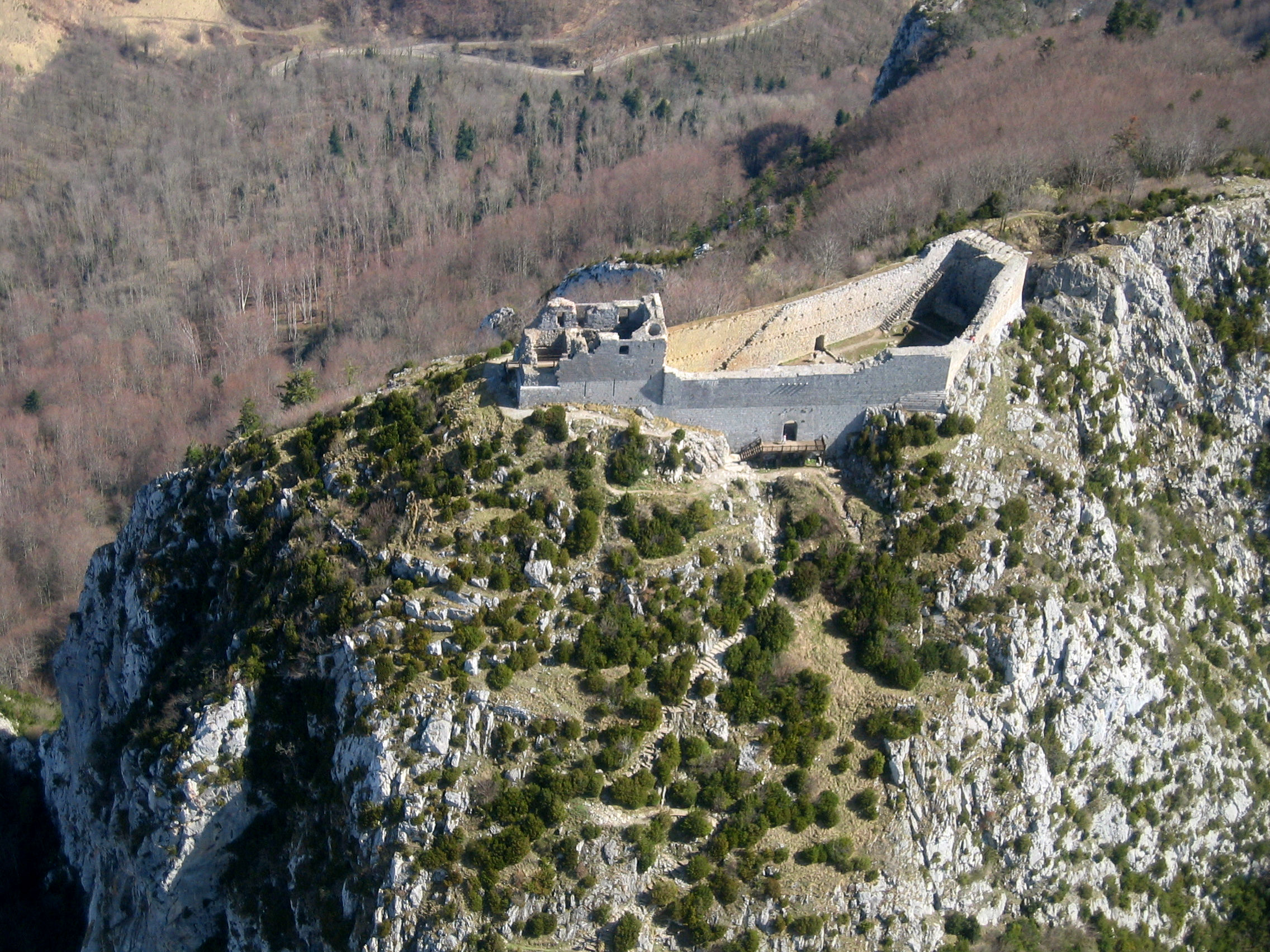
Château de Montségur
The name means "safe hill" in Occitan, but safety was the one thing Montségur ultimately could not provide. Perched at 1,200 meters on a sheer limestone outcrop the locals call a pog — from the Occitan puòg, meaning peak — this fortress in the Ariège department of southern France became the last refuge of the Cathar faith, and in March 1244, the site of one of the most devastating religious persecutions in medieval European history. Today the ruins draw pilgrims, historians, and spiritual seekers who climb the steep path 170 meters above the road to stand where over two hundred people chose death by fire rather than renounce their beliefs.
A Peak Between Worlds
Montségur rises 80 kilometers southwest of Carcassonne, in the borderlands where the Pyrenees begin their climb toward Spain. Human settlement here reaches back to the Stone Age, and Roman coins and tools have been unearthed on the slopes. Through the Middle Ages, the region passed between the Counts of Toulouse, the Viscounts of Carcassonne, and finally the Counts of Foix — each leaving their mark on a landscape that has always sat at the crossroads of competing powers. The rock itself feels like a natural fortress, a geological accident that invited defiance. From the summit, the view stretches across the foothills in every direction, and on clear mornings the light catches the distant snow of the Pyrenean peaks. It is a place that makes you understand why people believed they could hold out against an empire.
The Cathar Stronghold
Around 1204, Raymond de Péreille and his cousin Pierre-Roger de Mirepoix rebuilt the castle that had lain in ruins for decades. Refortified, Montségur became the beating heart of the Cathar movement — home to the theologian and bishop Guilhabert de Castres, and by 1233, formally designated the seat and head of the Cathar church. The Cathars were Christian dualists who rejected the material world and the authority of Rome, and their Perfecti — the ordained clergy — were strict pacifists who refused to fight. What made the castle dangerous to the Catholic establishment was not its military strength but its spiritual magnetism. Believers, dispossessed nobles, and refugees gathered on the pog, building a community of faith around the fortress walls. When fifty men from Montségur participated in the murder of Inquisition representatives at Avignonet on May 28, 1242, the response from the French crown was swift and final.
The Siege and the Pyre
In 1242, Hugues de Arcis led roughly 10,000 royal troops against a castle defended by about 100 fighters and sheltering 211 Perfecti and civilian refugees. The siege ground on for nine months. The Cathars held out through a brutal winter, sustained by sympathetic locals who smuggled supplies up hidden paths. When Basque mercenaries finally seized the barbican in March 1244, the defenders negotiated a surrender: everyone could leave freely, except those who refused to renounce the Cathar faith. A two-week truce followed. During those final days, some defenders chose to receive the consolamentum — the Cathar sacrament — knowing it sealed their fate. On March 16, 1244, between 210 and 215 Cathars, led by Bishop Bertrand Marty, walked down the mountain to a field where a pyre had been erected. No stakes were needed. They mounted the woodpile and perished voluntarily in the flames.
Three Castles, One Ghost
The fortress that visitors see today is not the one the Cathars knew. After the fall, royal forces razed the original structure completely. What stands on the pog now — referred to by French archaeologists as Montségur III — is a post-medieval military fortification typical of 17th-century French defensive architecture, rebuilt and upgraded over three centuries by the crown. Of the Cathar-era castle, designated Montségur II, almost nothing remains. Only the small terraced dwelling ruins on the northeastern flank, just outside the current fortress walls, have been confirmed as authentic Cathar habitations. There is a strange irony in this: the most visited "Cathar castle" in France preserves almost no Cathar stonework. What it preserves, instead, is meaning. The pog itself — the sheer rock, the punishing climb, the wind that never stops — is the true monument.
Solstice Light and Enduring Memory
Each summer solstice, visitors gather at Montségur to witness a solar alignment through two windows in the fortress walls, a phenomenon that has drawn astronomers, spiritual pilgrims, and locals for generations. At the base of the mountain, in the Prat dels Cremats — Occitan for "Field of the Burned" — a modern stele bears an inscription: "Als catars, als martirs del pur amor crestian. 16 de març 1244." To the Cathars, to the martyrs of pure Christian love. The site has inspired a rich body of literature and music, from Iron Maiden's 2003 song "Montségur" to a century of novels exploring Cathar treasure legends. But the real pull of this place is simpler than any legend. Listed as a monument historique since 1862, Montségur endures because it asks the question that has never gone away: what would you refuse to renounce, even at the cost of everything?
From the Air
Located at 42.88°N, 1.83°E in the Ariège Pyrenees. The pog is a distinctive limestone pinnacle visible from altitude, rising sharply from surrounding forested hills. Best viewed at 3,000-5,000 ft AGL. Nearest airports: LFCG (Pamiers - Les Pujols), LFMP (Perpignan). The Pyrenean foothills create turbulence; clear weather recommended for low approaches.