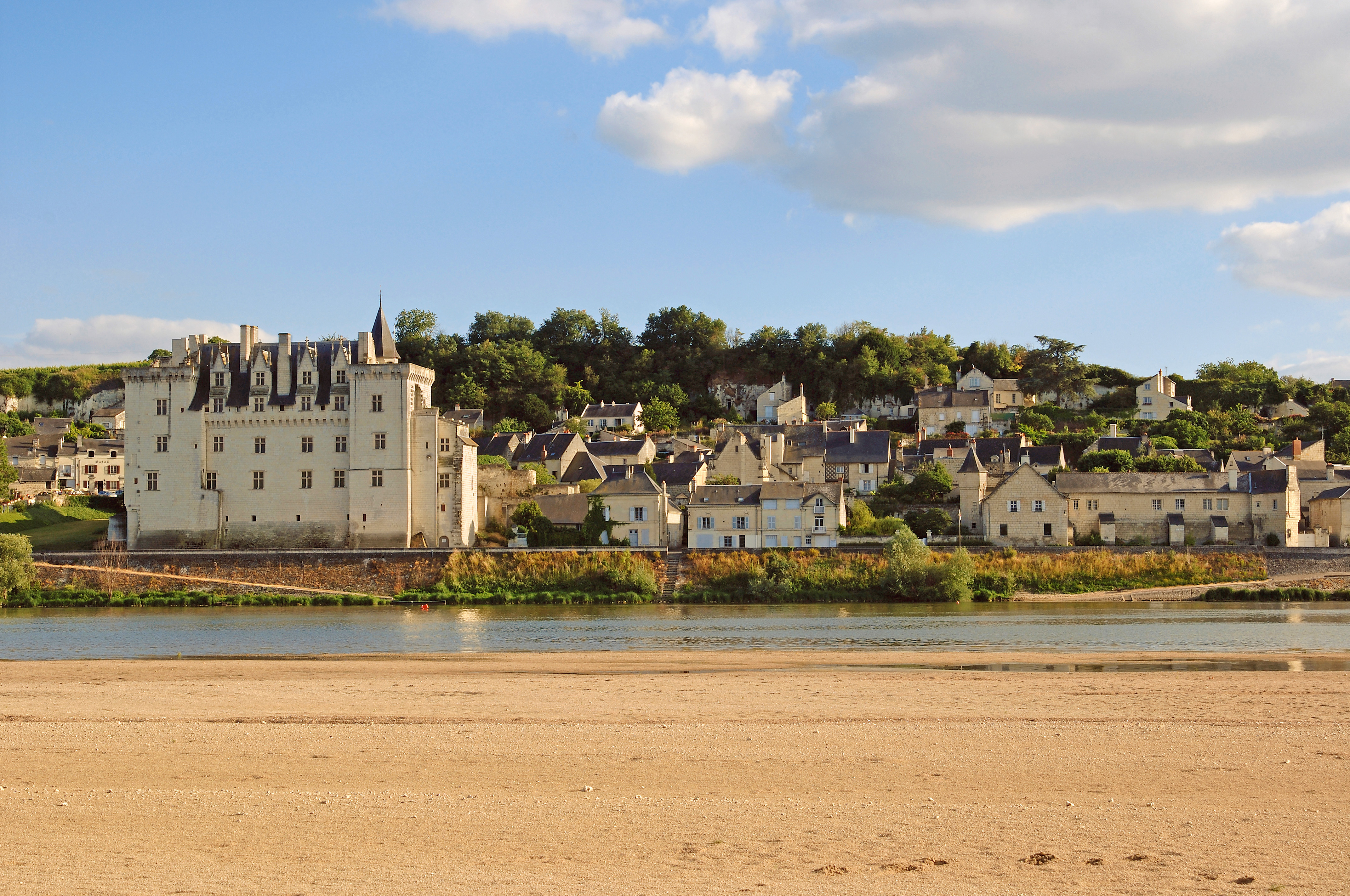
Château de Montsoreau
Most castles sit beside rivers. The Château de Montsoreau was built into one. Its foundations rest directly in the bed of the Loire, where the river meets the Vienne at the convergence of three historic regions — Anjou, Poitou, and Touraine. From the water, the castle appears to grow from the current itself, its pale tufa walls rising from the same stone that forms the local bedrock. William Turner painted it in 1826. Auguste Rodin sketched its north facade around 1897. Alexandre Dumas wove it into his novel La Dame de Monsoreau. Something about this building, half-submerged and impossibly placed, has drawn artists and storytellers for centuries.
Stronghold at the Confluence
Written records of the site date to the sixth century, when it was known as Restis. In 990, Eudes, the first Count of Blois, transformed it into a fortified castle. Within a decade, the Anjou realm had seized it, and Foulques Nerra gave it to Gautier I of Montsoreau, a member of one of Anjou's most prominent families. The fortified castrum quickly became one of forty strongholds in the region and one of the few granted the title of lordship at the turn of the first millennium. A town grew around the castle, and by the second half of the eleventh century, chroniclers described it as one of the most populous and well-fortified settlements in the area. The lords of Montsoreau supervised nearby Fontevraud Abbey from its founding in 1101 — Gautier de Montsoreau's own stepmother, Hersende de Champagne, served as the abbey's first abbess.
A Wealthy Man's Ambition
By 1450, the castle had passed through four noble families and fallen into debt. Louis II Chabot sold the domains to his brother-in-law Jean II de Chambes, one of the wealthiest men in the kingdom. Chambes had entered the service of Charles VII as a young esquire in 1426 and risen to become senior councillor, chamberlain, and eventually the king's "first master of ostel." He served as ambassador to Venice in 1459 and held governorships from La Rochelle to Aigues-Mortes. Between 1450 and 1460, while Chambes was away on diplomatic missions, his castle was rebuilt in the Flamboyant Gothic style that marks the transition from military architecture to architecture of pleasure — large windows replacing arrow slits, ornate chimneys replacing defensive towers.
Between War and Ruin
The castle's later centuries brought turbulence. Protestants sacked Montsoreau in 1568, destroying the Holy Cross Collegiate Church and the town's fortifications. Four years later, Jean VI de Chambes helped organize the regional equivalent of the St. Bartholomew's Day Massacre in Saumur and Angers. By the seventeenth century, the fortress had lost its garrison. René de Chambes petitioned Cardinal Richelieu for royal troops and was refused. His fate was grimmer still: convicted of counterfeiting, he was sentenced to death and fled to England, never to return. The castle passed through increasingly indifferent owners, accumulating 400,000 livres in debts by the early eighteenth century. By 1910, its deterioration alarmed the French Archaeological Society enough that a senator intervened, and the Maine-et-Loire department began acquiring the property in 1913.
Conceptual Art in Gothic Halls
Restoration continued through the twentieth century, interrupted by two world wars. When the château reopened to visitors in 2001, it attracted about 35,000 people a year with a son-et-lumière spectacle. But the most surprising reinvention came in 2015, when French art collector Philippe Méaille signed a twenty-five-year lease and installed his collection of works by the conceptual art collective Art & Language. The result is an unlikely pairing: a fifteenth-century Flamboyant Gothic castle housing one of the world's most important collections of conceptual art. The Château de Montsoreau-Museum of Contemporary Art opened in April 2016, adding yet another chapter to a building that has been fortress, lordship, literary inspiration, and now gallery — all while keeping its foundations in the river.
From the Air
Located at 47.22°N, 0.06°E at the confluence of the Loire and Vienne rivers. The castle is distinctive from the air because it sits directly in the Loire riverbed. Nearest airport: Tours Val de Loire (LFOT), approximately 55 km northeast, or Saumur (LFOD). Part of the UNESCO World Heritage Loire Valley. Best viewed at 1,500–2,000 ft AGL. Follow the Loire upstream from Saumur for a dramatic approach.