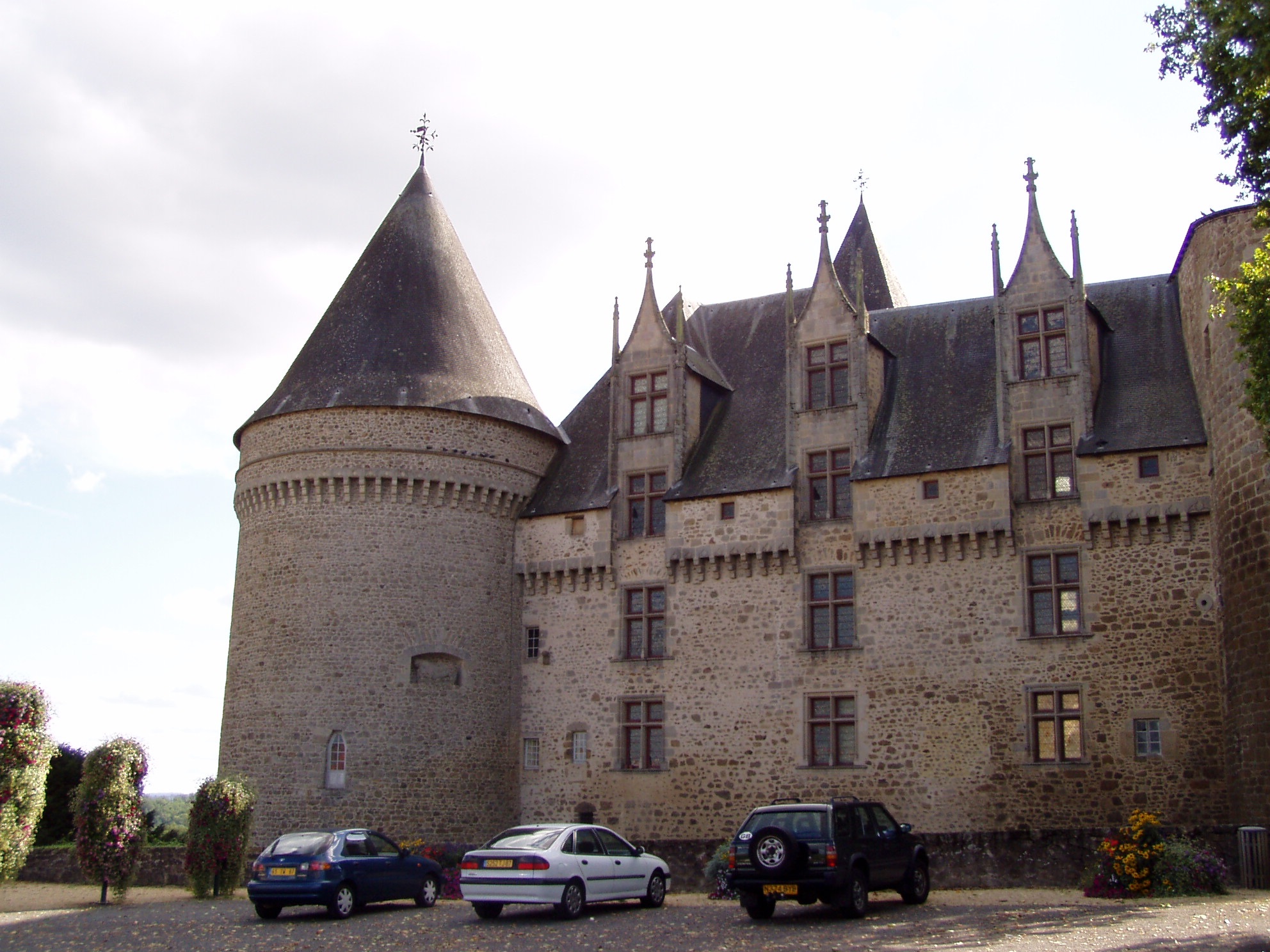
Château de Rochechouart
In 1205, a woman named Alix was locked in a lion's cage. The intendant of Château de Rochechouart had accused her of adultery, and the Viscount -- her husband, Aymeric VI -- ordered this peculiar trial by ordeal. The lion lay down at her feet. Alix was cleared, and the intendant was thrown into the cage in her place, where the lion was less charitable. The story, whether embellished or not, captures something essential about this castle at the confluence of the Grêne and Vayres rivers: it has always been a place where power, drama, and the unexpected converge.
Eight Centuries of One Name
The Viscounts of Rochechouart occupied this castle for 800 years, beginning with Aymeric I around 990 AD. Their story tracks with nearly every major chapter of French medieval and early modern history. Aymeric IV rode with Godfrey of Bouillon on the First Crusade. Aymeric IX joined the Aragon expedition alongside King Philippe III the Bold in 1283. Viscount Jean I fought at the Battle of Crécy in 1346 and died ten years later defending King John II at the Battle of Poitiers. During the Hundred Years' War, the castle became a center of resistance against the English -- Louis de Rochechouart served as chamberlain to Charles V and companion-in-arms of the legendary Bertrand du Guesclin, while his grandson Geoffroy fought alongside Joan of Arc. The family's reach extended beyond the battlefield: Françoise-Athénaïs de Rochechouart, better known as Madame de Montespan, became the famous favorite of Louis XIV.
Blood on the Stones
Not every chapter of the Rochechouart story glitters. François, son of Jean, decorated the hunting room with vivid multicolored frescoes -- then was condemned to exile for the murder of Pierre Bermondet. His son Claude, who painted the Hercules room in elegant grisaille murals, fought as a comrade of Constable Anne de Montmorency and was wounded and captured at the Battle of Saint-Quentin in 1557. During the Reign of Terror, Viscountess Marie-Victoire de Rochechouart was arrested, imprisoned in Paris, and sent to the guillotine in 1794. The dynasty's final military figure, General-Count Louis-Victor-Léon de Rochechouart, fought through the Napoleonic wars, surviving the catastrophic Battle of Berezina, and later served as Governor of Paris from 1814 to 1821. His son Louis-Jules finally sold the castle to the general council of Haute-Vienne in 1936, ending the family's centuries-long stewardship.
Where Crusaders Meet the Avant-Garde
The castle's second life began in the 1980s, when its rooms started hosting cultural events. Since 1985, it has housed a museum of contemporary art -- one of the more striking juxtapositions in French culture. In rooms where viscounts once plotted Crusade strategy, visitors now encounter works by the Dadaist Raoul Hausmann, Arte Povera sculptor Giuseppe Penone, conceptual artist Christian Boltanski, and British sculptor Tony Cragg. The hunting room still displays its original early-16th-century frescoes, their colors still vivid after five hundred years. Nearby, the Hercules room preserves its mid-16th-century grisaille murals. In the main courtyard, a gallery rests on twisted columns that have supported it since the Renaissance. The castle also houses the local subprefecture offices, meaning that Haute-Vienne's bureaucratic business is conducted within walls that have witnessed crusading oaths, a lion's trial by ordeal, and the intimate court intrigues of the Sun King's favorite mistress.
A Fortress Above the Waters
Rochechouart sits at the top of a promontory where the Grêne and Vayres rivers meet, a natural defensive position that explains why a castle has stood here since the early Middle Ages. Aymeric VI built the current structure around 1170 to 1230, and his keep and entry châtelet survive as the oldest visible elements. The castle that visitors see today is largely the product of Jean de Rochechouart-Ponville's Renaissance restoration, which gave the fortress its more refined architectural character. Listed as a monument historique by the French Ministry of Culture, the château carries its weight of history lightly -- part administrative building, part living museum, part memorial to a family whose name was woven into the fabric of France for eight unbroken centuries.
From the Air
Located at 45.82°N, 0.82°E in Haute-Vienne, at the confluence of the Grêne and Vayres rivers. The castle is perched on a promontory and clearly visible from moderate altitude. Nearest major airport is Limoges-Bellegarde (LFBL), approximately 40 km east. Best viewed at 2,000-3,000 ft AGL in clear weather.