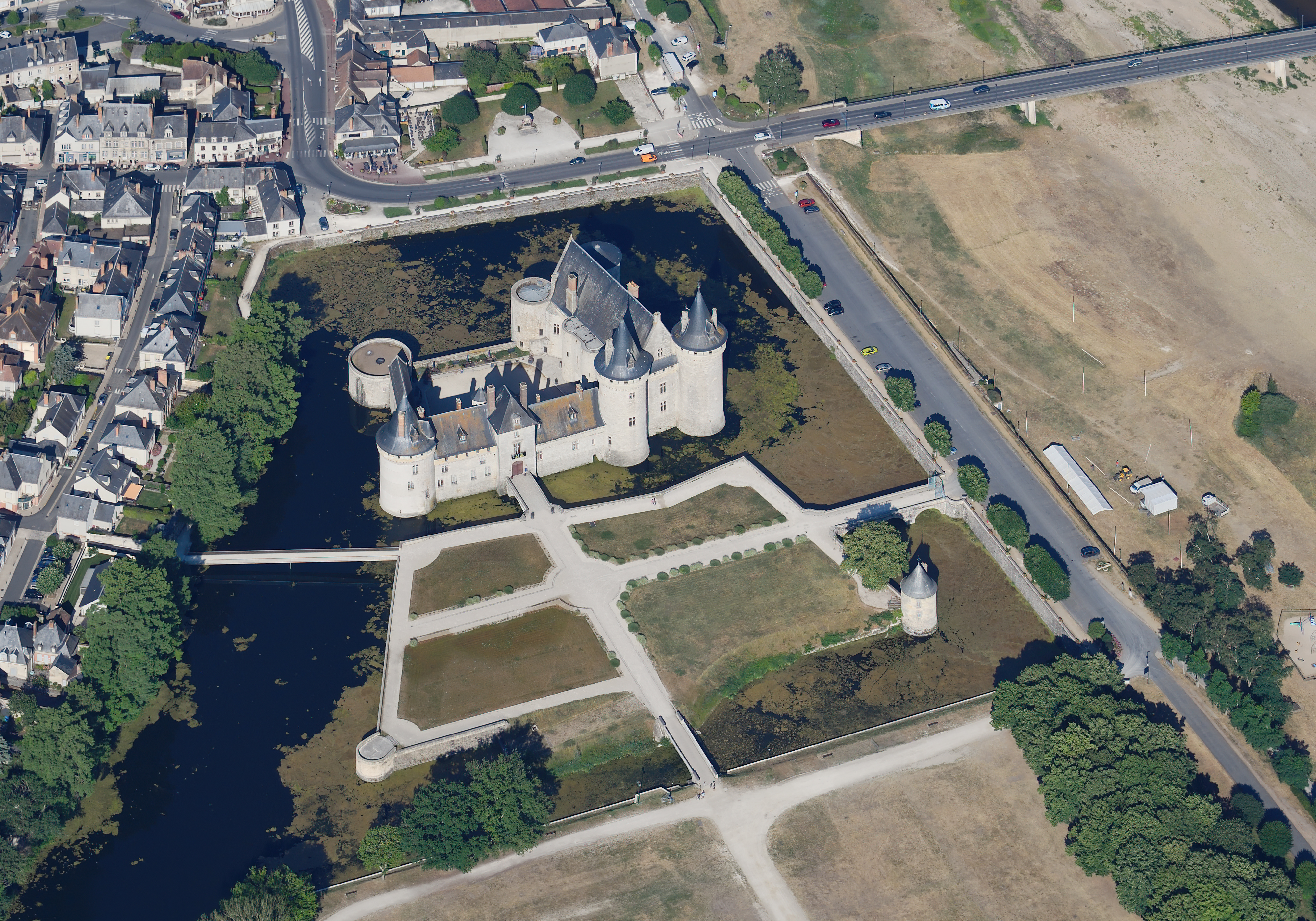
Chateau de Sully-sur-Loire
Joan of Arc arrived at Sully in June 1429, on her way to recapture the Loire bridging points from the English. She came back in March 1430, uninvited and under suspicion -- she had broken the king's truce with the Burgundians by attacking Paris, and the castle where she now stood belonged to George de La Tremoille, her chief detractor at court. She left Sully without the king's permission, rode for Compiegne, and was captured on May 23. It was the last time she would move freely. The Chateau de Sully-sur-Loire has watched many such turning points from its perch on three islands at the confluence of the Loire and the River Sange, a natural fording site that made it strategically essential for nearly a thousand years.
Three Islands, One Fortress
The chateau's unusual layout owes everything to geography. Three small islands clustered in the Loire at its confluence with the Sange, low enough that only the worst floods submerged them. On the northwestern island rose the main keep; on the southwestern, the inner courtyard with its defense towers and galleries; on the eastern, the outer courtyard that once held a church, stables, and domestic buildings. Drawbridges connected the three, and palisades extended over the moats to link them into a single fortification. The town of Sully grew up on the southern bank, its church of Saint Germain perched on a knoll high enough to survive the flooding that defined life along the Loire. Dikes were raised, reservoirs dug, and a mill race channeled between the two rivers -- but the water always returned, shaping the castle's defenses as much as any architect.
The King's Punishment Tower
The first documented reference to a fortress here dates to 1102, describing a castrum soliacense -- a building of enough status to mark the Lords of Sully as regional powers. In 1218, one of those lords overstepped. He levied excessive taxes on his subjects, and King Philip Augustus responded with a characteristically blunt strategy: he seized the lordship and built a cylindrical keep in the outer courtyard, directly in front of the lord's own tower. The message was architectural humiliation. Before the Lord of Sully could reclaim his title, he had to compensate the Bishop of Orleans, his feudal superior, and reimburse the king for the cost of the punitive tower. The keep stood until 1717, a seven-century reminder that royal patience had limits.
Grand Sully and the Huguenot Duke
In 1602, Claude de La Tremoille sold the estate to Maximilien de Bethune, the brilliant finance minister of King Henri IV. Known as Grand Sully, Bethune was a Huguenot who had fought alongside Henri in the Wars of Religion and been rewarded with the title Duke of Sully in 1606. The religious wars made the duke cautious. He demolished the ruined Catholic church of Saint Ythier, which had stood in the outer courtyard since the 11th century, and fortified the existing structures. His descendants continued to reshape the castle -- building a connecting wing to the gate tower in 1715, destroying the old royal keep in 1717, and removing the stables in 1767 to clear the outer courtyard. Through it all, the family held on, the title passing through collateral lines when direct succession failed, until Eugene II undertook major repairs between 1869 and 1908.
Music Where Armies Once Marched
When Eugene II's son died in 1908, the duke lost interest in the chateau, and the property eventually passed to the Departement du Loiret. Restoration work has continued in phases ever since, uncovering layers of construction that stretch from medieval palisades to 18th-century salon decor. The chateau still holds a set of six 17th-century tapestries depicting the story of Psyche, along with paintings of the Sully ancestors and period furnishings. The tomb of Grand Sully and his second wife rests here as well, the man who balanced France's finances sleeping beneath the fortress he bought to secure his legacy. Each June, the chateau hosts a classical music festival, its vaulted halls and riverside setting providing acoustics that no modern concert hall could replicate. The Loire still rises against the dikes some years, and the Sange still floods the surrounding fields, but the three-island fortress endures -- nine centuries of stone standing against the river it was built to control.
From the Air
Located at 47.768N, 2.375E on the Loire River, approximately 40 km east-southeast of Orleans. The chateau is visible from the air as a fortified complex rising from a moated island at the confluence of the Loire and the Sange rivers. The distinctive keep with its four towers and the adjacent inner courtyard make it easily identifiable. Best viewed from 2,000-3,000 feet AGL. Nearest airports include Orleans-Bricy (LFOJ) approximately 40 km to the west-northwest and Orleans-Saint-Denis-de-l'Hotel (LFOZ) approximately 30 km to the west. The Loire River is a reliable visual navigation aid running east-west through the area.