Chateau de Talcy
Pierre de Ronsard was twenty when he saw Cassandre Salviati at a ball in Blois in 1545 and fell irrevocably in love. She was fifteen, the daughter of a Florentine banker who had bought a fortified estate north of the Loire. Ronsard was not considered a suitable match. She married someone else within a year. But Ronsard dedicated to Cassandre some of the most celebrated sonnets in the French language -- verses that turned a country chateau into one of the great addresses of literary history. A generation later, Cassandre's niece Diane would inspire another poet, Agrippa d'Aubigne, to write the collection he called Le Printemps. The Chateau de Talcy produced no kings and won no battles, but it launched two of the most important bodies of French Renaissance poetry from behind its medieval tower.
A Banker's Fortress on Borrowed Ground
The estate first appears in records from 1221, though no description of the building survives. By 1480, the Simon family had built the square central tower that still dominates the courtyard. When the family line died out in 1502, the property eventually passed to Bernard Salviati, a Florentine banker who needed to stay close to his client, King Francois I, without drawing too much attention to his foreign origins. Salviati was granted permission to fortify the building in 1520, but with a pointed restriction: he could not keep an armed guard. The result was a chateau that looked defensive from the outside -- dramatic fortifications, a stern medieval tower -- but functioned as a private residence, its Italian owner carefully downplaying the Renaissance style that was becoming fashionable precisely because it was Italian. The Salviati wings were built plain and restrained, a diplomatic architecture reflecting a man who needed to belong without appearing to dominate.
The Room Where a Massacre Was Planned
Inside the chateau is a chamber called the Chambre de la Medicis. Here, according to tradition, Catherine de Medici and her son Charles IX gathered on June 28 and 29, 1572, for what became known as the Conference of Talcy. Two months later, the Massacre of Saint Bartholomew's Day convulsed Paris, as Catholic mobs slaughtered thousands of Huguenots in one of the most horrific episodes of the French Wars of Religion. Whether the massacre was actually planned in this room remains debated, but the connection between Talcy and the religious violence of the era runs deep. The Salviati family was Catholic, but the later owners -- the Gastebois, Vincens, and Stapfer families -- were devout Huguenots. Their Protestant faith would shape the chateau's fate in ways the Salviatis could never have imagined.
Saved by Conviction
The French Revolution destroyed countless aristocratic estates, but Talcy survived intact. The reason was its owners. By the 1790s, the chateau belonged to a network of Huguenot families -- the Gastebois, the Vincens, the Stapfers -- whose egalitarian beliefs aligned with revolutionary principles. They were no strangers to dissent. Albert Stapfer, who inherited the chateau in the 19th century, had manned the barricades in the 1830 revolution as a young liberal journalist. After retiring to Talcy, he took up an interest in daguerreotypes and photographed the chateau in a series of images that still hang on its walls -- some of the earliest photographic records of a Loire Valley estate. During the Franco-Prussian War, Albert hosted General Antoine Chanzy at Talcy before Prussian forces drove Chanzy out at the Battle of Beaugency in December 1870.
Preserved in Amber
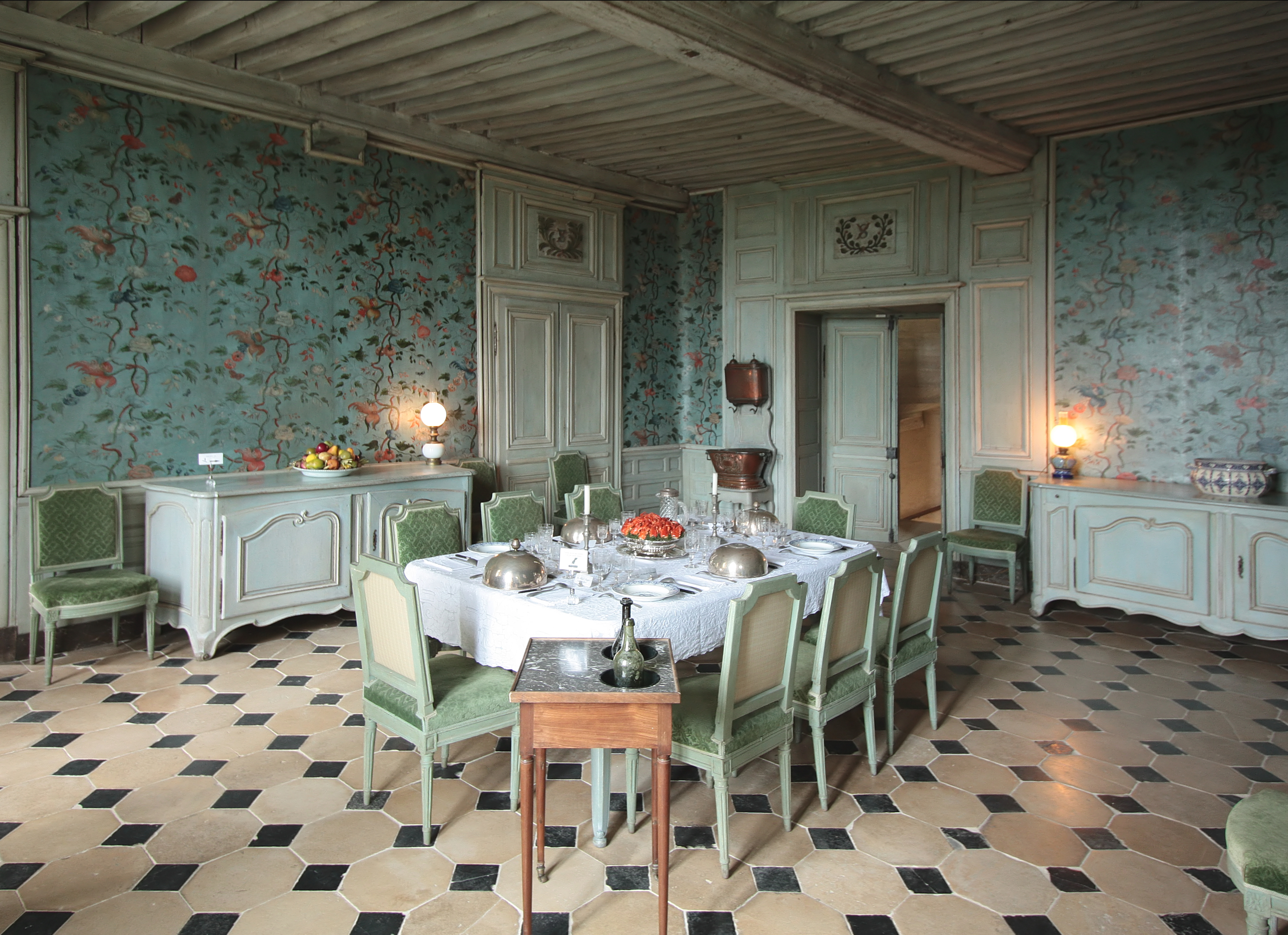
When Albert Stapfer died in 1892, his children maintained the property through the early 20th century. In 1933, Valentine and Helene Genevieve Stapfer sold the chateau to the French state on one strict condition: the 18th-century interiors must be preserved intact. The state agreed, and Talcy has remained essentially unchanged since. The courtyard well, covered by a distinctive stone-columned roof built in 1814, has become the chateau's emblem. A wine press from 1808 still sits in one of the barns. In a ground-floor room, a wooden plaque above the fireplace reads "Cult Evangelical Protestant" -- the worship space the Stapfer family built when the nearest church did not share their faith. Today, roughly 20,000 visitors a year walk through the rooms that Ronsard's Cassandre once knew, a modest place whose literary and religious history far outweighs its size.
From the Air
Located at 47.770N, 1.444E, north of the Loire River in the Loire Valley, approximately 25 km southwest of Orleans. The chateau is a modest structure centered on a square medieval tower, less visually prominent from the air than the grand chateaux at Chambord or Blois. Best viewed below 2,000 feet AGL. Nearest airports include Blois-Le Breuil (LFOQ) approximately 25 km to the south and Orleans-Saint-Denis-de-l'Hotel (LFOZ) approximately 45 km to the east. The Loire River provides reliable visual navigation running east-west to the south.