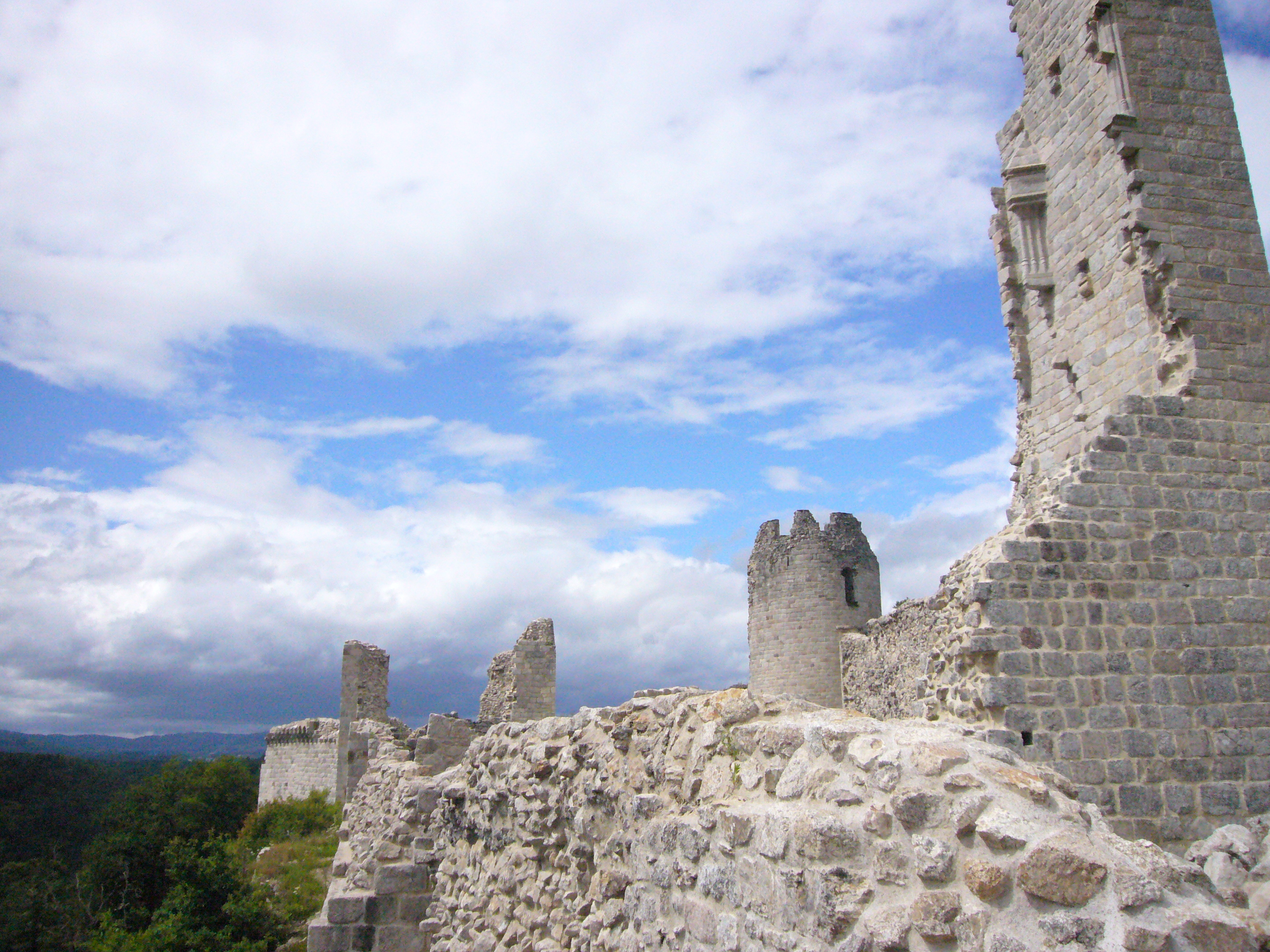
Chateau de Ventadour
In 1125, a servant's son was born inside the walls of a fortress that two kings of England would fail to conquer. Bernard de Ventadorn grew up to become one of the most celebrated troubadours in European history, and the castle that shaped him still clings to its rocky spur above the Luzege valley in Correze, refusing to disappear entirely. The Chateau de Ventadour is not a showpiece restoration or a manicured heritage site. It is a ruin in the truest sense -- wild, weathered, and stubbornly present after nearly a thousand years of construction, siege, plunder, demolition, and slow archaeological resurrection.
The Fortress That Defied Kings
When Archambaud II of Comborn's son claimed the rocky outcrop above the Luzege in 1059, he chose a site that nature had already fortified. The plateau stretches 170 meters long but only 30 meters wide at its broadest, a natural blade of rock with sheer drops on every side. The fortress he raised there controlled the viscounty of Ventadour, with political reach extending to Egletons and Ussel across the surrounding countryside. By the late 12th century, that reach had attracted dangerous attention. Henry II of England laid siege to Ventadour in 1182 and withdrew after months of failure. His son Richard the Lionheart tried again in 1198, equally unsuccessfully -- and departed for Chalus, where he was killed shortly after. The fortress that frustrated Plantagenet ambition stood long after the Plantagenet dynasty itself crumbled.
Where Troubadours Sang
Ventadour's place in literary history is as remarkable as its military record. Ebles II, viscount in the late 11th century, cultivated the courtly arts of Languedoc and befriended Guillaume IX of Aquitaine, one of the first known troubadours. Together they established a poetic school at Ventadour. From that tradition emerged Bernard de Ventadorn, born around 1125 to a servant within the castle. Bernard's poems of longing and unrequited love became foundational texts of troubadour poetry, influencing lyric traditions across Europe for centuries. That a servant's child could rise to such prominence through poetry speaks to the peculiar cultural ferment within these walls -- a place where the arts could flourish even as the ramparts were being raised higher against the next invader.
Wars, Bandits, and Slow Abandonment
The Hundred Years' War brought a different kind of occupier. In 1379, a brigand named Geoffroy seized Ventadour and used it as a base for ransoming and plundering the surrounding countryside for nearly a decade. The legitimate lords eventually reclaimed it, and Charles de Ventadour built a new residence within the walls around 1450. His son Louis established a military academy there, training pages for royal service. Henri III elevated Ventadour to a duchy in 1578, making it the first duchy of the Bas-Limousin. But prestige could not prevent what distance and changing tastes made inevitable. When Louis-Charles became duke in 1649, he preferred Paris. The castle began its long decline, abandoned to tenants and weather. By the time Nicolas de Nicolay visited, he observed that neglect of the roof had left the castle falling into ruins -- a situation he called a 'big shame.'
From Revolutionary Demolition to Romantic Ruins
The French Revolution accelerated what neglect had started. In 1793, the Committee of Public Safety in Egletons ordered Ventadour's destruction, and its roofs were torn away. Three years later, the castle was sold to a farrier for salvage. By 1800, a demolition contractor was hauling off the stones, cutting new access paths through the enclosure walls to make the work easier. The destruction might have been total had Madame d'Ambert de Lamaziere not purchased the vestiges in 1829 -- not to preserve history, but to host pastoral afternoons among what she called the 'romantic ruins.' The site passed to the Levis-Mirepoix family in 1895, and in 1900 a festival honored Bernard the troubadour. During World War II, the ruins found one last military purpose: the French Resistance used the outcrop as an observation post, and a brief engagement with a retreating Nazi column on the D991 is commemorated by a roadside memorial nearby.
Fragments Recovered
The site was classified as a historic monument in 1946, but nearly two decades passed before serious work began. Consolidation and excavation started in 1965, and by 1980 archaeologists had identified the original locations of rooms within the enclosure and recovered decorative elements from the lordly residence. Further digs in 2003 uncovered the northeastern curtain wall, and work in 2004 and 2005 exposed the barbican and tower. Today the ruins are open to visitors, with guided tours offered in summer. What remains is fragmentary -- traces of a chapel, a round tower, a section of wall that may have been a square keep -- but the site itself is extraordinary. The rocky outcrop is still remarkably wild, the valley below still green and steep. From the air, the narrow ridge of stone reads clearly against the forested landscape, a place that was built to be seen from a distance and still commands attention after a millennium.
From the Air
Located at 45.39N, 2.12E on a dramatic rocky outcrop above the Luzege valley in the Correze department of central France. Best viewed at 3,000-5,000 ft AGL to appreciate the narrow ridge and surrounding valley. The ruins are visible as stone fragments on a forested spur. Nearest airports include Brive-Souillac (LFSL) and Limoges-Bellegarde (LFBL). The D991 road below provides a useful visual reference.