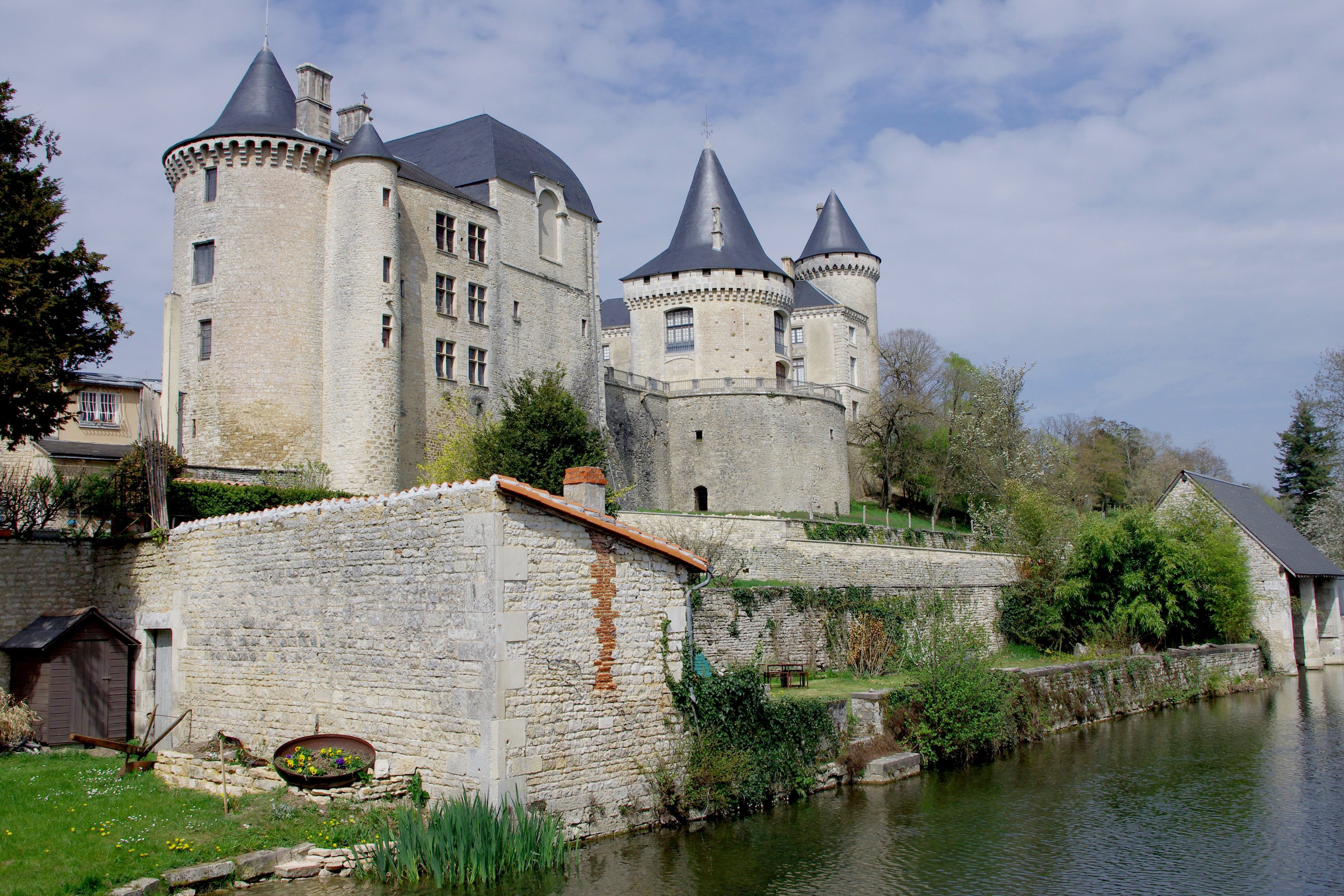
Château de Verteuil
Seven tapestries depicting the hunt of a unicorn once hung in the master bedroom of a castle in the Charente valley. By the 1790s, during the chaos of the French Revolution, peasants had taken them to insulate potatoes and cover fruit trees. In the 1850s, Count Hippolyte de La Rochefoucauld found them in a barn, still luminous despite decades of agricultural duty. By 1923, they belonged to John D. Rockefeller Jr. and hung in The Cloisters in New York. That improbable trajectory -- from medieval splendor through revolutionary destruction to a Manhattan museum -- mirrors the story of the Château de Verteuil itself, a fortress that has been besieged, burned, demolished, and rebuilt so many times that survival seems to be its defining trait.
One Family, One Thousand Years
The Château de Verteuil has been in the hands of the La Rochefoucauld family since 1080, when it first appears in the historical record. Nearly a millennium of continuous ownership by a single dynasty is extraordinary even by the standards of French aristocracy. The castle commands a strategic position above the village of Verteuil-sur-Charente, controlling the old road between Limoges and La Rochelle -- the route connecting the courts of France and Spain. The medieval chronicler Jean Froissart called it 'a strong castle in Poitou on the borders of Limousin and Saintonge.' Its location made it valuable, and its value made it a target. The first recorded siege came in 1135, and Eleanor of Aquitaine may have sheltered here with Louis VII in 1137, her mother being a Rochefoucauld. For centuries, kings, queens, and emperors passed through -- Philip VI in 1332, Francis I in 1516, Emperor Charles V in 1539, Henry II with his children in 1558.
The Castle That Refused to Stay Destroyed
Verteuil's history reads like a cycle of demolition and resurrection. During the Hundred Years' War, the English held it from 1360 to 1385 under the Treaty of Brétigny, yielded only when John Chandos threatened to behead the keeper's brother. When Charles VII finally expelled the English in 1442, he then turned and destroyed the castle himself, punishing the Rochefoucaulds for overreach. They gathered the original stones and rebuilt. In the Wars of Religion, the château served as a Huguenot stronghold -- the 6th national synod of the Reformed Church of France met here in 1567. During the Fronde revolt of 1650, royal troops under the Duc de la Meilleraye dismantled the towers, removed the drawbridge, and filled the defensive ditch. Still the family rebuilt. The Revolution of 1793 brought fire that gutted the gallery, the chapel facade, and the northwest wing. And still they rebuilt, this time in the Romantic style after the Bourbon Restoration of 1815.
The Author in Exile
Among the Rochefoucaulds who called Verteuil home, none left a deeper mark on French literature than François VI. After leading 2,000 knights to Bordeaux in the failed Fronde revolt against the crown, he was exiled by Louis XIV. He returned to Verteuil in 1652, and in the quiet of a partially ruined castle, spent seven years writing his Mémoires. Restored to royal favor in 1662, he published his Maximes three years later -- the collection of pithy, cynical aphorisms that remains a cornerstone of French moral philosophy. He died in Paris in 1680 but was buried in the Franciscan chapel at Verteuil, founded by his ancestor in 1470. In 1893, the architect Frantz Jourdain transformed the 14th-century tower into a library honoring the famous author, designing it as a 'chapelle intellectuelle' -- an intellectual chapel devoted to the man who wrote that 'our virtues are most frequently but vices in disguise.'
Towers and Shadows on the Charente
The present château, with its five conical towers and slate-capped watchtower, dates largely from the 15th century onward, though 12th-century walls survive in places. Designed on a triangular plan, the medieval gatehouse forms the point from which two wings extend. A 1728 inventory after the death of Duke François VIII cataloged 1,069 works in the library and described a master bedroom fitted with violet velvet embroidered in gold and silver. Since World War II, archaeological work has revealed buried sections dating to the 12th and 13th centuries, including the room that once housed the drawbridge mechanism. In 1958, a completely unknown 11th-century chapel was discovered beneath a 12th-century stairway, in excellent condition. The château was listed as a monument historique in 1966, with full protection granted in 2010, acknowledging that both the visible castle and the ground beneath it hold centuries of history still waiting to be uncovered.
Hidden in Plain Sight
During the Revolution, the Ruffec Committee of Public Safety arrived to enforce the new order at Verteuil. They burned archives and thirty family portraits. But the seven Unicorn tapestries -- among the finest surviving medieval textiles in the world -- were spared because their royal insignia had already been cut out, perhaps deliberately, to protect them from the mob. Peasants carried them away as practical goods. For decades, these masterworks, believed to have been woven to celebrate the marriage of Anne of Brittany and Louis XII around 1500, served as frost blankets and barn coverings. When Count Hippolyte found them in the 1850s, their colors remained remarkably vivid. After restoration, they hung in the château until 1923, when they were sold to Rockefeller and shipped to New York. Today, visitors to The Cloisters stand before them without knowing that these threads once kept a French farmer's vegetables from freezing.
From the Air
Located at 45.98°N, 0.23°E in the Charente valley, a few miles north of Angoulême. The château's five conical towers are visible from moderate altitude, sitting prominently above the village of Verteuil-sur-Charente along the river. Nearest airports include Angoulême-Brie-Champniers (LFBU) approximately 30 km south. Best viewed at 2,000-3,000 ft in clear conditions.