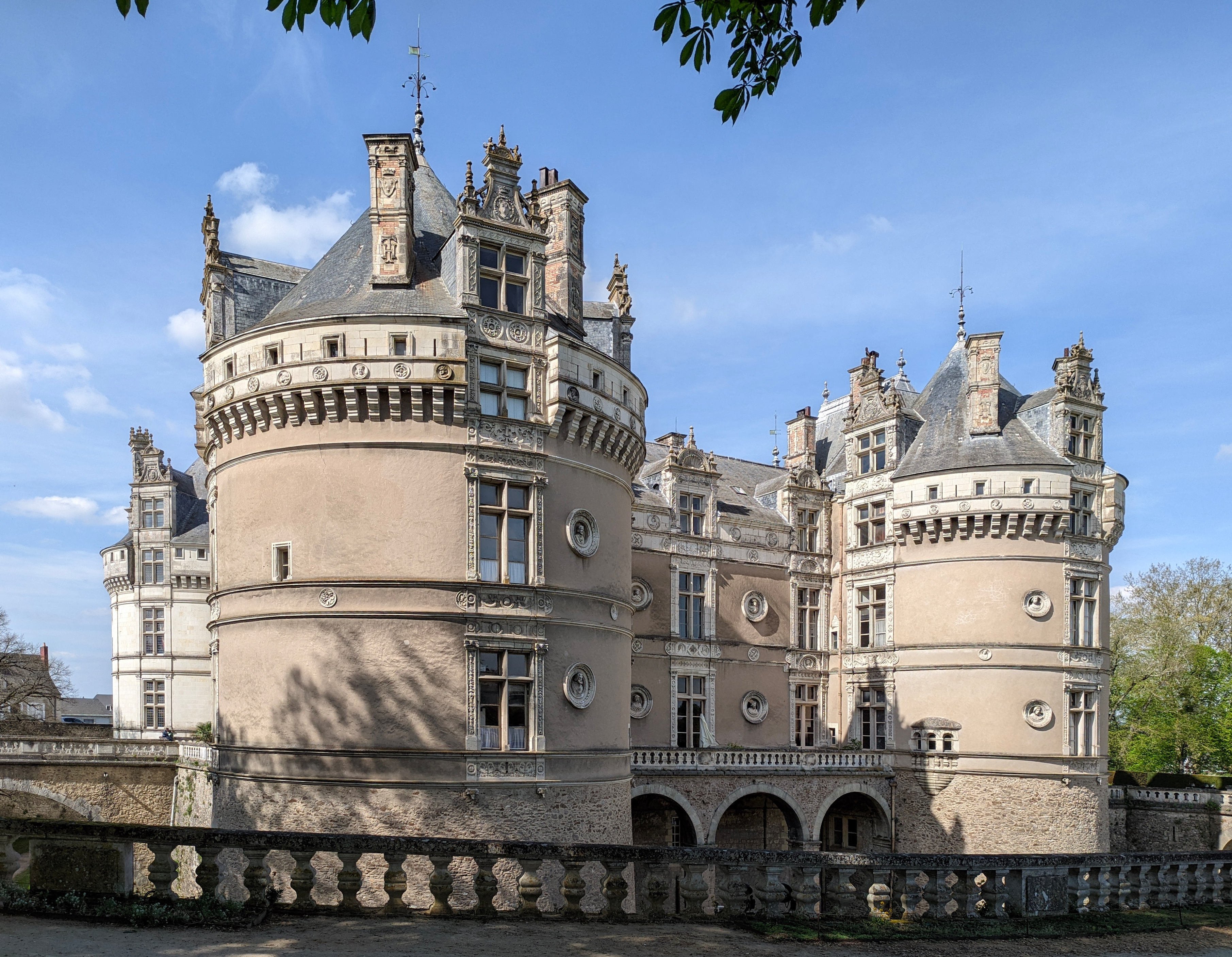
Chateau du Lude
Some chateaux become museums. The Chateau du Lude became a family home and never stopped being one. Perched on the banks of the Loir river at the crossroads of Anjou, Maine, and Touraine, this is the northernmost chateau of the Loire Valley and among the last important historic castles in France still inhabited by the family that has owned it for more than 260 years. Its facades tell four centuries of architectural evolution in a single glance -- medieval fortress walls giving way to Renaissance elegance, then to the clean lines of 18th-century classicism. The effect is less a building than a timeline carved in stone.
Sentinel on the Loir
The original fortress rose between the 10th and 11th centuries on the banks of the Loir -- not to be confused with the grander Loire to the south. Its purpose was bluntly military: defend the county of Anjou from Norman raids pushing up the river valleys. When the Normans faded as a threat, the English took their place during the Hundred Years' War, and Le Lude held its ground through those long centuries of intermittent siege. The site earned its strategic reputation the hard way, standing at a junction of three historic provinces where control of the river crossing meant control of the countryside. Traces of the medieval fortification still anchor the chateau's structure, visible in the thickness of certain walls and the bones of the old defensive plan.
Italian Artists in a French Fortress
Transformation began at the end of the 15th century when Jehan de Daillon, chamberlain to King Louis XI, took possession of the Le Lude estates. Daillon had ambitions that went beyond military architecture. He brought Italian artists north across the Alps to convert the fortress into a residence, joining the wave of Renaissance influence that was remaking the Loire Valley's castles from strongholds into palaces. The work married Italian decorative sensibility with the existing French medieval structure, producing a hybrid that was neither fully one tradition nor the other. It was a pattern repeated at chateaux across the valley, but at Le Lude the transformation happened gradually, each generation adding its own layer rather than demolishing what came before.
From the East India Company to the Revolution
In 1751, the chateau passed to Joseph Duvelaer, who headed the Council of the French East India Company. His niece, the Marquise de la Vieuville, left perhaps the most visible mark on Le Lude, commissioning the classical wing built in the style of Louis XVI -- the clean, restrained facade that visitors see today alongside the older Renaissance and medieval sections. When the French Revolution arrived, the Marquise defended the chateau, and it survived where many aristocratic properties did not. Her descendants, the Talhouet-Roy family, devoted the 19th century to careful restoration, preserving rather than remaking. The current occupants, Count and Countess Louis-Jean de Nicolay, continue that tradition, maintaining a property that has passed through family hands without interruption.
Gardens That Remember Every Century
Le Lude's gardens mirror the chateau's layered history. French formal design meets English landscape style in grounds that have evolved continuously rather than being planned in a single vision. A rose garden occupies one section, topiary hedges sculpt another, and a labyrinth offers the kind of playful geometry that 17th-century garden designers loved. A botanical walk threads through the property, introducing plants that reflect centuries of horticultural fashion. From the air, the chateau and its grounds read as a compact composition on the riverbank -- the Loir curving past medieval stone and manicured green in a scene that has changed less in outline than in detail over the past thousand years.
From the Air
Located at 47.65N, 0.16E on the Loir river in the Sarthe department. The chateau is visible along the north bank of the Loir, with its formal gardens extending toward the river. Le Mans Arnage Airport (LFRM) is approximately 45 km to the north-northwest. Tours Val de Loire Airport (LFOT) is roughly 50 km to the south. The surrounding terrain is gentle river valley farmland.