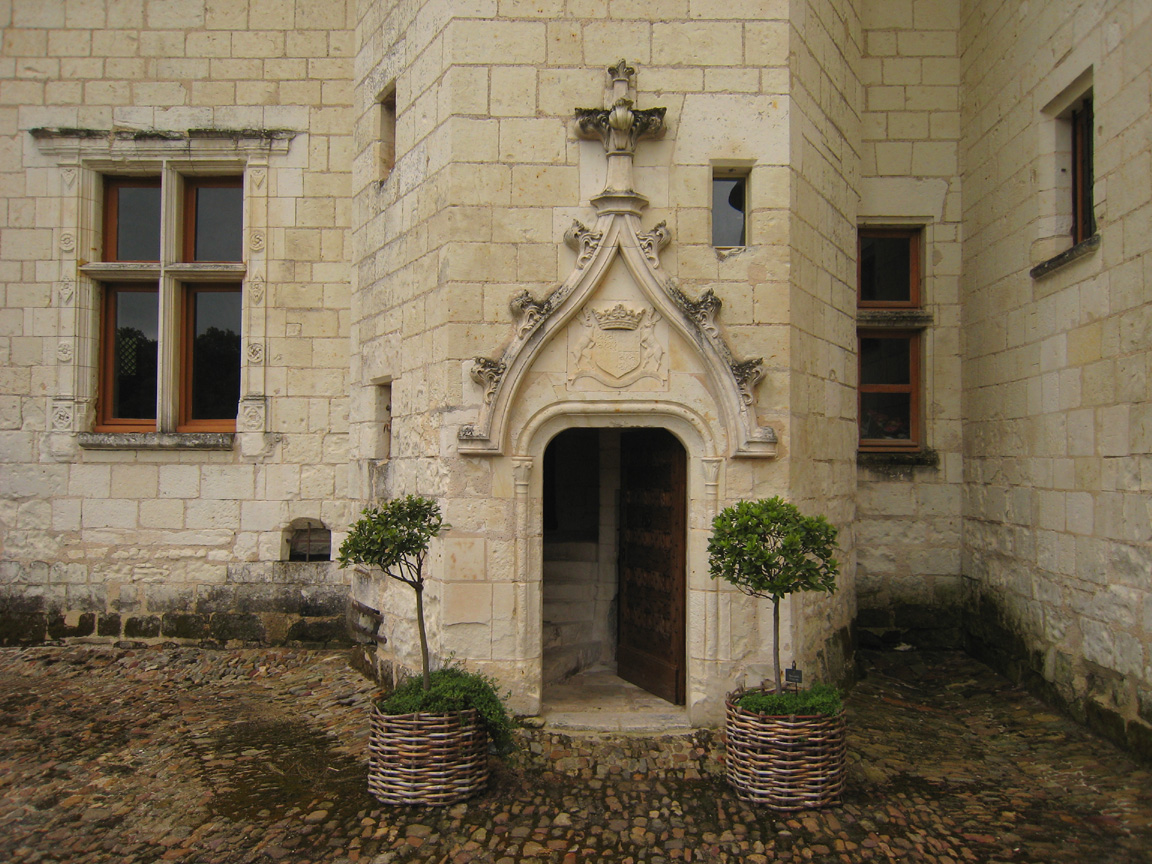
Château du Rivau
Joan of Arc needed horses. In 1429, with the Hundred Years' War grinding toward its conclusion, she rode to the Chateau du Rivau in the Touraine countryside because it was already famous for the quality of its war horses. Nearly a century later, Rabelais immortalized the castle in Gargantua, awarding it to the fictional captain Tolmere as a prize for victories in the Picrocholean Wars. The real Rivau has always blurred the line between history and legend, a fortified castle that became a Renaissance showpiece, then decayed for centuries before being reborn as a place where medieval stone, fairy-tale gardens, and contemporary art coexist in deliberate tension.
The Beauvau Dynasty
The Chateau du Rivau belongs to the Beauvau family's story as much as to the land. Related to the Counts of Anjou, the Beauvau held an unusual feudal privilege: they could pay homage to their suzerain while standing, wearing hats, and carrying swords at their sides. During the 13th century they served the Kings of France, and in 1454, Isabeau de Beauvau married Jean II de Bourbon, binding the family to the royal bloodline. The castle remained in Beauvau hands for 247 years. During the 17th century, Cardinal Richelieu himself protected Le Rivau because his sister Francoise had married Jean de Beauvau, lord of Rivau. When the family was elevated to princes of Lorraine, they left the Touraine, and the castle eventually passed to the Marquis Michel-Ange de Castellane, lord of Villandry, in 1768.
Stables Fit for Kings
War horses were bred at Le Rivau long before Joan of Arc arrived, but it was Francois de Beauvau, captain to King Francis I, who formalized the operation. Around 1510, he commissioned stables in the outbuildings courtyard whose plans drew directly from Italian Renaissance architecture, something the knights had encountered while fighting for the king in Italy. These were not functional sheds but designed spaces, among the first in equestrian architecture where an architect created stables with deliberate aesthetic intent. The stables became the royal stables of Henry III and housed his stallions. Francois de Beauvau died at the Battle of the Sesia River in 1524, fighting alongside the legendary knight Bayard. His heir, Gabriel de Beauvau, continued the work, building stables whose pioneering style blended military purpose with Renaissance elegance.
From Fortress to Fairy Tale
The castle retains the silhouette of a 13th-century fortification: a square keep at its heart, defensive walls, the compact geometry of a building designed to withstand siege. But the Renaissance softened it. In the dining hall, a Flemish master of the 16th century painted the biblical Feast of Belshazzar over the fireplace mantel. The Golden Fleece Room speaks to the chivalric aspirations of its owners. At the turn of the 20th century, the sculptor Alphonse de Moncel de Perrin, who had worked on the ornamentation of the Petit-Palais in Paris, secured Le Rivau's listing as a Monument Historique in 1918. The painter Pierre-Laurent Brenot lived there from 1960 to 1992, after which new owners began an 18-year restoration campaign that stabilized the castle and grounds.
Gardens of Wonder
Today, twelve gardens surround the castle, each one themed around fairy tales and legends. They hold the official French designation Jardin Remarquable, recognition reserved for gardens of exceptional design and botanical significance. More than 300 rose varieties bloom here, cultivated from the stocks of celebrated breeders including Andre Eve and David Austin. Among the rose beds and hedgerows, contemporary sculptures by artists such as Fabien Verschaere, Frans Krajcberg, and Philippe Ramette appear unexpectedly, their modern forms creating a deliberate counterpoint to the medieval and Renaissance surroundings. The effect is a place that refuses to be a museum, where the past and present are equally visible, and where a castle that once bred horses for war now cultivates beauty for its own sake.
From the Air
Located at 47.104N, 0.323E in the village of Lemere, Touraine, in the Indre-et-Loire department. The castle sits in the Loire Valley chateau region. From the air, look for a compact fortified structure with a square keep surrounded by formal gardens. Nearest airports: Tours Val de Loire (LFOT) approximately 50 km northeast, Poitiers-Biard (LFBI) approximately 70 km south. The surrounding landscape is gentle rolling farmland and vineyards typical of the Touraine. Best viewed at low altitude in clear weather.