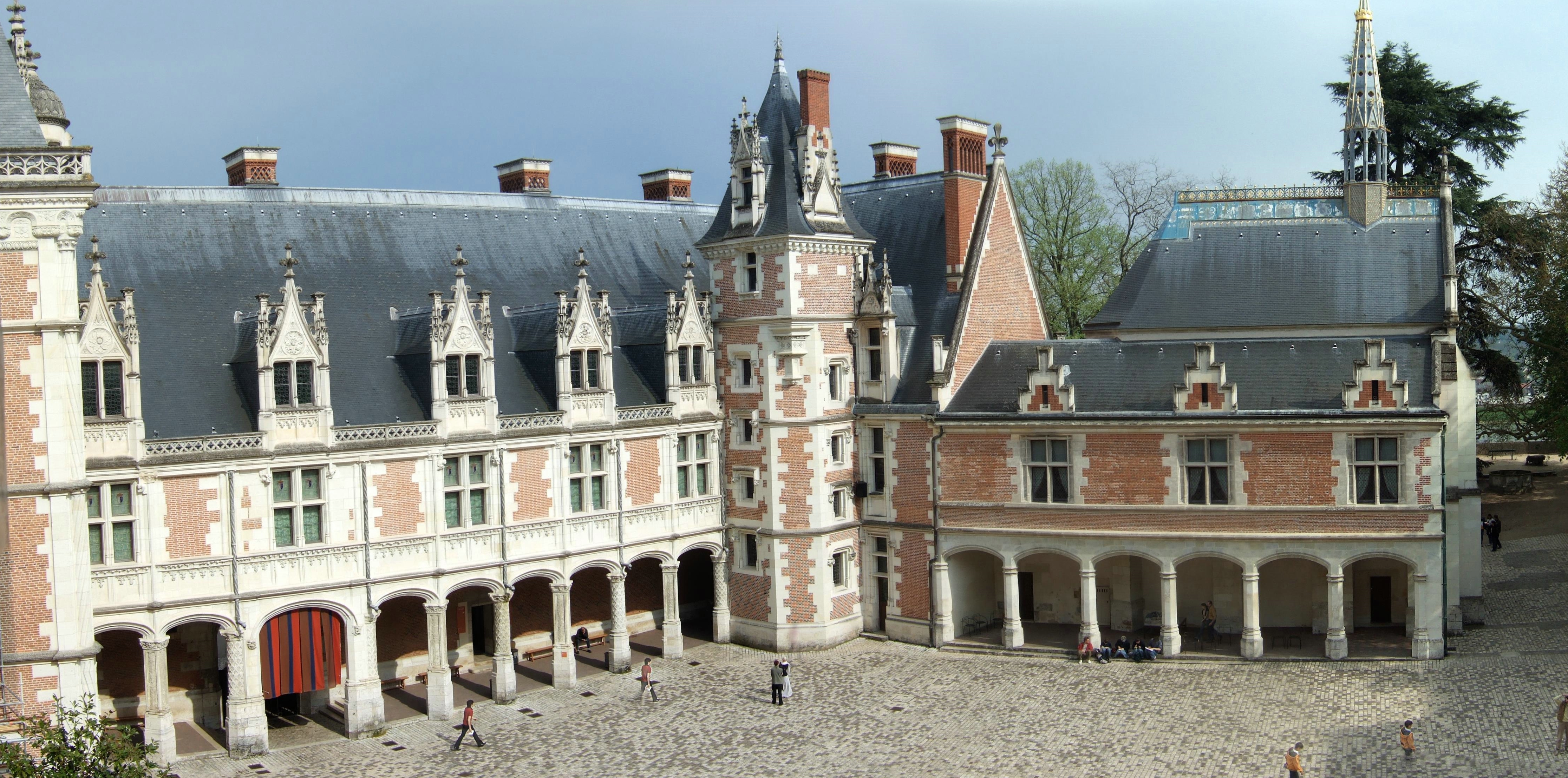
Château of Blois
On the morning of December 23, 1588, Henry I, Duke of Guise, walked through the corridors of the Château de Blois to answer a summons from the king. He never left the building alive. Henry III's bodyguards killed him in the royal apartments, and the next day they murdered his brother, Cardinal Louis II of Guise, within the same walls. The château had been a seat of power for centuries by then, but those two December days fixed its reputation: this was a place where the business of governing France was conducted with both elegance and violence, sometimes in the same room.
Four Styles, One Courtyard
What makes the Royal Château de Blois architecturally extraordinary is not any single wing but the collision of four. Construction began in the thirteenth century with a medieval fortress, and each subsequent era added rather than replaced. The Louis XII wing, built around 1500 in the Late Gothic style, faces a courtyard with the Francis I wing, whose Renaissance facade features the most famous element of the entire complex: a monumental spiral staircase covered in fine bas-relief sculpture, open to the courtyard through a series of balconies. These staircases served as prototypes for the even grander ones at the Château de Chambord, built a few years later. Behind the Francis I wing, the Façade des Loges presents a series of disconnected loggias in the Italian manner. The fourth addition, the Classical wing designed by François Mansart for Gaston, Duke of Orléans in the seventeenth century, speaks an entirely different architectural language. Standing in the courtyard, a visitor can turn in a slow circle and watch French architecture evolve from medieval fortress to Baroque palace.
Vikings, Counts, and a Library That Became a Nation's
The site's recorded history begins in 854, when the Viking chieftain Hastein attacked the castle then known as Blisum castrum. Over the tenth and eleventh centuries, the Counts of Blois -- who also controlled Chartres and Champagne -- rebuilt the fortress. Count Theobald I raised a 'big tower,' and the St-Sauveur Collegiate Church was added by the twelfth century. The castle served as the seat of the County of Blois until 1397, then controlled the Duchy of Orléans, and became in effect the capital of the Kingdom of France between 1498 and 1544. It was during this period that the château's library grew into one of the most significant collections in Europe. After the death of Queen Claude of France in 1524, Francis I relocated the library to Fontainebleau. That collection became the royal library, and eventually formed the backbone of the Bibliothèque nationale de France.
Murder in the Royal Apartments
The Wars of Religion brought the château its darkest chapter. Driven from Paris after the Day of the Barricades in May 1588, Henry III retreated to Blois and summoned the Estates General. His chief political rival, the Duke of Guise, arrived confident in his popular support and his control of the Catholic League. On December 23, the king's bodyguards -- the Quarante-cinq -- ambushed Guise as he passed through the royal apartments. The duke fought but was overwhelmed. The following day, his brother the Cardinal of Guise was also killed. Catherine de' Medici, by then elderly and ill, reportedly murmured from her chambers in the château that her son had 'cut well' but would need to 'sew' the consequences. She died at Blois thirteen days later, on January 5, 1589. Henry III himself would be assassinated by a monk seven months after that. The rooms where the murders occurred are part of today's museum tour.
The Chamber of Secrets
Visitors to the château are shown a small wood-paneled room known as the Chamber of Secrets, traditionally identified as Catherine de' Medici's hiding place for poisons. The panels concealed small cupboards opened by pressing hidden pedals in the baseboard -- a mechanism that has fueled centuries of speculation. In reality, such concealed cabinets were common in Renaissance Italy and were typically used to store precious objects, correspondence, and valuables rather than toxins. The room's theatrical reputation says more about the legends that attached themselves to Catherine after her death than about any documented poisoning campaign. Still, the cupboards open with a satisfying click, and the temptation to imagine darker contents has proved irresistible to generations of tourists.
Born and Buried Within These Walls
The château's guest register is written partly in births and partly in deaths. Louis XII was born here in 1462 and ruled France from these rooms. Charles of Blois was born within the walls in 1319. Anne of Brittany, the last independent Duchess of Brittany, died here in 1514 after marrying Louis XII. Her daughter Claude of France also died in the château in 1524. Gaston, Duke of Orléans -- son of Henry IV and the last Count of Blois -- died here in 1660, having spent his final years commissioning the Classical wing that bears his name. Today the château belongs to the city of Blois and houses the Musée des Beaux-Arts, with collections of painting, sculpture, and tapestries from the sixteenth through nineteenth centuries. Joan of Arc once passed through these rooms in 1429, receiving the Archbishop of Reims's blessing before departing to relieve the siege of Orléans. The building that witnessed her departure also witnessed much of what followed.
From the Air
Located at 47.586°N, 1.331°E, in the city center of Blois on the north bank of the Loire River. The château complex is a major landmark visible from the air, identifiable by its distinctive multi-wing layout and prominent position above the river. Nearest airports: Blois-Le Breuil (LFOQ) approximately 5 km northwest, Tours Val de Loire (LFOT) approximately 55 km southwest. Best viewed at 1,500-2,500 ft AGL. The Loire River provides clear navigation through the valley.