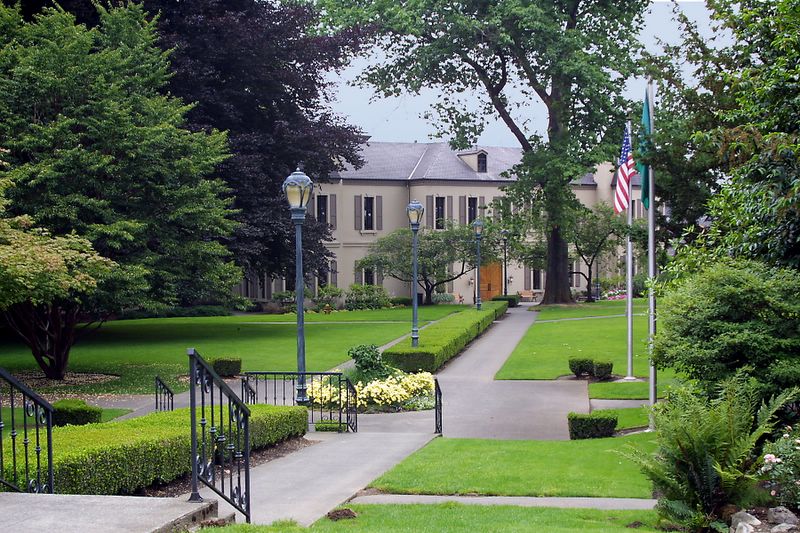
Chateau Ste. Michelle
Before the vines, there were Douglas firs. The 118-acre property in Woodinville where Chateau Ste. Michelle makes its wine was once a hunting retreat called Hollywood Farm, owned by lumber baron Frederick Stimson, who filled it with mature trees and used it as a rural escape from Seattle's sawmill economy. The winery acquired the land in 1976 and built a French-style chateau among Stimson's old-growth plantings, creating one of the stranger juxtapositions in Pacific Northwest agriculture: a Bordeaux fantasy nestled in a former timber estate, twenty miles east of downtown Seattle. It is the oldest winery in Washington state, and its story tracks the unlikely rise of an entire wine industry in a region better known for rain, coffee, and software.
From NAWICO to Chateau
The winery's origins predate the chateau by decades. In 1934, National Wine Company -- known as NAWICO -- began making wine in Seattle, advertising itself with a large neon sign in the Wallingford neighborhood that became a minor landmark. In 1940, NAWICO merged with the Pomerelle Wine Company, and in 1954 the combined operation formally reorganized as American Wine Growers, which eventually became Chateau Ste. Michelle. The transformation from a regional operation into a serious estate winery accelerated after the move to Woodinville in 1976. The property's mature landscaping and rolling grounds gave the operation an air of European permanence that belied its relatively young history. Over the following decades, the winery became a proving ground for Washington winemakers. Kay Simon, who co-founded Chinook Wines with her husband Clay Mackey, got her start here. Mackey worked as a vineyard manager for Chateau Ste. Michelle before the couple struck out on their own -- a pattern repeated by many of the state's most respected vintners.
Grapes from the Dry Side
The Woodinville chateau is a tasting room and a showpiece, but the grapes grow two hundred miles to the east. Chateau Ste. Michelle owns several estate vineyards in Eastern Washington, where the rain shadow of the Cascades creates the arid, sun-drenched conditions that wine grapes demand. The Canoe Ridge vineyard in the Horse Heaven Hills, the Cold Creek vineyard, and the Indian Wells vineyard in the Columbia Valley supply the fruit for a production that now exceeds 600,000 cases of Riesling alone each year. The winery also maintains international partnerships that would have seemed improbable for a Washington producer a generation ago: Col Solare is a collaboration with Tuscan winemaker Piero Antinori, and Eroica Riesling is made with Ernst Loosen of Germany's Mosel region. In 2004, Wine Enthusiast magazine named Chateau Ste. Michelle its American Winery of the Year.
A Turbulent Cellar
For much of its modern history, the winery was owned by Altria, the company formerly known as Philip Morris -- a tobacco conglomerate that also happened to control one of the Pacific Northwest's most celebrated wine brands. In 2021, Altria sold Ste. Michelle Wine Estates to the private equity firm Sycamore Partners for $1.2 billion. The changes came fast. Sycamore moved wine production out of the Woodinville property and briefly put the land up for sale in 2022 before reversing course. With the 2022 harvest, white wine production relocated to the eastern Washington facilities, a move the company framed as reducing freight trips and diesel fuel use. Then came a redevelopment proposal in 2024: 90 single-family homes, a 120-room hotel, a new music venue seating up to 5,800 spectators, and retail shops -- all on the grounds where Stimson once hunted and visitors once sipped Riesling beneath the trees. The plan requires rezoning the property from its current industrial designation. In December 2025, Sycamore sold the business again, this time to the Wyckoff family, one of the estate's own top grape growers.
Summer Evenings on the Lawn
For many Seattleites, Chateau Ste. Michelle means summer concerts as much as wine. The winery's outdoor amphitheater has hosted performances on its grounds for decades, drawing crowds who spread blankets across the lawn with bottles and picnic baskets while acts play against the backdrop of the chateau. The setting -- old trees, manicured grounds, the faux-French architecture catching the long Northwest evening light -- gives the concerts an atmosphere that no arena can replicate. Whether the amphitheater survives the proposed redevelopment remains an open question, though the 2024 plans include a new music venue. For now, the property exists in a state of transition: no longer just a winery, not yet whatever it will become next. Its history of reinvention -- from timber estate to farmland to winery to concert venue to potential mixed-use development -- mirrors the restless transformation of the Eastside suburbs themselves.
From the Air
Located at 47.729N, 122.150W in Woodinville, Washington, approximately 20 miles northeast of downtown Seattle. From the air, look for the French-style chateau and manicured grounds surrounded by mature trees along the Sammamish River valley, east of Interstate 405. The property sits in the heart of Woodinville wine country, with numerous tasting rooms visible nearby. Nearest airports: Renton Municipal (KRNT) 16nm south, Boeing Field (KBFI) 15nm southwest, Snohomish County/Paine Field (KPAE) 14nm north. Best viewed at 2,000-3,000 feet in clear conditions.