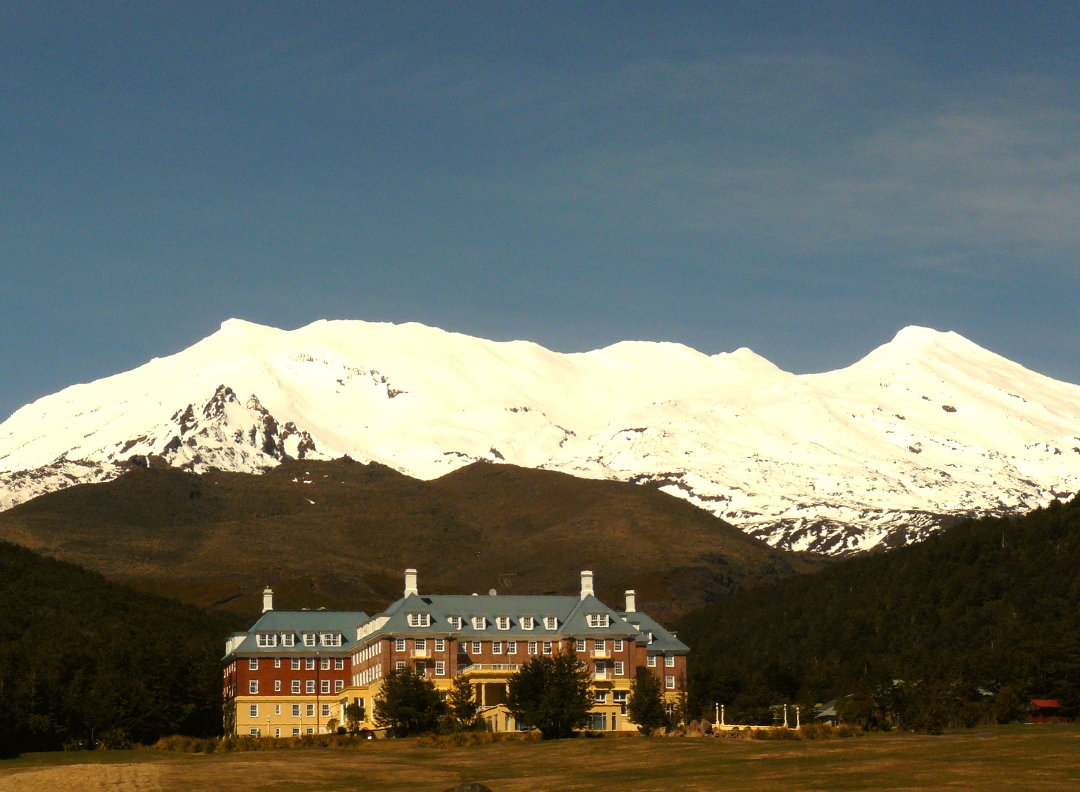
Chateau Tongariro
Rodolph Wigley had a vision so extravagant it nearly bankrupted two companies. In 1928, the managing director of the Mount Cook Tourist Company signed a lease to build a luxury hotel on the slopes of Mount Ruapehu, deep inside New Zealand's oldest national park. The architect, Herbert Hall, drew inspiration from the grand Canadian Pacific Railway hotels, particularly the Chateau Lake Louise, and designed a neo-Georgian structure of four stories and a basement surrounded by volcanic peaks. The building opened to guests on 1 August 1929, still unfurnished, with panoramic windows framing Mount Ngauruhoe and Mount Tongariro. Four months later, the Great Depression arrived. The Chateau's story had barely begun, and it was already in trouble.
A Castle Built on Borrowed Time
The finances were shaky from the start. Wigley's Tongariro Park Tourist Company floated shares on the market, but only 30,000 pounds were subscribed against a building budget of 40,000 to 60,000 pounds. He contracted Fletcher Construction anyway, sweetening the deal by having Fletchers buy 15,000 pounds in company shares. The Chateau was lavishly appointed with custom-made furniture, hot and cold running water in every room, and panoramic views of the volcanic plateau. But Wigley had led Fletchers to believe the Mount Cook Tourist Company would cover cost overruns, and when the Depression hit, that promise evaporated. James Fletcher approached Prime Minister Joseph Ward for an increased government loan; Ward agreed to raise it to 60,000 pounds, and Wigley promised the money would flow to Fletchers. He passed on only 10,000. By February 1931, Fletchers put the company into receivership, ran the hotel for three months, and walked away having lost 19,000 pounds.
The Government Takes the Keys
In 1932, the National Park Board took over the Chateau and quickly transferred it to the Department of Tourist and Health Resorts, which would own and operate the hotel for the next 26 years. During this period, the hotel manager doubled as the de facto administrator of Tongariro National Park. The sole park ranger, Alf Cowling, was instructed that his services and his horse were to be at the disposal of the Chateau's manager, available for hire to guests when not otherwise needed. During World War II, the Chateau served as a rest and recuperation centre for Air Force personnel returning from overseas service. After the war, the Whakapapa skifield entered a boom period, with new ski-tows and chairlifts drawing visitors up the mountain. By the 1950s, the hotel's power supply could no longer keep pace with demand, and an 8.5-mile overhead transmission line was constructed in 1955 to connect the complex to the King Country Electric Power Board.
New Owners, Old Problems
Privatisation came in 1990 when the government sold the Chateau to Kah New Zealand Limited, a subsidiary of the Malaysian conglomerate Oriental Holdings Berhad. The land itself remained Crown property, leased to the new owners. Kah invested three million New Zealand dollars in refurbishment and renamed the hotel The Grand Chateau, though locals never stopped calling it the Chateau Tongariro. To avoid disturbing guests during expansion, the company used a Scandinavian modular construction system: rooms were built in Auckland, trucked to the site, and lifted into place by crane. The 2008 financial crisis hit the skiing trade hard. Kah posted losses for four straight years totalling 1.9 million dollars before returning to profit in 2016. When Tourism New Zealand floated the idea of the government repurchasing the hotel, as it had done in 1932, the proposal was rejected.
The Silence on the Mountain
When the Chateau's long-term lease expired in April 2020, Kah switched to month-by-month arrangements rather than commit to a new agreement. In January 2023, news broke that the building faced significant seismic risks requiring substantial earthquake strengthening. Four days after the announcement, Kah declared the hotel would close permanently on 5 February. The keys were handed to the Department of Conservation. Yet despite surrendering the ground lease, the buildings themselves remain Kah's property as of late 2024, creating an unusual limbo for one of New Zealand's most recognisable heritage structures. In 2023, the New Zealand Institute of Architects recognised the Chateau with its Enduring Architecture award, a bittersweet tribute to a building listed as a Category 1 historic place by Heritage New Zealand, now standing empty on the volcanic slopes where Wigley's improbable ambition first took shape nearly a century ago.
From the Air
The Chateau Tongariro sits at 39.20S, 175.54E in Whakapapa Village on the northwestern slopes of Mount Ruapehu (2,797m), within Tongariro National Park. Best viewed from the west or northwest at 3,000-5,000 feet AGL, where the neo-Georgian structure stands out against the volcanic terrain. Mount Ngauruhoe (the cone used as Mount Doom in the Lord of the Rings films) is visible to the northeast, and Mount Tongariro to the north. The nearest airport is Waiouru (no ICAO code for civilian use); Ohakea Air Force Base (NZOH) lies approximately 80 nautical miles to the south. Weather in this area can change rapidly, with cloud often obscuring the volcanic peaks.