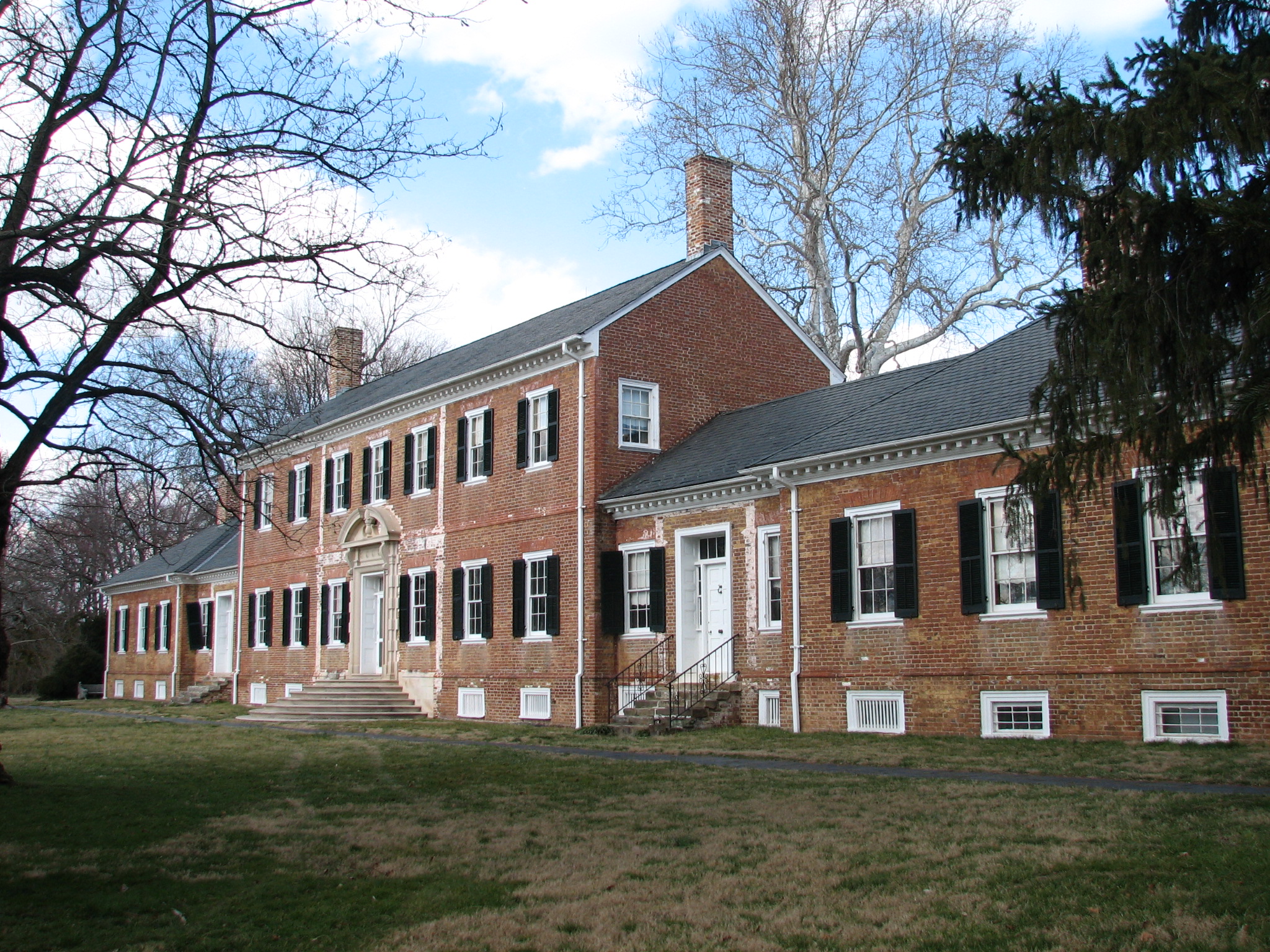
Chatham Manor
Walt Whitman came to Chatham Manor searching for his wounded brother. What he found outside the Georgian mansion on the bluffs above the Rappahannock River stopped him cold: "a heap of amputated feet, legs, arms, hands, etc. -- about a load for a one-horse cart. Several dead bodies lie near, each covered with its brown woolen blanket." It was December 1862, and the elegant home that George Washington had once visited for pleasant dinners with his friend William Fitzhugh was serving as a field hospital, its rooms slick with blood. Chatham Manor holds a distinction no other private residence in America can claim -- it was visited by Washington, Thomas Jefferson, Abraham Lincoln, and Dwight Eisenhower. But its story runs deeper than presidential guest lists. It is a story of enslaved people who built its walls, fought for their freedom, and were betrayed by the courts.
A Plantation with a View
William Fitzhugh completed Chatham in 1771 after three years of construction, positioning the Georgian mansion on a bluff overlooking the Rappahannock River and the town of Fredericksburg. The riverside facade was the showpiece, designed to impress anyone looking up from across the water. Fitzhugh owned upward of 100 enslaved people and about 49,000 acres of land, with 60 to 90 enslaved workers at Chatham depending on the season. They were field hands, house servants, millers, carpenters, and blacksmiths -- the labor force that made the plantation's orchard, mill, and horse-racing track possible. Fitzhugh named the estate after William Pitt, 1st Earl of Chatham, the British parliamentarian who championed American colonial rights. He and George Washington were friends and colleagues from the House of Burgesses; Washington's diaries record frequent visits. Fitzhugh's daughter Molly married Washington's step-grandson, George Washington Parke Custis. Their daughter Mary Anna later married Robert E. Lee.
Freedom Denied, Freedom Won
Chatham's history of slavery contains both cruelty and resilience. In January 1805, enslaved workers rebelled after an overseer demanded they return to work too soon after Christmas. They overpowered and whipped the overseer and four assistants. An armed posse crushed the uprising -- one man was executed, two died fleeing, and two were deported to the Caribbean or Louisiana. Decades later, owner Hannah Jones Coalter tried to right a different wrong. When she died in 1857, her will attempted to free her 93 enslaved people, offering each a choice: manumission with a financial stake to start new lives, or remaining enslaved with a master of their choosing. The local Stafford court upheld her wishes. But the Virginia Supreme Court, emboldened by the Dred Scott decision, overturned the manumissions, ruling that enslaved people were property incapable of exercising choice. One woman refused to accept the verdict. Ellen Mitchell, an enslaved laundress, was allowed a 90-day pass to travel north. She gave speeches in Washington, Baltimore, Philadelphia, New York, and Boston, raising enough money to buy freedom for herself and her children. Her former owner, impressed, freed her mother as well. The Mitchell family settled in Cincinnati, where Ellen ran a laundry business.
Hospital on the Heights
The Civil War transformed Chatham from a private estate into a command post and charnel house. Owner J. Horace Lacy left to serve the Confederacy, and Union troops occupied the mansion in 1862. In April, General Irvin McDowell brought 30,000 men to Fredericksburg; President Lincoln traveled there to confer with him at Chatham. That November, General Burnside launched his disastrous assault on Fredericksburg from the bluffs near the manor. Burnside suffered 12,600 casualties, and hundreds of the wounded were carried back to Chatham for surgery. Clara Barton, who would later found the American Red Cross, tended the injured. Dr. Mary Edwards Walker, the only woman to receive the Medal of Honor, worked alongside her. From the manor's lawn, a German military observer named Count Zeppelin sent up a reconnaissance balloon -- an experience he later recalled when he founded his airship company. More than 130 Union soldiers died at Chatham and were buried in the gardens. As winter set in, soldiers tore paneling from the walls for firewood, their pencil graffiti still visible on the exposed plaster today.
Ruin and Resurrection
When the Lacys returned in November 1865, Chatham was a wreck. Over 750 panes of glass had been shattered. Blood stained the floors. The surrounding forest had been clear-cut for fuel, the gardens destroyed, the lawn pocked with graves. Unable to maintain the estate, they sold it in 1872 for $23,900. The property passed through several owners until the 1920s, when General Daniel Devore and his wife undertook a sweeping restoration, reorienting the house from its river entrance to the east side -- now accessible by automobile rather than boat -- and commissioning landscape architect Ellen Biddle Shipman to design a walled English garden. In 1931, General Motors executive John Lee Pratt purchased Chatham for $150,000. During World War II, Generals George Marshall and Dwight Eisenhower visited to relax and go duck hunting, adding another chapter to the home's remarkable guest book. Pratt bequeathed the manor to the National Park Service upon his death in 1975. Today, Chatham serves as headquarters for the Fredericksburg and Spotsylvania National Military Park, its five museum rooms open to visitors, the view across the Rappahannock restored to what soldiers and presidents once saw.
From the Air
Chatham Manor sits at approximately 38.31°N, 77.46°W on the north bank of the Rappahannock River in Stafford County, Virginia, directly across from Fredericksburg. The Georgian mansion is visible from the air on its prominent bluff, with the walled garden on its east side and the river below to the west. The Rappahannock curves through the landscape and the historic downtown of Fredericksburg spreads out on the south bank. Shannon Airport (KEZF) is about 3 miles to the southeast. Stafford Regional Airport (KRMN) lies approximately 8 miles to the north. Best viewed at 1,500-2,500 feet AGL. The contrast between the manicured grounds and the surrounding development makes the estate easy to spot.