Chattanooga Campaign
'I will hold the town till we starve.' General George H. Thomas sent those words by telegraph to Ulysses S. Grant in October 1863, and he meant every one of them. The Union Army of the Cumberland was trapped in Chattanooga, Tennessee -- a vital railroad hub that connected Nashville and Knoxville to Atlanta -- besieged by Confederate General Braxton Bragg's army occupying the commanding heights of Missionary Ridge and Lookout Mountain. Soldiers' rations had been cut to four cakes of hard bread and a quarter pound of pork every three days. Their horses and mules were dying. The only supply route was a tortuous sixty-mile mountain road that autumn rains had washed into impassable mud. What happened over the next five weeks would break the siege, rout one of the Confederacy's two major armies, and set the stage for the final collapse of the Southern cause.
Starving on the Banks of the Tennessee
After the Union defeat at the Battle of Chickamauga in September 1863, Rosecrans retreated to Chattanooga, where his army built a tight three-mile semicircle of defensive works around the city. Bragg chose siege over assault, positioning his forces on the dominating terrain of Missionary Ridge and Lookout Mountain. Both features offered sweeping views of the city, the Tennessee River, and every Union supply line. Confederate cavalry under Joseph Wheeler intercepted and destroyed a train of 800 wagons, burning hundreds and killing hundreds of mules. President Lincoln remarked that Rosecrans seemed 'confused and stunned like a duck hit on the head.' Washington moved fast: Secretary of War Stanton dispatched Joseph Hooker with 20,000 men from Virginia, and Grant was given command of the newly created Military Division of the Mississippi. Grant arrived over the treacherous mountain roads on October 23 and immediately replaced Rosecrans with Thomas, the 'Rock of Chickamauga.'
The Cracker Line
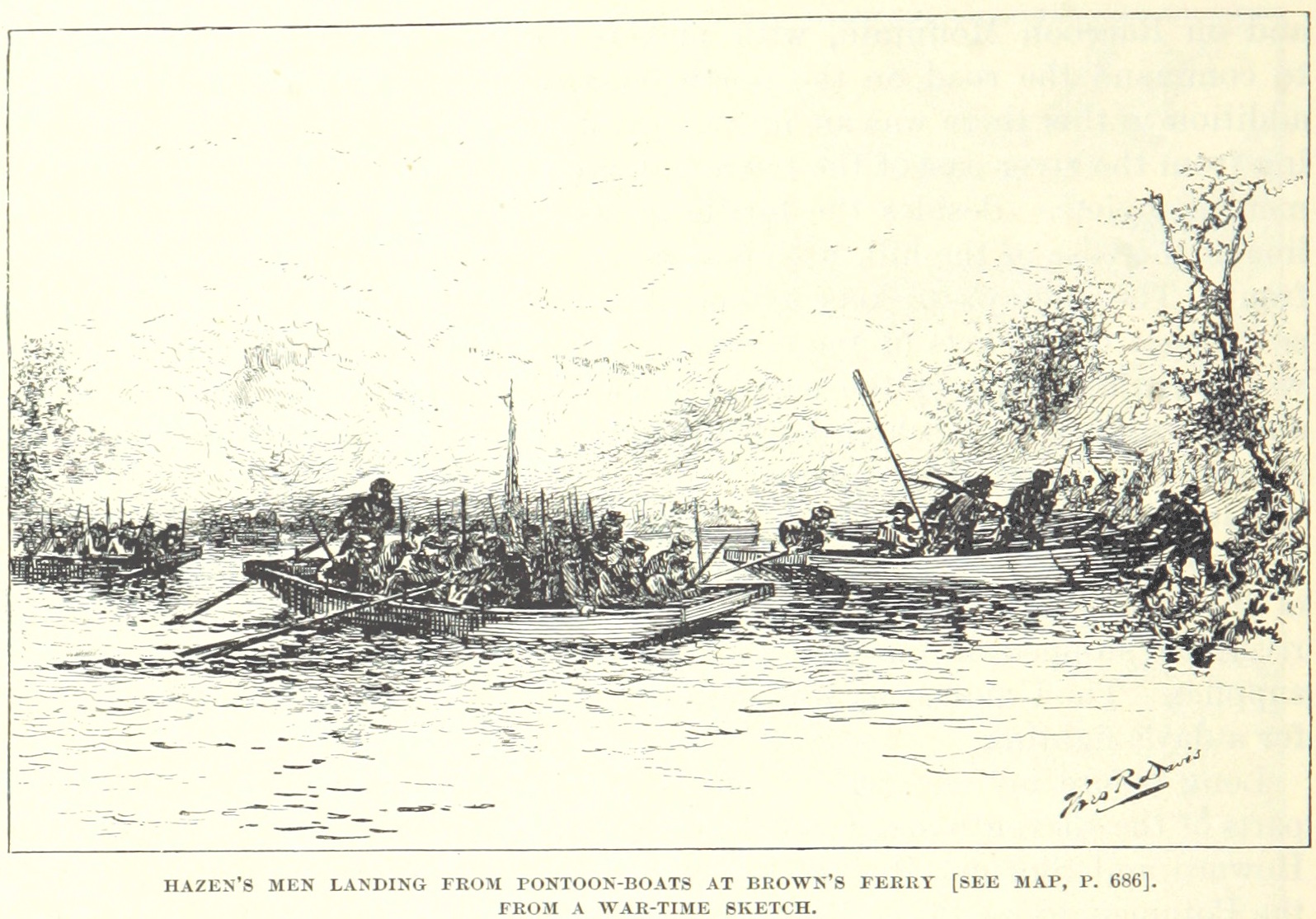
Grant's first order of business was food. Chief engineer William 'Baldy' Smith had devised a plan to open a supply route through Lookout Valley to Brown's Ferry on the Tennessee River. Before dawn on October 27, Hazen's brigade floated silently downriver on pontoons past the Confederate positions on Lookout Mountain, aided by fog and a moonless sky. They seized Brown's Ferry by 4:40 a.m. Longstreet, the Confederate commander responsible for that sector, dismissed the move as a feint and did not even bother informing Bragg. When Hooker's column linked up with the ferry the next afternoon, the 'Cracker Line' was open. Bragg ordered Longstreet to counterattack at Wauhatchie on the night of October 28, but the assault was poorly planned and undermanned. General Geary's son Edward, an artillery lieutenant, died in the fighting, collapsing in his father's arms. The attack failed, and the siege was effectively broken. Food began flowing into the starving city.
The Battle Above the Clouds
On November 24, 'Fighting Joe' Hooker exceeded his orders in spectacular fashion. Told merely to demonstrate against Lookout Mountain, he instead ordered a full assault, sending Geary's division across Lookout Creek and sweeping northeast along the mountain's base. The position that looked impregnable from below was, as historian Thomas Connelly wrote, a myth -- the bench halfway up the mountain was commanded by Federal artillery at Moccasin Bend, and the Confederate guns on the summit could not be depressed enough to reach it. By early afternoon, thick fog rolled in and wrapped the mountain. Quartermaster General Montgomery Meigs, watching from Orchard Knob, christened the action the 'Battle Above the Clouds.' Both sides blazed away blindly in the mist. Hooker predicted the Confederates would evacuate that night, and he was right. Under a lunar eclipse at midnight, the Confederate divisions retreated behind Chattanooga Creek, burning the bridges behind them.
The Impossible Charge Up Missionary Ridge
November 25 was supposed to belong to Sherman, who was to attack Bragg's right flank on Missionary Ridge. But Sherman's assaults on Tunnel Hill gained nothing against Patrick Cleburne's tenacious defense. By 3:30 p.m., Grant ordered Thomas's Army of the Cumberland forward in a demonstration -- a distraction, nothing more. The troops surged across the open ground and captured the rifle pits at the base of the ridge, fulfilling their orders. Then, pinned under withering fire from above with nowhere to hide, they did something no one had ordered: they kept going. Soldiers who had endured the humiliation of Chickamauga and weeks of taunts from Sherman's and Hooker's men charged uphill into what should have been an impregnable position. Bragg had placed his defenses along the physical crest rather than the military crest, robbing his guns of effective firing angles. The disorganized but furious Union advance overwhelmed the Confederate line. By 4:30 p.m. the center of Bragg's army had broken and fled in panic. Arthur MacArthur Jr. -- father of Douglas MacArthur -- earned a Medal of Honor that day for seizing a regimental flag and leading the charge to the summit.
Gateway to the Deep South
The rout was nearly total. Only Cleburne's rearguard held firm, buying time for the Confederate retreat to Dalton, Georgia, and thwarting the Union pursuit at Ringgold Gap, where 4,100 Confederates held off 12,000 Union soldiers for five hours. Total casualties were staggering: 5,824 Union and at least 6,667 Confederate, including over 4,000 prisoners. When a chaplain asked Thomas whether the dead should be sorted by state for burial, the general replied: 'Mix 'em up. I'm tired of States' rights.' Bragg resigned his command on December 1. The Confederate enthusiasm that had soared after Chickamauga was shattered. Chattanooga -- the 'Gateway to the Lower South' -- was now firmly in Union hands, and it became the supply base for Sherman's 1864 Atlanta campaign. Grant had won his last battle in the Western Theater before taking command of all Union armies. Today, portions of the battlefield are preserved as part of the Chickamauga and Chattanooga National Military Park.
From the Air
Located at 35.03N, 85.29W in Chattanooga, Tennessee, at the southern end of the Tennessee Valley where the Tennessee River bends through a dramatic gap in the Appalachian ridges. Lookout Mountain rises prominently southwest of downtown and is unmistakable from the air -- a flat-topped ridge running northeast to southwest. Missionary Ridge runs north-south east of the city center. The nearest major airport is Chattanooga Metropolitan Airport (KCHA). Chickamauga and Chattanooga National Military Park preserves key battlefield areas on both Lookout Mountain and Missionary Ridge. Recommended viewing altitude: 3,000-6,000 feet AGL for a commanding view of both ridgelines and the river bend.