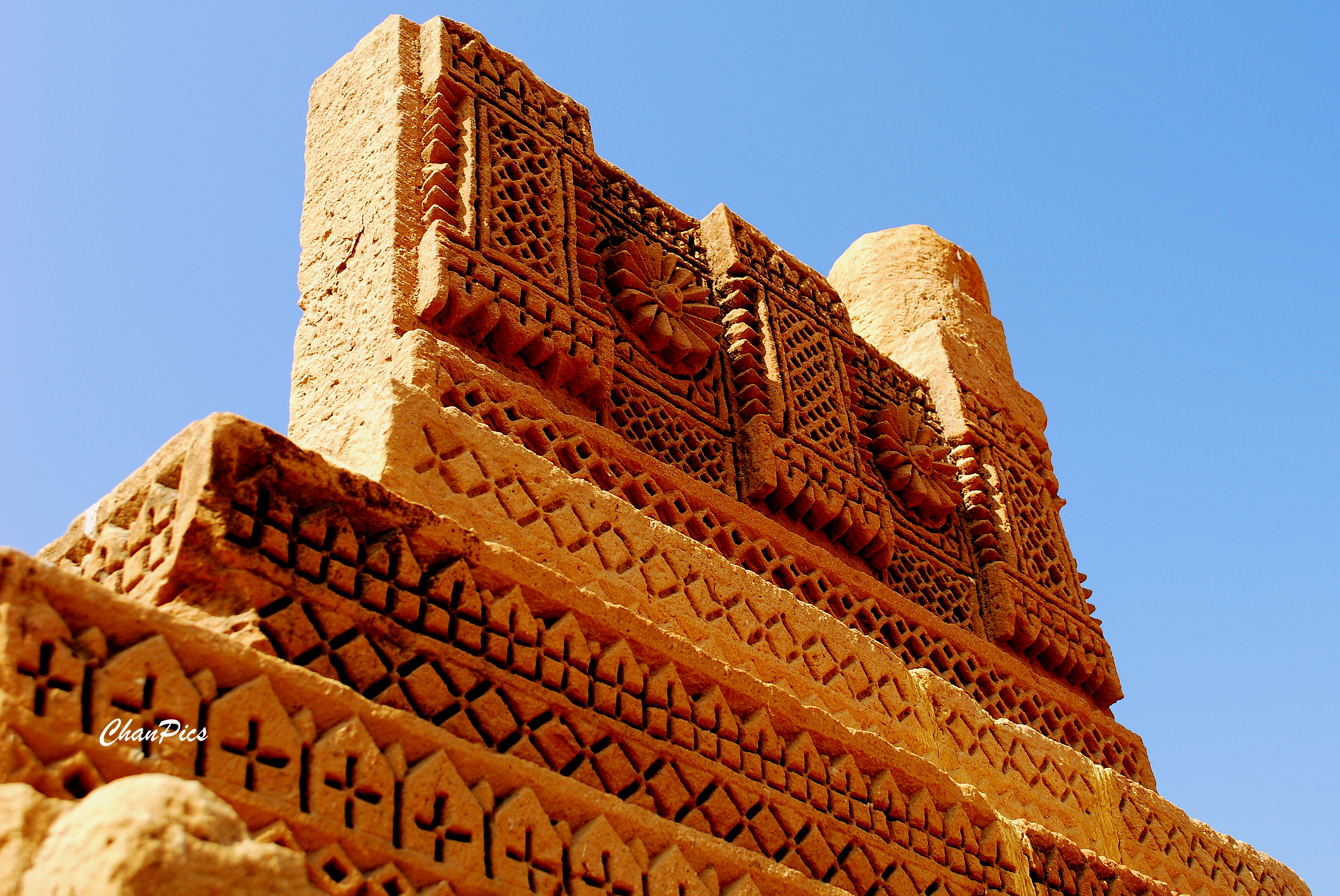
Chaukhandi Tombs
Scholars have argued for over a century about who built them, when they were built, and what the name itself means. The Chaukhandi tombs sit on a windswept rise east of Karachi, row after row of buff-colored sandstone sarcophagi stacked in pyramidal tiers, their surfaces dense with carved horsemen, hunting scenes, geometric medallions, and depictions of jewelry. No other Islamic cemetery on earth looks quite like this.
Stone Upon Stone
A typical Chaukhandi grave is an exercise in vertical geometry. Six vertical sandstone slabs form the base: two long ones on each side indicating the body's length, two shorter ones at head and foot. A second, smaller set of six slabs sits atop the first, creating a stepped pyramid. Horizontal slabs cap the upper tier, and the northernmost point is often carved into a knob resembling a turban or crown. The bodies lie oriented north-south, heads to the north, facing Mecca to the west in accordance with Islamic burial custom. Some graves stand alone; others cluster in groups of up to eight on a shared platform. The arid climate of lower Sindh has preserved the sandstone remarkably well, leaving carvings from the 16th through 18th centuries still sharp enough to trace with a fingertip.
Riders on Men's Graves, Jewelry on Women's
The carvings reveal a strict gendered vocabulary. Men's graves bear mounted horsemen, weapons, and scenes of combat or hunting. Women's graves display jewelry: necklaces, bangles, earrings rendered in stone. This distinction was first catalogued in detail by German scholar Salome Zajadacz-Hastenrath, whose 1978 study established a typological framework and relative chronology for the tombs. She concluded that the Chaukhandi style reached its apex during the first half of the 17th century, producing what she called 'tombs with projecting surfaces' whose sculptural power went far beyond folk art. The Encyclopedia of Islam later noted that only the Chaukhandi tombs had received such systematic scholarly treatment among South Asian Islamic funerary sites.
A Mystery of Tribal Origins
The cemetery is generally attributed to the Jokhio tribe of Sindh, though tombs of the Burfat, Jakhra, Shaikh, and Kalmati Baloch peoples have also been identified among the graves. The Jokhio trace their ancestry to the Samma dynasty, and some scholars believe these Rajput-descended tribes emigrated from Kutch and Rajputana toward Sindh during the Samma period. The word 'Chaukhandi' itself is disputed. One theory derives it from the Sindhi words for 'four' and 'pillar,' referring to the domed structures that once topped some graves. Another scholar, Kaleem Lashari, argues it is not a place name at all but a title of ownership carved onto specific tombs. The original discovery was recorded in a letter to H.B.E. Frere in 1851, but it was not until 1917 that H.D. Baskerville formally documented the cemetery, and not until 1922 that the site received legal protection under the Ancient Monuments Preservation Act.
Sandstone in the Modern City
Karachi has grown around the Chaukhandi necropolis. What was once a remote cemetery near the village of Chaukhandi now sits within reach of the expanding city's southeastern sprawl. After Pakistan's independence, the tombs languished in official neglect until historian I.H. Qureshi, then the education minister, prompted the Department of Archaeology and Museums to act. The department's director general confessed they had not even realized the site was legally protected. Conservation remains a concern, with scholars like Lashari calling for urgent action to preserve the Bhawani Serai and Tutai Chaukhandi graveyards. Yet the tombs endure, their carved riders still galloping across sandstone slabs while the city creeps closer, a collision of deep time and modern growth played out in the dry Sindh air.
From the Air
The Chaukhandi tombs are located at 24.87N, 67.27E in eastern Karachi, Sindh province. From lower altitudes (2,000-5,000 feet), the sandy-colored tomb clusters are visible on elevated ground east of Karachi's urban sprawl, near the Landhi area. Jinnah International Airport (ICAO: OPKC) is approximately 10 km to the northwest. The Makli Necropolis near Thatta, a related UNESCO site, lies about 100 km to the east.